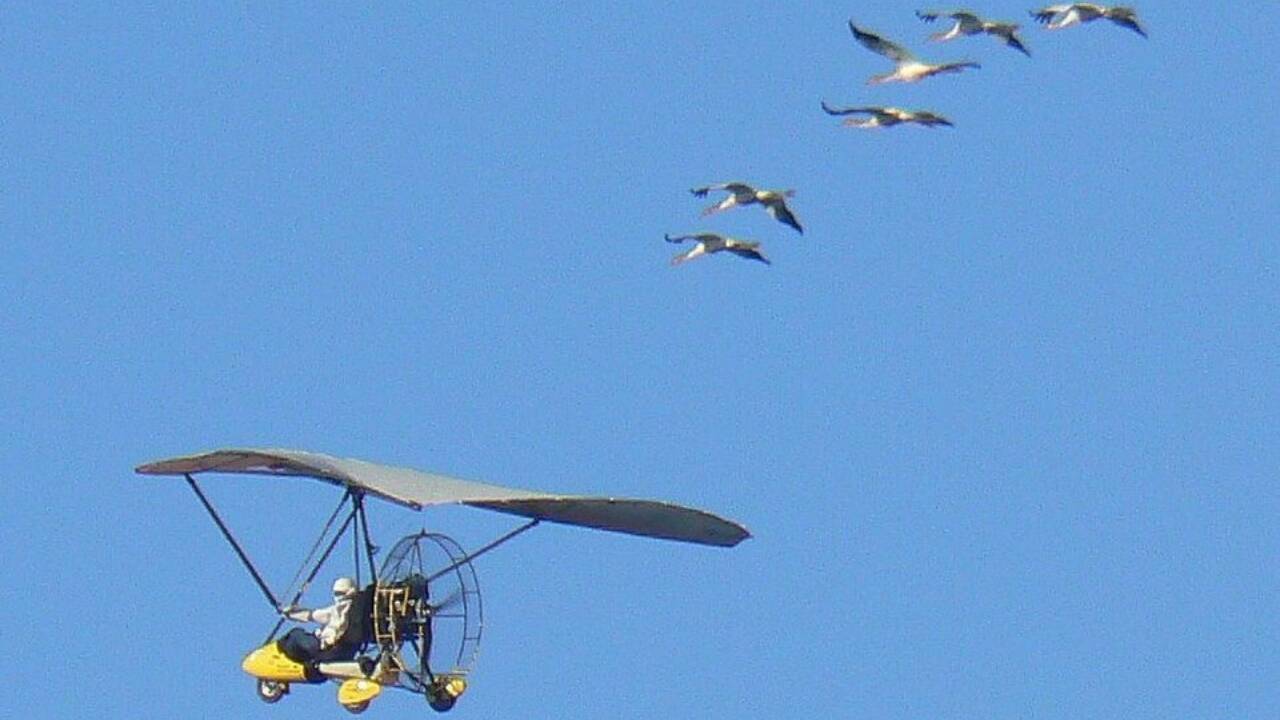
Every autumn between 2001 and 2015, an unusual aircraft took to the skies over the American Midwest and flew a little more than 40 miles per hour in an ultralight plane piloted by a person dressed head-to-toe, resembling a whooping crane. This plane led a flock of endangered birds in a 1,200-mile (1,930 km) journey from Wisconsin to Florida. According to the Smithsonian National Air and Space Museum , the young cranes had been raised in captivity and had no wild animals to teach them their ancient migration routes. Therefore, by following the ultralight, they learned the path they would later fly on their own, thus helping to establish a new eastern migratory population of one of North America’s rarest birds.
Get breaking news anytime, anywhere. Download the TOI app now!

Teaching a species how to migrate again
According to the Smithsonian National Air and Space Museum, Operation Migration was founded in 1994 by Bill Lishman and Joe Duff, who adapted the strategies that were originally developed to guide Canada geese with ultralight aircraft. This concept relied on a biological principle known as imprinting, where a newly hatched crane chick instinctively bonds with the first caregiver it sees. Furthermore, to ensure that the birds identified with cranes rather than humans, biologists wore white crane costumes, concealed their faces, avoided speaking near the chicks and even used crane-shaped hand puppets while feeding them. Additionally, before the eggs hatched, they were exposed to recordings of ultralight engines so that the chicks would recognise the sound when their training began.
The training progressed gradually from short taxi runs to sustained flights behind the ultralight. According to the U.S. Fish and Wildlife Service , in 2001, the first guided migration of whooping cranes began, taking the birds across seven states from Necedah National Wildlife Refuge in Wisconsin to wintering grounds in Florida. The journey unfolded over several weeks, with carefully planned stopovers and portable pens protecting the whooping cranes overnight. While flying, a speaker mounted beneath the aircraft played recorded whooping crane brood calls, thus encouraging the birds to remain in formation behind what they believed to be their parent crane.
Fifteen years of monitored migration
According to the Wisconsin Society for Ornithology , Operation Migration pilots eventually guided 186 whooping cranes over 17,457 miles of migration routes while raising more than $10 million to support conservation efforts. The birds that survived the first winter returned north the following spring without human guidance, showing that they had learned the migration route. These flights became a widely recognised conservation effort and inspired documentaries, museum exhibits and public support for endangered species recovery.
Notably, whooping cranes had once numbered in the thousands across North America, but habitat loss and unregulated hunting pushed the species to the brink of extinction. According to the USFWS, only 21 wild whooping cranes remained in 1941 and with captive breeding, habitat protection and innovative strategies like Operation Migration, the decline was gradually reversed. It is worth noting that the aircraft-guided operation ended after the 2015 migration, as wildlife managers adopted new recovery strategies. Operation Migration showed that saving a species can require teaching behaviours that would normally pass from one generation to the next. According to the Smithsonian National Air and Space Museum, the combination of captive breeding, costume rearing, ultralight aircraft and long-term monitoring was an unusually creative wildlife conservation effort.