
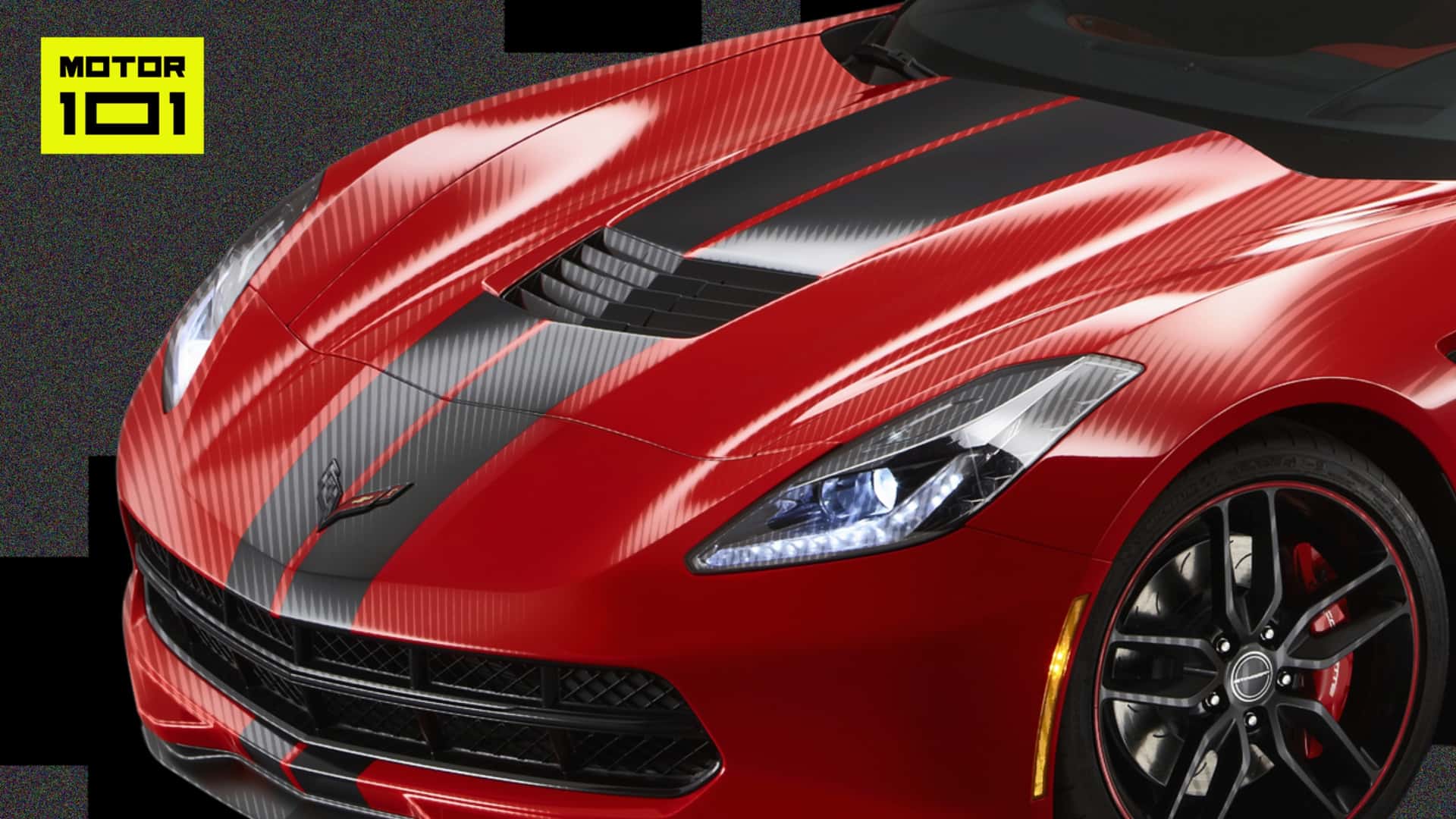
The Chevrolet Corvette is a weirdly resilient automobile. Created as a post-war trophy purchase for vets looking for something fun to drive, it survived not just the oil crisis of the 1970s but also the 2008 financial crisis, as well as whatever the heck we’re going to call what’s happening right now.
Affectionately known as "America’s sports car," it’s been a rolling symbol of Americana in a way Mustangs and Camaros were always a bit too rough around the edges to be. Enthusiasts know it as the official car of dad jorts and self-printed "it’s a 1 of 1, trust me bro" certificates at Cars & Coffee. But most know it as the default two-door aspirational (yet attainable) vehicle for everybody from Barbie to, like, every wannabe CarTok influencer who doesn’t quite have enough followers for a Ferrari yet.
From its optimistic, chrome-laden '50s roots to its world-beating, mid-engined end game, the story of the Corvette is a long and interesting one. Here’s every generation of Corvette and how each moved the sports car forward.
C1: 1953-1962

After WWII, GM design head Harley Earl noticed that American troops were coming home and buying European sports cars and convinced the company that it needed a two-seater of its own. Fast forward to GM's Motorama show in 1953—the first Corvette appeared as a show car, with a fiberglass body, a straight-six, and a two-speed (yes, really) automatic gearbox.
Public response to the show car was positive, and six months later, the C1 entered production in Flint, Michigan. But it wasn’t an instant success. Early production was limited, yet a significant fraction went unsold—the "solid axle" 'Vette was neither civilized enough to serve as a good grand tourer nor athletic enough to be a great sports car, per Car and Driver.
The first Corvette appeared as a show car, with a fiberglass body, a straight-six, and a two-speed (yes, really) automatic gearbox.
This didn’t stop GM from improving upon things, though. Bigger V8 engines became available starting in ‘55, and a ‘56 facelift made it look like an American 300SL before the ‘58 refresh gave it four headlamps and an even more sporting aesthetic, culminating in quad taillights for ‘61—a Corvette signature that persists today.
These days, the C1 Corvette is remembered as it existed: best as a museum piece that eventually evolved into greater things. It’s an instrumental car that demands respect—and big money when a clean one crosses the auction block. But from a material performance perspective, its greatest contribution is arguably laying the groundwork for what would come next.
C2: 1963-1967
Based on the work of engineer Zora Arkus-Duntov and designer Bill Mitchell, the C2 was called the Sting Ray (two words) and featured a svelte, more purposeful fiberglass body that really does resemble the animal it’s named after. This lighter, V8-only sequel upped the Corvette’s sports car cred by introducing independent rear suspension and a fixed-top coupe variant. That iconic split rear window, by the way, is exclusive to first-model-year 1963 cars.
Chevy spent the next couple of years fitting increasingly larger V8s, introducing disc brakes at all four corners, and a “Z06” package with upgraded brakes, shocks, and anti-roll bars. But the most legendary C2 was probably the Grand Sport, a wild, lightweight racing prototype Arkus-Duntov had developed in secret to take on the Ford Shelby Cobra. Just five were ever made before GM put a stop to the project.
The C2 was called the Sting Ray (two words) and featured a svelte, more purposeful fiberglass body that really does resemble the animal it’s named after.
Even ignoring the Grand Sport, though, the Corvette had leveled up. Today, the C2 sits as a bit of a sweet spot among the classic Corvettes, blending the romantic, chrome-forward character of the C1 with the aggressive style of what would follow.
C3: 1968-1982
Whereas the C2 took inspiration from stingrays, the C3’s sea creature of choice was the shark, specifically the Shark II concept car from 1965. It kept the Stingray name, though (one word now), and frankly, a lot of the C2’s hardware under the skin. New, however, were removable roof panels for the coupe, something the Corvette still gets today.
The third-gen Corvette was technologically a step forward, but the 1970s oil crisis meant big engines got culled, compression ratios dropped, and remaining motors were downsized. Throw in an industry-wide shift from gross to net horsepower ratings, and by 1975, the base L48 V8 was making a listed 165 hp. What’s more, evolving safety standards meant plastic, body-colored bumpers instead of hard chrome from 1973 onward.
Whereas the C2 took inspiration from stingrays, the C3’s sea creature of choice was the shark, specifically the Shark II concept car from 1965.
Despite all the headwinds, the C3 (which was mostly a reworked C2, remember) held down the fort for 14 years, making it the longest-running Corvette generation to date. By the end of its life, then, Chevy needed a new ‘Vette badly—C/D recalls a 1981 comparo in which it finished last behind a Datsun and a DeLorean—and in preparation, production moved from St. Louis, Missouri, to Bowling Green, Kentucky.
C4: 1984-1996
After skipping model year 1983, the fully redesigned C4 dropped for '84 with a very clean, very '80s wedge look and a 205-horsepower 5.7-liter V8. The C4 was built on a new, “birdcage” unibody chassis, while updated suspension, new steering, and an optional Z51 package made it handle better than any Corvette before it. It was a more modern affair inside, too, rocking a gauge cluster that was now digital.
In 1986, GM acquired Lotus and tapped it to help develop the ZR-1, a Corvette with true world-beating aspirations. Lotus helped design the LT5 V8 to power it all: an aluminum-block, dual-overhead cam engine that made 375 hp. The most powerful Corvette in a long while, the ZR-1 hit 60 mph in less than five seconds, which was serious performance for the early ‘90s.
After skipping model year 1983, the fully redesigned C4 dropped for '84 with a very clean, very '80s wedge look and a 205-horsepower 5.7-liter V8.
These days, the C4 has its share of fans, but this being a GM product of the ‘80s and ‘90s, finding one that doesn’t need work may just be a taller task than driving one quickly. And even when clean, its slightly sweaty aura means it doesn’t quite carry the same cultural weight or collector’s item status as its ancestors.
C5: 1997-2004
After some internal turmoil as to whether the Corvette would return at all, the C5 arrived for 1997, replacing the C4’s '80s right angles with turn-of-the-century curves. Said to be the first GM product developed with customer survey input, the fifth-gen ‘Vette was practically a clean-sheet design.
The LS engine arrived with it, specifically the 5.7-liter LS1, making 345 horsepower. Proper engineering went beyond what sat under the hood, too. Balsa wood was used in the chassis to isolate road noise. Weight distribution stood at 51:49; there was an optional head-up display, and “Active Handling” stability control electronically kept the car pointed straight. Final model years even got magnetic dampers as an option, and a lighter, more powerful Z06 got stiffer suspension, a titanium exhaust, and a suffix that harked back to the C2 days.
After some internal turmoil as to whether the Corvette would return at all, the C5 arrived for 1997, replacing the C4’s '80s right angles with turn-of-the-century curves.
Chevy even took the C5 endurance racing to great success, with the C5-R racking up 31 ALMS class wins, four championships, and winning its class three times at Le Mans.
GM historians may argue that the Corvette was always a thorn in the snooty Europeans’ side. But the C5, with its supercar performance for fraction-of-a-supercar price and motorsport dominance, is arguably when the aristocrats started to get worried.
C6: 2005-2013
There were two big tells that GM was no longer shy about aiming squarely at Europe when developing the C6 Corvette. For one, it was created alongside a fancy Cadillac twin called the XLR. Secondly, it was physically smaller than the car it replaced.
The base model made 400 horsepower while the Z06 pumped out 505, but the Corvette name reached a whole new peak with the C6 ZR1. Lugging around a bunch of carbon fiber, carbon ceramic Brembo brakes, magnetic dampers, and a hood you can see through, the 638-horse, supercharged ZR1 hit 60 mph in just 3.3 seconds and lapped the Nürburgring in a Nissan GT-R-beating 7:26.4.
There were two big tells that GM was no longer shy about aiming squarely at Europe when developing the C6 Corvette.
C6 was the generation of Corvette, then, that truly started delivering exotic, world-beating performance. No, it still didn’t feel like a Porsche 911-killing scalpel behind the wheel, but it delivered on pace and was a long way from what a Corvette used to be in the corners.
The C6.R, meanwhile, continued the Corvette’s dominance on the track, scoring four Le Mans class wins and becoming one of the most recognizable race cars of its era.
C7: 2014-2019
If the C6 doubled down on the C5’s newfound dynamic legitimacy, then the C7 doubled down on that of the C6. Unveiled at the 2013 Detroit Auto Show, it was tauter, more chiseled, had quad taillights that were controversially no longer circular, and generally looked like a Corvette that was drawn up from the beginning to serve as product placement in a Transformers movie.
Despite that, this was also the era in which retro was all the rage, so Chevy brought back the Stingray name for the base model. A new 455-horsepower LT1 V8, rev-matching, five selectable drive modes, optional magnetic suspension, and an active exhaust made it a thoroughly modern sports car. As did the new interior, a space clad in leather, carbon, and an eight-inch touchscreen that no longer felt like a penalty to sit in.
If the C6 doubled down on the C5’s newfound dynamic legitimacy, then the C7 doubled down on that of the C6.
The inevitable Z06 version made a supercharged 650 hp before the final-year ZR1 pushed the limits of what was possible in a front-engine production car, rocking an even bigger supercharger that helped make 755 hp. These versions were so extreme that the Z06 actually became prone to overheating on track, resulting in Chevy implementing an extended warranty and a new dealer-installed radiator package.
America’s sports car as we knew it had seemingly reached its summit, so it was time for a Corvette as we’ve never seen before.
C8: 2020-Present
Quiet rumblings and aspirations for a mid-engined Corvette date back all the way to the Zora days in the '60s, but it would take until 2020 for Chevy to finally take the leap. The mid-engined C8 was, and frankly continues to be, a big deal—490 horsepower from an engine mounted Ferrari-style for less than $60,000 frankly looks like a typo, even more so in hindsight. Even now, enthusiasts often refer to this car as the “C8” rather than “Corvette” because it’s so different from every version that came before.
At launch, both the styling and the way it drove proved a little divisive, with Motor1 editor-in-chief Jeff Perez finding "a lot to love" but also “some room for improvement" after the first drive. But consensus has warmed over the years, with Associate Editor Chris Rosales calling it “an American Cayman killer” after driving a 2025 Stingray.
Quiet rumblings and aspirations for a mid-engined Corvette date back all the way to the Zora days in the '60s, but it would take until 2020 for Chevy to finally take the leap.
Naturally, Chevy wasted no time aiming its new McLaren-shaped Corvette at true supercars with not just a Z06 but also the first hybrid Corvette: the E-Ray, a 655-hp hybrid ‘Vette that got from zero to 60 mph in just 2.5 seconds, making it the quickest Corvette ever. The E-Ray’s dominance was short-lived, though, because around the corner came a new ZR1, which slapped two turbos onto the Z06’s flat-plane V8 to produce a nutty 1,064 hp. Chevy then followed that up by adding the E-Ray’s hybrid system into the mix to create the ZR1X, a 1,250-hp hypercar slayer that’s said to get from zero to 60 mph in less than 2 seconds and spars with the likes of the Ford Mustang GTD at the top of the Nordschleife’s lap board.
For 2027, Chevy is introducing a new Grand Sport model and an E-Ray-replacing Grand Sport X hybrid, with chief engineer Josh Holder heavily implying that these would be some of the last C8 variants of the generation.
What’s Next?
A few years ago, I would’ve bet big on an all-electric, Rimac-rivaling C9 Corvette. But with the EV situation not being what it once was or what people expected it to be, I’d be shocked if the next-gen Corvette doesn’t keep the V8 around, at least in one variant or another. A pair of “CX” concepts (pronounced C10) unveiled last year heavily hint at Chevy pulling an iPhone and skipping the C9 name entirely.
Judging from the CX designs, expect a mid-engined shape that’s even more exotic, more refined, perhaps more electrified, and even faster. In other words, expect More Corvette: more of America’s sports car figuring out new ways to embarrass exotics that cost three times as much.
FAQs
When was the Chevrolet Corvette first introduced?
The Corvette debuted in 1953, introduced by General Motors at the Motorama in New York. The first model was a convertible with a fiberglass body—an innovative choice at the time.
Why is the Corvette called “America’s sports car”?
The Corvette earned this nickname because it was the first mass-produced American car designed specifically to compete with European sports cars, blending performance, style, and affordability. Over decades, it became a symbol of U.S. automotive engineering.
How has the Corvette evolved over its generations?
The Corvette has gone through eight generations (C1–C8). Early models (like the C1) focused on style, while later versions emphasized performance and technology. A major shift came with the C8 (2020), which introduced a mid-engine layout—something previously seen mainly in exotic supercars.
What role did Zora Arkus-Duntov play in Corvette history?
Zora Arkus-Duntov is often called the “Father of the Corvette.” He joined GM in the 1950s and transformed the Corvette from a stylish but underpowered car into a true high-performance machine by advocating for V8 engines and racing development.
Has the Corvette been successful in racing?
Yes. The Corvette has a long and successful racing history, particularly in endurance events like the 24 Hours of Le Mans. Corvette Racing teams have won multiple championships, strengthening the car’s reputation for performance and durability.