Get all your news in one place.
100's of premium titles.
One app.
Start reading
Euronews
Euronews
Jean-Nicolas Beuze, UNHCR Representative to the EU

Europe's security and prosperity start before people reach its borders

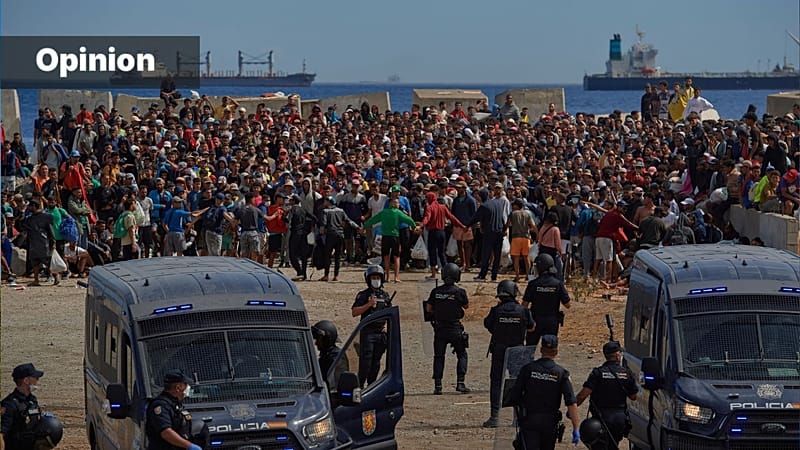
It is spending increasing political energy asking how to stop people reaching its borders, when the more consequential question is what happens long before they get there. If Europe wants to use its external aid to strengthen its own security and prosperity, it must answer that question in the next seven-year budget cycle.

Lasting prosperity and security require investment much earlier – where displacement begins, where refugees are first received and where fragile societies are most at risk of buckling under such prolonged pressure. Most solutions are there, not at Europe's border.

The distinction matters – and so does where Europe puts its money

Europe is increasingly tempted to view external assistance through the narrow lens of migration control: more money for partners willing to contain movements or accept returns.

Some of these objectives are legitimate. Governments have a responsibility to manage their borders, maintain functioning asylum and integration systems and where necessary, return those without a legal right to stay while complying with line with international law.

But a foreign aid policy built principally around preventing people from reaching the European territory is not a strategy for managing forced displacement. It risks simply moving the pressure elsewhere, making others – often with fewer resources than Europe – responsible for managing it, while potentially allowing others to instrumentalise migration flows and erode trust in Europe as a partner.

Where Europe puts its money, it advances its vision of what the world of tomorrow should look like. If Europe leaves the space empty, others – often with very different values – will fill it.

The EU is surrounded by countries facing extreme fragility risks. Many host refugees at a scale that would test far stronger institutions. Close to two-thirds of those arriving in Europe through irregular routes and seeking asylum come from these countries. That pressure is unlikely to disappear – and could grow – if underlying needs are not addressed earlier. Traffickers and actors with extremist agenda prey on precisely these vulnerabilities.

Addressing displacement means addressing its consequences before they cascade into wider instability. It means keeping children in school, keeping health systems functioning, creating livelihoods, supporting host communities, and strengthening institutions.

This is not charity, it is strategic investment

The next EU budget (MFF) offers Europe a crucial opportunity to put this principle into practice. The question is not only how much money Europe allocates to external action, but what it is intended to achieve and what Europe expects in return.

The MFF will determine which countries, crises and priorities receive sustained European backing. It will shape Global Europe, the EU's principal framework for development and humanitarian action, and therefore Europe’s ability to use its financial weight to advance its own security and prosperity.

This is not a technical exercise in dividing budget lines. It is a strategic choice about where European resources can deliver the greatest return: reducing instability, strengthening economic resilience, opening markets and building partnerships before crises become more costly to manage .

Refugees who work contribute to local economies. Stronger infrastructure supports trade. More resilient economies create markets for European goods and services. Stronger public institutions help societies withstand polarisation and resist extremist political movements.

This is why the design of Global Europe matters. Europe needs the capacity to finance the full displacement cycle: reducing fragility and conflict; protecting people when displacement occurs; supporting host countries and communities; creating livelihoods; and investing in solutions, including safe return where conditions permit, as well as resettlement and labour or education mobility.

The principle is simple: invest European money to the problem where it can deliver the greatest return – including for Europe's own security and prosperity.

Money spent strengthening a fragile health system today reduces the risk of a pandemic tomorrow. Money spent helping a refugee find work strengthens a host economy and provides a stronger trading partner for the EU. Money spent supporting the rule of law reduces the risk that instability and political extremism will spill across borders.

Not soft investments – investments in Europe’s own interests

Europe has a finite pool of resources and an expanding set of demands. Defence, cohesion, competitiveness and stronger public services will rightly compete for political attention and money. These priorities are closely linked to Europe’s external choices. A safer and more prosperous Europe depends in large part on what happens beyond its borders.

The next MFF will determine whether Europe puts its money behind short-term crisis management or long-term resilience; whether it strengthens relationships or creates transactional dependencies; and whether its external spending generates returns for Europeans as well as its partners.

Europe cannot prevent every conflict or stop every person from moving. But it can influence whether people have a viable future closer to home, whether host countries remain resilient, whether markets and partnerships grow, and whether crises extend across borders.

The choice is straightforward: use Europe’s money to manage the consequences of forced displacement on Europe, or invest more decisively in preventing those consequences from becoming Europe’s problem in the first place.

Jean-Nicolas Beuze is the UNHCR (United Nations High Commissioner for Refugees) Representative to the EU.

Sign up to read this article
Read news from 100's of titles, curated specifically for you.
Already a member? Sign in here
Related Stories
Top stories on inkl right now
One subscription that gives you access to news from hundreds of sites
Already a member? Sign in here
Our Picks
Fourteen days free
Download the app
One app. One membership.
100+ trusted global sources.