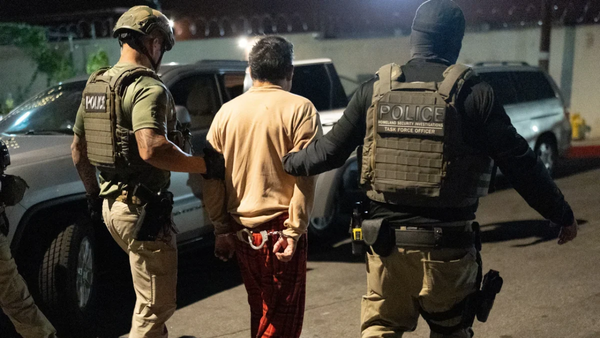
Mexican drug cartel leader Ismael "El Mayo" Zambada was sentenced to life in prison in New York on Monday.
Zambada, 76, had pleaded guilty to being a principal leader of the Sinaloa Cartel, considered by federal authorities to be one of the most violent and powerful drug trafficking organizations in the world.

"Nobody wins in a war like this," Zambada said through a Spanish-language translator, according to the Associated Press. He then apologized "for the harm I caused and the example I set," urging others to "choose a different path."
"Violence must end," Zambada said. "In Mexico and elsewhere affected by violence, too many lives are lost."
He had been charged with, among other things, being a leader within the cartel from January 1989 through January 2024 when he was captured. Among the charges he faced were RICO conspiracy for his participation in money laundering, murder and drug conspiracies, and violations of state law for murder and kidnapping between 2000 and 2012.
During his time at the helm of the cartel, he ordered and plotted various murders, including his own nephew. Assistant U.S. Attorney Adam Amir told the court that more than a million Americans died of drug overdoses during Zambada's that period of time.
"Ismael Zambada Garcia spent nearly four decades poisoning American communities to make billions of dollars in profit and ordering the murders of anyone who stood in his way. Today, that chapter closes for good," United States Attorney for the Eastern District of New York Joseph Nocella, Jr. said.
The Justice Department said that Zambada was a key member of the cartel since its very founding. As one of its leaders, he directed the importation of lethal quantities of narcotics — including, among others, cocaine, heroin, methamphetamine, and fentanyl — into the United States and laundered billions of dollars in drug proceeds back to Mexico.
Federal authorities say that Zambada sought to keep and enhance his power after the 2016 capture of his partner, El Chapo, in 2016.
"He will spend the rest of his life in a United States prison, exactly where he belongs," Nocella, Jr. said. "This sentence was made possible by the tireless bilateral cooperation between U.S. and Mexican law enforcement who refused to let El Mayo's years of evading justice become a permanent state of affairs. We hope that today's sentence brings some measure of justice to the countless victims of the Sinaloa Cartel's narcotics trafficking and violence."