
Get all your news in one place.
100's of premium titles.
One app.
Start reading
AAP
AAP
Lifestyle
Liz Hobday

Could radically different computers rescue the AI era?

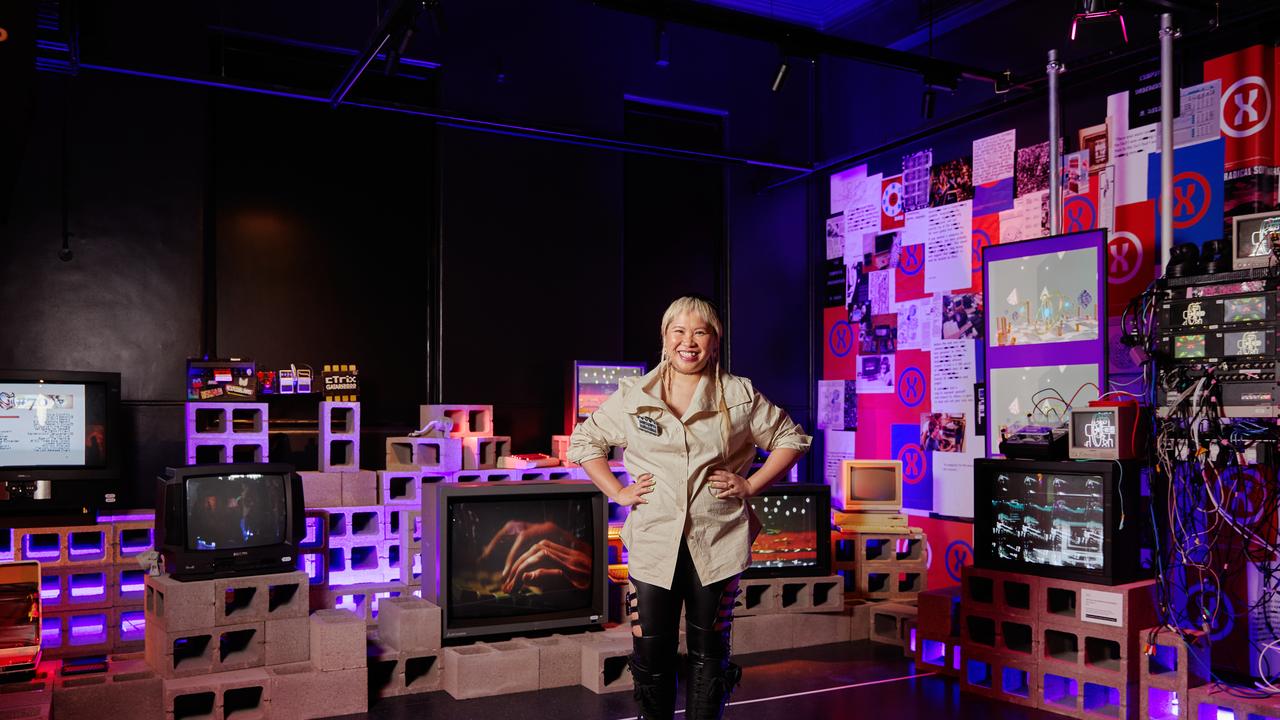
Huang Buntine says humans were empowered by earlier computers - unlike the anxieties of the AI era. (PR IMAGE PHOTO)

A 1984 Sega computer rescued from a demolition site was the start of designer Mel Huang Buntine's collection of vintage IT.

Beginning with the first and only Sega personal computer, the SC-3000H, the Buntine Computer Collection has been steadily growing since 2018.

"We just got really obsessed with this idea of fixing old computers and preserving them, because they were all just going to landfill," she told AAP.

The Sega and many other items are going on display at the National Communications Museum exhibition Radical Computing.

Long before the tech bro era and the rise of artificial intelligence, the show explores how smaller machines democratised computers for creative projects.

"I think we take it for granted how radical the idea of owning your own computer once was, and this exhibition is exploring that," Huang told AAP.

A view of the CM-2 at the National Communication Museum
The CM-2 was the first commercial supercomputer with a design inspired by the human brain. (PR IMAGE PHOTO)

As well as tech-inspired artworks, there are 1980s models from a fondly-remembered Australian computing company, Microbee.

The centrepiece is a recent donation to the museum's collection, an early supercomputer known as the CM-2 made in about 1987.

Believed to be the only CM-2 in Australia, it's the second model in series of parallel supercomputers made by the Connection Machine company.

The CM-2 was the first commercial supercomputer with a massively parallel architecture, its design was inspired by the neural network structure of the human brain - just like today's AI machines.

A later edition, the CM-5, was made famous by the 1993 feature film Jurassic Park, with banks of CM-5 computers used on set in the control room of the dinosaur park.

Led by industrial designer Tamiko Thiel, its black cube design and "random and pleasing" LED light display were as celebrated as its engineering.

"Until NCM contacted me, I had never even known that there were Connection Machines in Australia! I am so excited that they will be uncovering and telling the story of computing in Australia for the first time," Thiel said in a statement.

The Radical Computing exhibition at the National Communication Museum
The show's organisers argue there's an urgent need to rethink contemporary digital environments. (PR IMAGE PHOTO)

Importantly, Thiel's design was human-centred, and made to show its workings rather than conceal them.

Amid widespread anxiety about big tech and social media and warnings about the rise of artificial intelligence, Huang hopes for a return to the ethos of the early days of computing.

It was an era when humans understood and were empowered by computers, and exercised agency over their technology and devices, she said.

The museum's artistic director and co-chief executive Emily Siddons agrees.

"It has never been more urgent to rethink our digital environments and consider how we can build more personal and less extractive systems for our future," she said.

Radical Computing runs from Saturday until February 2027.

Sign up to read this article
Read news from 100's of titles, curated specifically for you.
Already a member? Sign in here
Related Stories
Top stories on inkl right now
One subscription that gives you access to news from hundreds of sites
Already a member? Sign in here
Our Picks
Fourteen days free
Download the app
One app. One membership.
100+ trusted global sources.