China has revived a decades-old connectivity idea in a new form, proposing a China-Bangladesh-Myanmar Economic Corridor (CBMEC).
Get breaking news anytime, anywhere. Download the TOI app now!

Also Read: Beijing pushes for a China-Pakistan-style economic corridor with Bangladesh and Myanmar
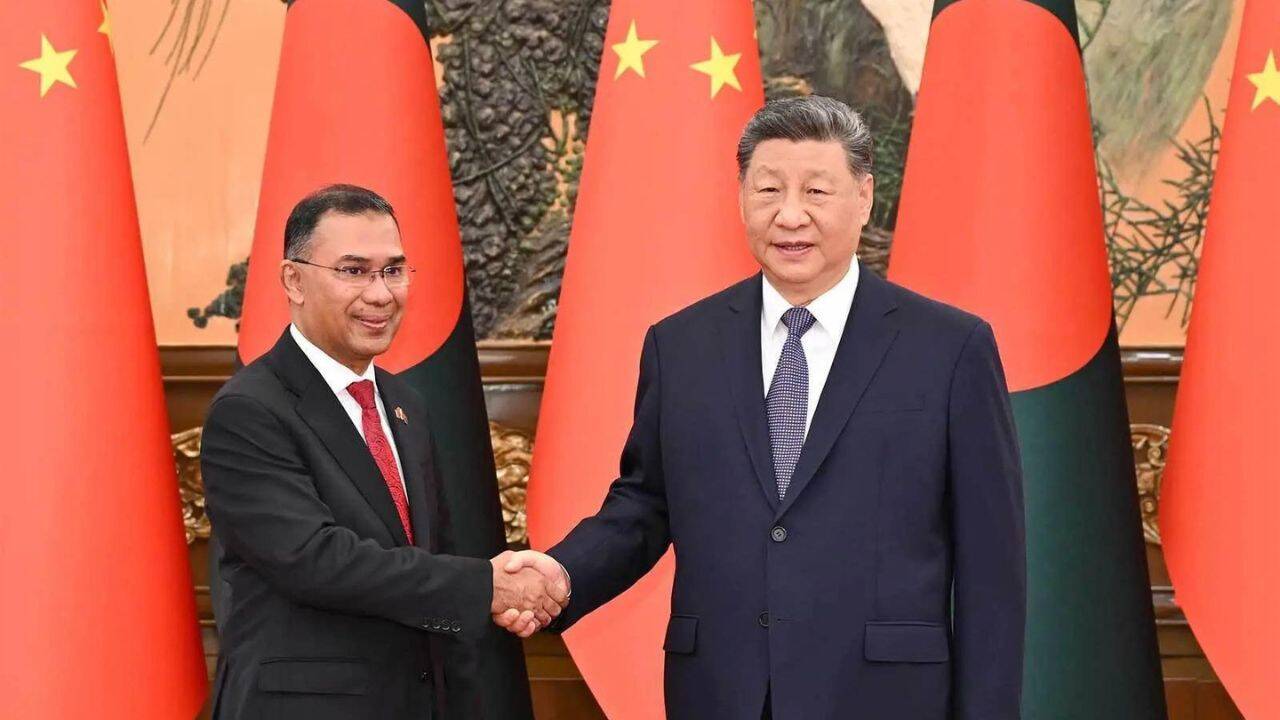
The proposal, discussed during Bangladesh Prime Minister Tarique Rahman’s recent state visit to Beijing, is a reworked version of an earlier plan that ultimately failed to materialise — a four-country economic corridor linking Bangladesh, China, India and Myanmar.
For India, the significance of CBMEC lies in the project’s strategic geography. If realised, the corridor would give China overland access to the Bay of Bengal through Myanmar and Bangladesh, expanding Beijing’s presence in India’s eastern neighbourhood.
China’s renewed push also comes at a time when New Delhi is trying to rebuild ties with Dhaka following political changes in Bangladesh. It also follows Myanmar’s military-backed President Min Aung Hlaing’s visit to India, underscoring the renewed diplomatic focus on the region.
The proposal has, therefore, revived debate over China’s regional connectivity ambitions and what they could mean for India’s strategic interests.
A revived corridor, without India
The proposed CBMEC builds on the existing China-Myanmar Economic Corridor, which stretches around 1,700 kilometres from Kunming in China’s Yunnan province to the Kyaukphyu Special Economic Zone in Myanmar’s Rakhine state.
CBMEC itself is envisaged to begin in Kunming and run to Mandalay in Myanmar. From there, it would split into two branches — one heading to Yangon, Myanmar’s former capital and commercial hub, and the other to Kyaukphyu, a deep-sea port in Rakhine state. The route would then extend from Rakhine towards Bangladesh’s Chattogram and Mongla ports on the Bay of Bengal.
If built, the project would give China direct overland access to Bangladesh's Chattogram and Mongla ports on the Bay of Bengal.
According to Antara Ghosal Singh, a China Fellow at the Observer Research Foundation (ORF), Beijing is “re-upping its BCIM minus India plan” at a time when its China-Pakistan Economic Corridor (CPEC) has stalled. The more immediate triggers, she noted, are the changing dynamics between New Delhi and Dhaka and the continuing uncertainty in Myanmar.
“China has long proposed the BCIM. India initially showed interest in it but later declined. Now that CPEC is stalled, China is re-upping its BCIM minus India plan,” Singh, a specialist in Chinese foreign policy, told The Times of India.
BCIM refers to the Bangladesh-China-India-Myanmar Economic Corridor. The precursor to the proposed CBMEC, this unrealised four-nation trade corridor traces its origins to 1999. The idea gained momentum in 2013, when Beijing and New Delhi agreed to study a corridor linking Kunming with Kolkata via Mandalay and Dhaka, following which China hosted the first meeting of the BCIM Joint Study Group.
However, the project gradually stalled as India grew increasingly wary of China’s expanding strategic footprint and opposed Beijing’s attempt to bring the corridor under the Belt and Road Initiative (BRI). Relations between the two countries deteriorated further amid border tensions, and by 2019 the BCIM corridor had been removed from the BRI umbrella.
Why CBMEC matters to India
For India, the project carries implications that go beyond economics.
Through CPEC, which New Delhi strongly opposes because it passes through Pakistan-occupied Kashmir (PoK), China already enjoys access to the Arabian Sea on India’s western flank. A successful CBMEC would give Beijing greater access to the Bay of Bengal on India’s eastern flank as well.
Satyendra Pradhan, a former deputy national security advisor, called it part of China’s policy of creating a "string of pearls".
“China has followed systematically the policy of creating a string of pearls around India. It considers India its strategic rival in South Asia,” Pradhan said.