
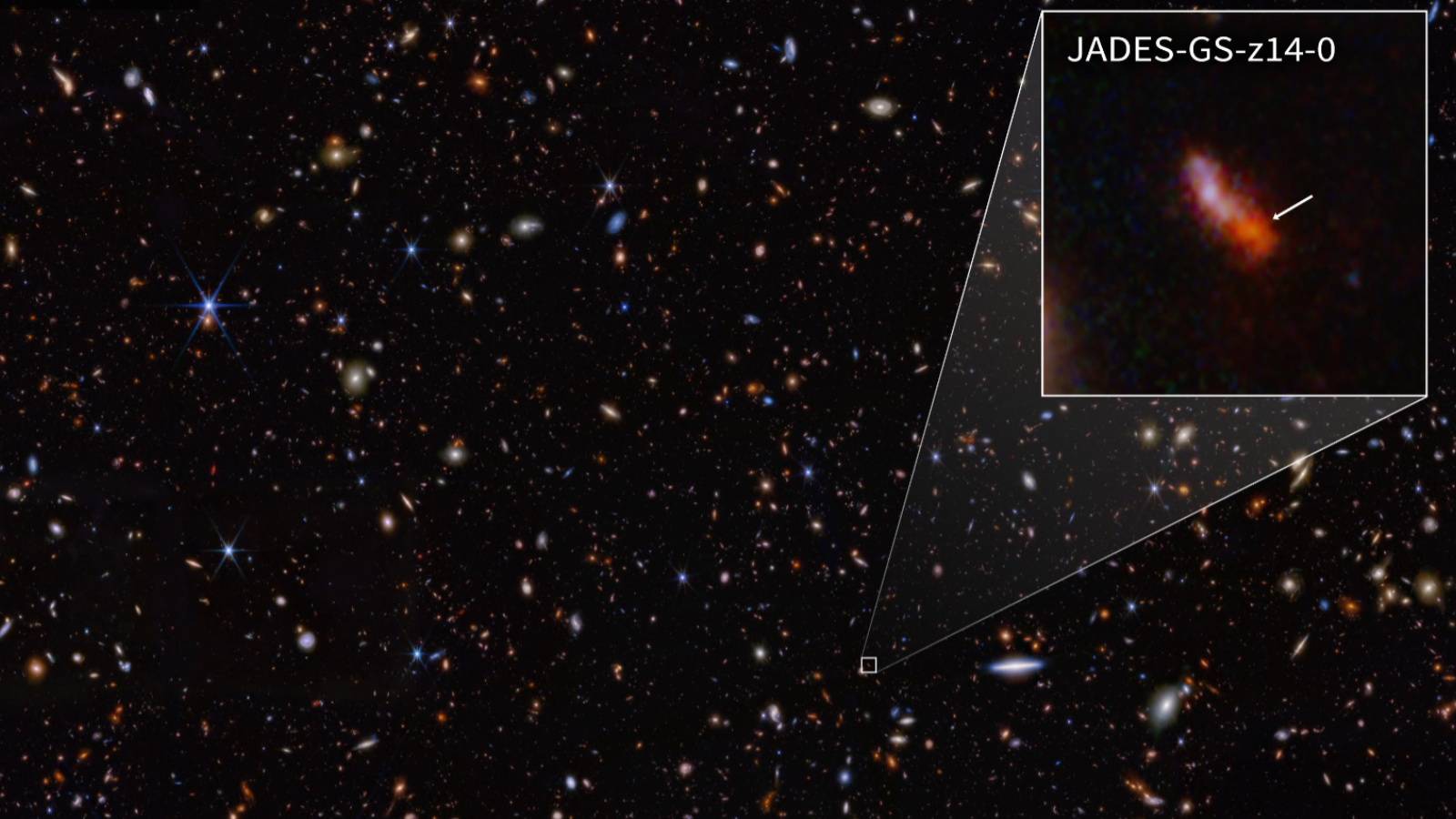
Since it began sending data back to Earth in 2022, the James Webb Space Telescope (JWST) has greatly impacted astronomy, and one of its most revolutionary achievements is the observation of some of the most distant galaxies ever seen. However, because light doesn't travel instantly — but rather moves at about 300 million meters (985 million feet) per second in a vacuum — we don't see those galaxies as they are today, but as they were billions of years ago.
Moreover, our universe is estimated to be 13.8 billion years old. So, we should assume that the most distant galaxy we could ever hope to see is no more than 13.8 billion light-years away. (One light-years is the distance light travels in a year). That point should be a "cosmological horizon" of sorts — beyond which no telescope should be able to see. And, because nothing can travel through space faster than c, that means there should be no way a galaxy further than 13.8 billion light years away, and getting more distant all the time could affect Earth. Right?













