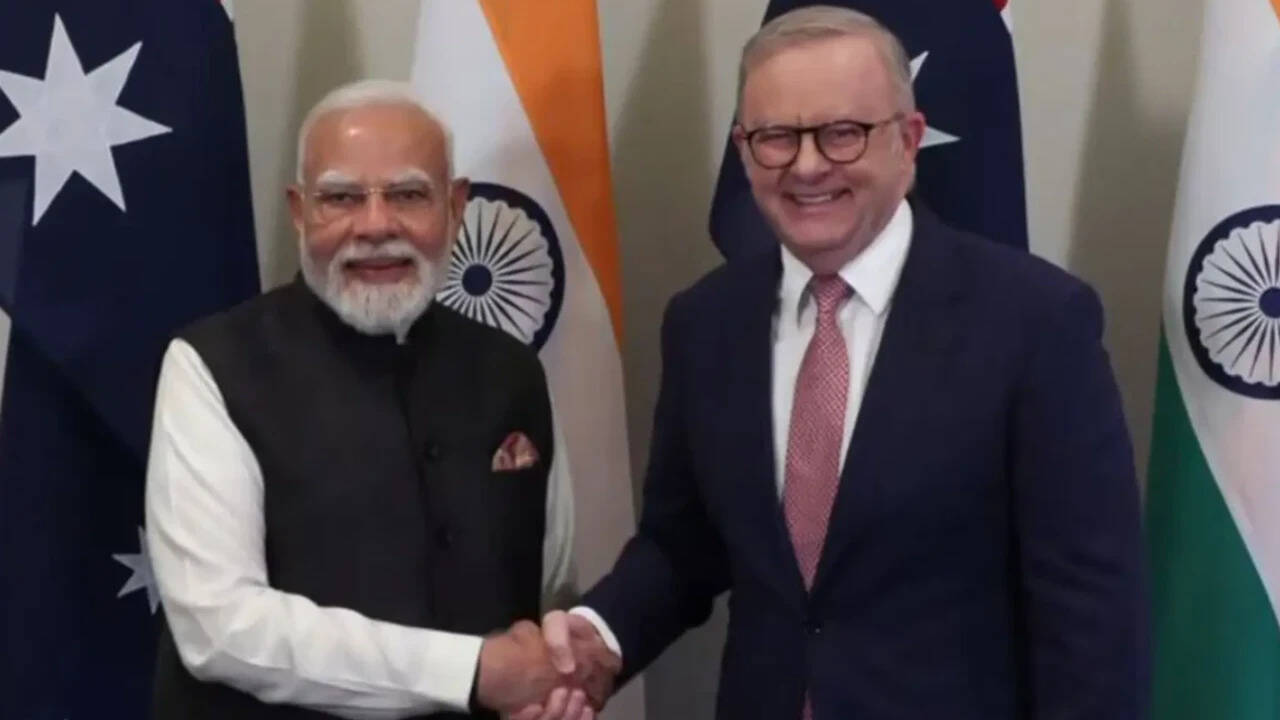
Prime Minister Narendra Modi held talks with Australian Prime Minister Anthony Albanese in Melbourne on Thursday, during which Albanese raised concerns over China's recent intercontinental ballistic missile (ICBM) launch into the South Pacific, foreign secretary Vikram Misri said.
Get breaking news anytime, anywhere. Download the TOI app now!

Briefing the media after PM Modi's visit to Australia, Misri confirmed that the issue figured during the leaders' discussions.
"Regarding the question about the ICBM (intercontinental ballistic missile) launch, yes, this was raised by the Australian premier, and there was a certain amount of concern expressed about this development," Misri said. He added that PM Modi reiterated India's position on the Indo-Pacific.
"The Prime Minister mentioned that we see the Indo-Pacific as an area where we would like to see peace, security, and stability," Misri said.
According to the foreign secretary, both countries agreed to deepen cooperation in pursuit of those objectives.
"Australia and India have shared interests and shared objectives in this regard and will continue to not only exchange perspectives on this but also intensify cooperation in various areas to ensure that peace, security, and stability in the Indo-Pacific area continue to be met," he added.
The remarks came days after China conducted a rare submarine-launched ballistic missile test in the Pacific Ocean. According to Chinese authorities, a People's Liberation Army Navy (PLAN) submarine launched a strategic missile fitted with a dummy warhead into the Pacific, with the missile landing in a designated maritime area.
Chinese news agency Xinhua described the launch as a 'routine arrangement' of China's annual military training and not directed against any specific country or target. Beijing's foreign ministry spokesperson Mao Ning said the launch was conducted "safely, in a standardised and professional manner throughout."
Media outlet CNN, citing a regional source, reported that the missile flew across the exclusive economic zones (EEZs) of the Federated States of Micronesia, Nauru, Kiribati and Tuvalu before landing near the EEZ boundary of either Kiribati or Tuvalu.
The test drew criticism from Australia and New Zealand. Australian foreign minister Penny Wong described it as "destabilising" for the region, saying it should be viewed in the context of China's rapid military expansion. She also said the lack of transparency surrounding Beijing's intentions remained a concern and that China should explain the purpose of the launch.
The United States on Wednesday said China gave it only a few hours' notice before its ballistic missile test and failed to provide sufficient details. A US State Department official said Beijing's notification 'fell considerably short' of the transparency standards followed by the other P5 nuclear-weapon states.
Misri said India and Australia continue to coordinate closely on the Pacific through multiple platforms.
India's foreign secretary also said India and Australia remain in close coordination on the Pacific Islands through the Forum for India-Pacific Islands Cooperation (FIPIC), the Quad and other bilateral mechanisms to advance regional cooperation.