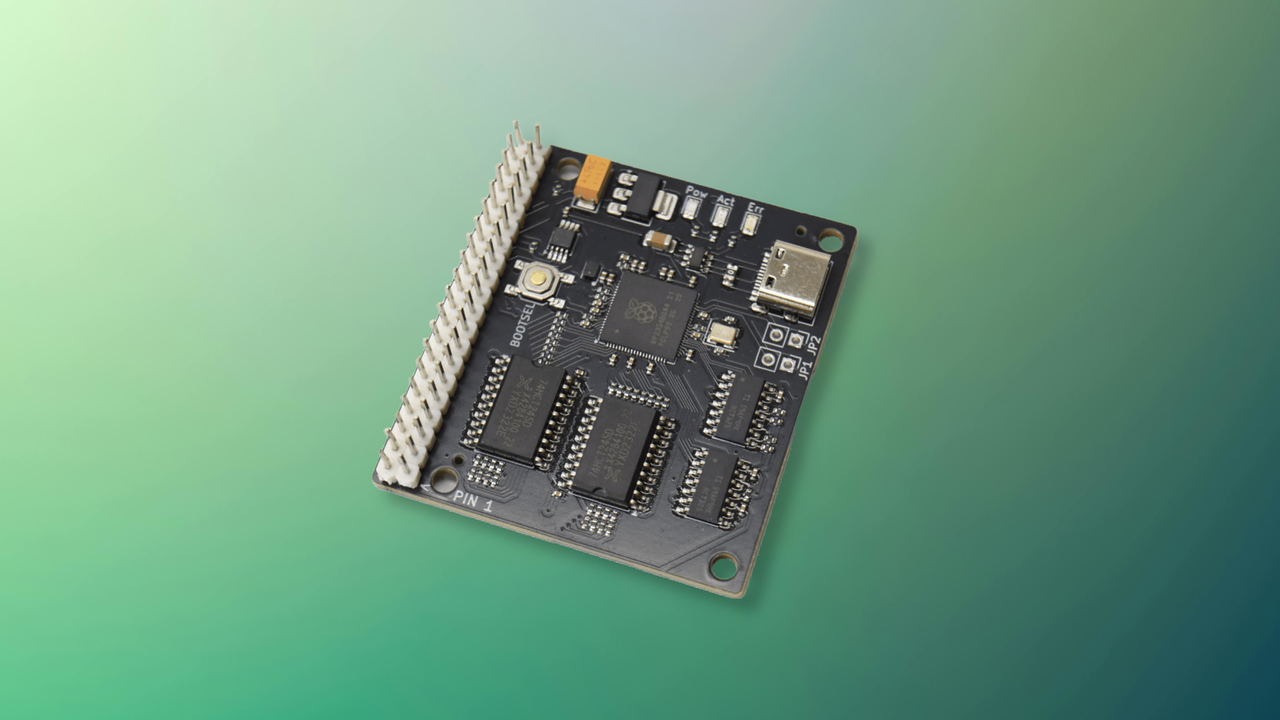
If you've got a plethora of older IDE (PATA) hard drives that you need to run data recovery, backup, or for the fun of running retro hardware, then your biggest issue is connecting to a more modern system. JJ Dasher, from JJ's Messy Bench, has created ATAboy, an open source IDE to USB interface designed specifically for older hard disks.
The premise is simple. You have a drive that uses CHS (Cylinder Head Sector), PIO Mode 0 ATA and you want to get data to and from it. With ATABoy you connect up the drive, external power and then connect the USB Type C to your modern day PC. Jump into a serial terminal (PuTTY for example) and then use the very authentic "Award" style BIOS menu appear. From there you can auto detect the geometry, or manually enter the details. Mount the drive and your modern PC will detect and offer the drive as USB Mass Storage. That's it! ATAboy works with Windows, macOS and Linux devices, but the USB interface is "only" USB 1.1 (for now) and while that may sound sedentry for 2026, we have to remember that for older IDE drives that use CHS, this is still a fast interface. Often these drives were at most only a few hundred Megabytes in capacity.
The "Award" influenced BIOS screen is a sheer joy to behold, spoken as a person who was tinkering with 486 PCs back in the 1990s. The interface is simple, clean, and heavily nostalgic.

On the PCB we have the Raspberry Pi RP2350 SoC (System on Chip) as used in the Raspberry Pi Pico 2 and the Pico 2W. This potent dual core Arm CPU runs at 250MHz, and the onboard GPIO handles the IDE to USB interface. The PCB was designed using KiCad, a popular open source CAD application.
ATAboy seems like a dream come true for those of us who enjoy using older PCs. It is compatible with CHS and LBA-type IDE disks, but it is geared more towards CHS. If you want to preserve an old drive, create an image, or simply move files to your modern PC, then ATAboy could be the tool for you. For some of the legacy disks, you will need to experiment with manually configuring the interface, usually because of unusual geometries.
If you want to buy one, JJ has them for sale for $50 or you can get the schematics and bill of materials (BOM) from JJ's GitHub repo to build your own. There, you can also find the latest firmware. You can also find a 3D printable case, designed using FreeCAD, to keep your ATAboy safe from harm. You could print this on one of the best 3D printers or even one of the best budget 3D printers.

Follow Tom's Hardware on Google News, or add us as a preferred source, to get our latest news, analysis, & reviews in your feeds.