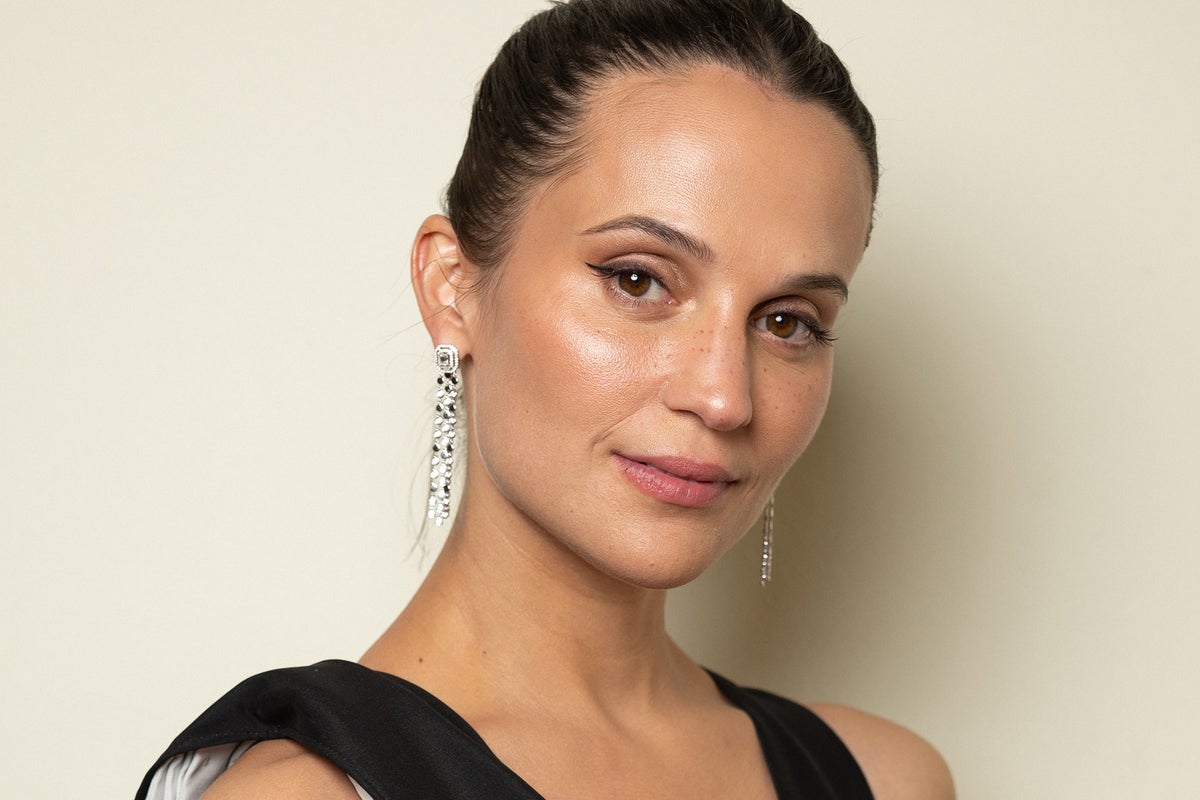
It’s no wonder Alicia Vikander said yes to starring in The Wizard of the Kremlin – Olivier Assayas’s new political thriller about the turbulent beginnings of the Russian Federation. By the end of her first 10 minutes on screen, the Swedish actor has performed a punk rock song at a house party while holding a naked man on a leash, and been lowered from the rafters as some kind of metallic deity in a stage adaptation of Yevgeny Zamyatin’s We. “It’s a supporting role, but I get to have some very distinct moments,” she agrees, flashing a grin.
Neither background nor the subject, hers is the kind of tricky, underwritten character that Vikander is able to make deftly three-dimensional with her mix of edge and subtle vulnerability. For years now, directors have sought her for exactly that kind of nuance. Now 37, Vikander has spent much of her career playing women defined by restraint – androids, wives, muses, figures bound by decorum or circumstance. She won an Oscar in her mid-twenties for her quietly devastating turn as the partner of a trans woman in The Danish Girl (2015), having already outshone Keira Knightley in Joe Wright’s Anna Karenina (2012) and brought eerie interiority to a humanoid robot in Ex Machina (2014). Hollywood quickly moved to scale her up: a CIA hacker in Jason Bourne (2016); the inheritor of a billion-dollar franchise in Tomb Raider.