The Anxiety That Has No Object
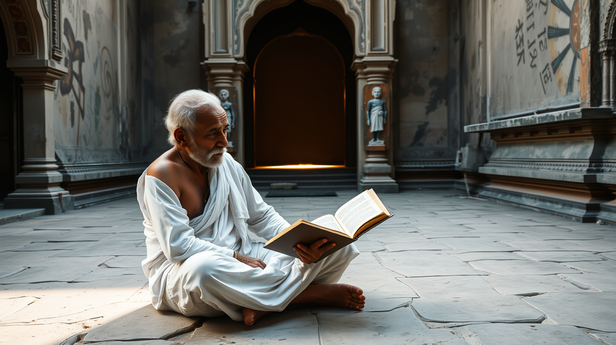
You can name what you are afraid of. Deadlines. Rejection. The future. The body failing. But underneath those named fears sits something older and harder to locate, a low-grade dread that persists even when nothing is wrong. The promotion came through. The relationship is fine. Sleep was good. And still, something hums. Adi Shankaracharya, the 8th-century philosopher from Kaladi in Kerala, would say you have correctly identified the symptom and completely misidentified the cause.
His diagnosis: the anxiety is not about the objects you fear. It arises from the structure of the self that is doing the fearing.
What Shankara Actually Said
Advaita means non-dual. Vedanta is the philosophical tradition drawn from the Upanishads. Put them together and Shankara's central claim becomes precise: there is only one consciousness, Brahman, and the individual self, the atman, is not a fragment of it or a reflection of it. It is identical to it. The Mandukya Upanishad states this in its shortest and most uncompromising form: the syllable Aum contains four states of consciousness, and the fourth, turiya, is the ground beneath all experience, not a state you enter but what you already are.
The world as you experience it, the office, the marriage, the body, the fear, Shankara calls maya. This word is routinely mistranslated as illusion, which makes Advaita sound like denial. Maya is better understood as misapprehension. The rope seen as a snake in dim light is a real rope. The snake is the error. What you take to be a bounded, mortal, separate self is a real something, but the boundedness, the mortality, the separateness are the error.
Why the Separate Self Is the Wound
The Bhagavad Gita, in Chapter 2, verse 20, states of the atman: na jayate mriyate va kadacit, it is never born and never dies. Shankara's commentary on this verse is not consolation. It is an ontological claim. The thing you are most afraid of losing, your life, your continuity, your sense of being you, is, in Advaita's account, the very superimposition that generates fear in the first place.
A separate self has edges. Edges can be threatened. Everything that can be taken from you is something the separate self has decided belongs to it: reputation, health, love, time. Shankara's Vivekachudamani, a text on discrimination between the real and the unreal, returns again and again to this point, that the identification of consciousness with the body-mind complex is the root of all suffering. Not a contributing factor. The root.
This is what makes Advaita radical in a way that most modern anxiety frameworks are not. Cognitive behavioural therapy works on the content of thought. Meditation works on the relationship to thought. Advaita goes further: it questions the reality of the thinker.
What This Does to Modern Dread
You are sitting in a traffic jam on the Western Express Highway, late for something that matters, and the dread is physical, chest tight, jaw set. Every anxiety-management technique you know asks you to work with that state: breathe through it, reframe it, accept it. Shankara asks a different question. Who is late? Trace the answer back far enough and you reach something that cannot be named, cannot be threatened, and has never been anywhere other than exactly here.
This is not a comfort. It is a displacement. The liberation Advaita promises, moksha, is not the relief of having your problems solved. It is the recognition that the self who owns the problems was always a construction. The Chandogya Upanishad's instruction, tat tvam asi, that thou art, is addressed to a student who already knows all the Vedic rituals and is still suffering. The knowledge Shankara transmits is not information. It is a shift in the locus of identity.
Modern anxiety is, at its structural core, a problem of identification. You are identified with outcomes, with continuity, with the story of a self that must be protected and advanced. Every piece of bad news is a threat to that story. Advaita does not ask you to stop caring about outcomes. It asks you to notice what is aware of caring, and to sit with the possibility that that awareness has no stake in the outcome at all.
Why This Is Harder Than It Sounds, and More Useful Than It Seems
The obvious objection: this sounds like detachment dressed up in Sanskrit. If atman is Brahman and all is consciousness, why does anything matter? Shankara's answer, drawn from his commentaries on the Brahma Sutras, is that the practice of Advaita does not produce indifference. It produces what the tradition calls viveka, discrimination. You continue to act. You continue to feel. But the actions and feelings arise in a self that is no longer convinced it will be destroyed if things go wrong.
The Naishkarmya Siddhi, a later Advaita text by Suresvara, one of Shankara's direct disciples, makes this distinction carefully: liberation is not the absence of experience but the absence of bondage to experience. The person who has genuinely absorbed Advaita does not stop grieving or laughing. They grieve and laugh without the undertow of existential threat that colours every ordinary moment.
That undertow, the sense that something essential is always at risk, is what most people mean when they say they are anxious. Shankara's answer is not a technique for managing it. It is a philosophical argument that the thing you believe is at risk does not exist in the way you think it does.
The argument does not dissolve anxiety the way a pill does. It requires sustained inquiry, what Advaita calls vichara, self-inquiry, and a teacher, and time. But it is the only framework that addresses not the symptoms of modern anxiety but its architecture. Every other answer works on the furniture. Advaita questions the room.