
Get all your news in one place.
100's of premium titles.
One app.
Start reading
Guitar World
Guitar World
Entertainment
Alex Lynham

“A strange and weird anomaly that stands apart not only from most known octave fuzz designs, but also from fuzzes full stop”: JHS Coyote review

JHS Pedals Coyote.

What is it?

The Coyote is a new octave fuzz pedal from JHS, based on the Moonrock Fuzz by G.S. Wyllie. If your reaction to that is "the what?" you're not alone.


According to JHS, after being around the music scene in the 1960s, Wyllie lived a reclusive life in North Carolina, "sandcast[ing] his own enclosures," and "etch[ing] his own boards," never mass producing the pedal.

That didn't stop it from ending up in the hands of famous musicians like Paul Simon, Bruce Springsteen, Joan Baez and David Byrne.

Specs

(Image credit: JHS Pedals)
  • PRICE: $149 | £149 | €199
  • TYPE: Octave Fuzz
  • MADE: USA
  • CONTROLS: Volume, Mode
  • CONNECTIVITY: Input, Output, 9V DC in
  • BYPASS: True
  • POWER: 9VDC Centre-negative, 5mA
  • DIMENSIONS: 65x40x120 mm
  • WEIGHT: 0.5lbs/250g
  • CONTACT: JHS Pedals

Build quality

(Image credit: Future/Matt Lincoln)

Build quality rating: ★★★★½

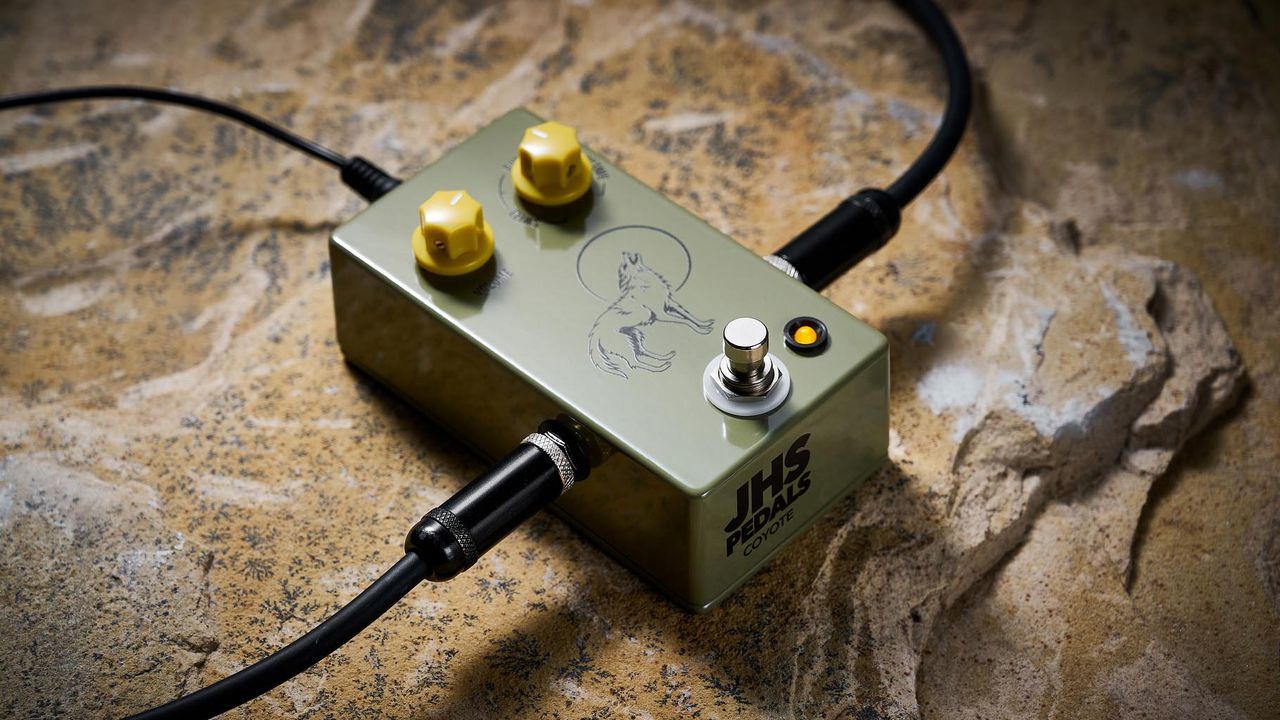
The Coyote is a clean build, inside and out, housed in a tidy green enclosure.

The pedal has an unusual topology, using a transformer, but not in the normal way you'd expect for an octave pedal. The result is a very different voicing, particularly for the fuzz.

Usability and features

(Image credit: Future/Matt Lincoln)

Usability and features rating: ★★★★☆

Like any fuzz pedal, the Coyote is pretty user-friendly. It's a case of plugging it in to a Marshall half-stack, grabbing a guitar and twisting the two knobs

Like any fuzz pedal, the Coyote is pretty user-friendly. It's a case of plugging it in to a Marshall half-stack, grabbing a guitar and twisting the two knobs. The flip side of this of course, comes from the unusual function of the second control.

JHS describe it as going from a swell when fully counter-clockwise, to a fuzz at 12 o'clock, and an octaver when turned further clockwise. It's a reasonable description, but the multi-function knob makes the pedal more complex. Still, with an analog pedal like this, it's basically unavoidable.

Sounds

(Image credit: Future/Matt Lincoln)

Sounds rating: ★★★★☆

Of course, unless you're one of the handful of Moonrock owners, you've never heard this pedal before.

The real question is, have you heard anything like it? The answer to that question is, yes. It's got its own thing going on, but fundamentally, it sounds similar to other analog octave units.

At 12 o'clock, the level is a fair bit below unity volume on our test unit, with a range of pickups. A quick nudge to the right sorts everything out.

(Image credit: Future/Matt Lincoln)

It's the second control that absorbs most of my attention. JHS describe it as a 'swell' when it's set counter-clockwise, but it's closer to a gate in character

It's the second control that absorbs most of my attention. JHS describe it as a 'swell' when it's set counter-clockwise, but it's closer to a gate in character. Compared to say, a Boss Slow Gear, the Coyote is less predictable, and I didn't find it very useful.

Once it's into fuzz territory, we're on more stable footing. In some ways this is a little bit like a Fuzz Face, but smoother, more like a Big Muff in overall voicing.

(Image credit: Future/Matt Lincoln)

Whatever pickups I used, I found it to be quite dark, and mid gain, so pushing it with a treble booster in front was necessary to get the most from it. If you play more low-gain styles of music, the saturation level might not be an issue, but the voicing may be.

The octave works best, like most octaves, on the neck pickup above the twelfth fret. Where it differs is that, like a Fuzz Face, but unlike most other Octave Fuzzes, it cleans up really rather nicely at the guitar. This lends it versatility for replicating hyper-specific recorded psychedelic guitar tones.

Verdict

(Image credit: Future/Matt Lincoln)

A strange and weird anomaly that stands apart not only from most known octave fuzz designs, but also from fuzzes full stop

Anybody who's been following the guitar pedal market for more than a few months will know that hype and marketing often come over sounds, not to mention originality.

Here would seem to be the exception. The Coyote is a strange and weird anomaly that stands apart not only from most known octave fuzz designs, but also from fuzzes full stop. The issue is, that as JHS themselves acknowledge, it's still not a pedal for everybody.

Guitar World verdict: If you're after an octave fuzz, and the usual suspects haven't done it for you, then the Coyote is worth a look. As a standalone fuzz, it's not the best option – players after a touch-sensitive fuzz are better off with a Fuzz Face, while for most others a Big Muff will do. The space cadets, as always, can try a Z-Vex or Death By Audio sonic destruction device.

Ratings scorecard

Test

Results

Score

Build quality

Typically tidy construction from JHS Pedals.

★★★★½

Usability and features

Two knobs and that's that but the Swell knob might take some getting used to.

★★★★☆

Sounds

It's not your common or garden variety fuzz and that's the appeal.

★★★★☆

Overall

One for the fuzz adventurists looking for something more exotic.

★★★★☆

Also try

Hands-on videos

JHS Pedals

R.J. Ronquillo

Jamie Slays

Sign up to read this article
Read news from 100's of titles, curated specifically for you.
Already a member? Sign in here
Related Stories
Top stories on inkl right now
One subscription that gives you access to news from hundreds of sites
Already a member? Sign in here
Our Picks
Fourteen days free
Download the app
One app. One membership.
100+ trusted global sources.