Get all your news in one place.
100's of premium titles.
One app.
Start reading
The Economic Times
The Economic Times
Shreya Biswas

A dusty painting sat unnoticed in a French attic for years; when experts examined it, the forgotten artwork was identified as a lost Caravaggio worth over $100 million

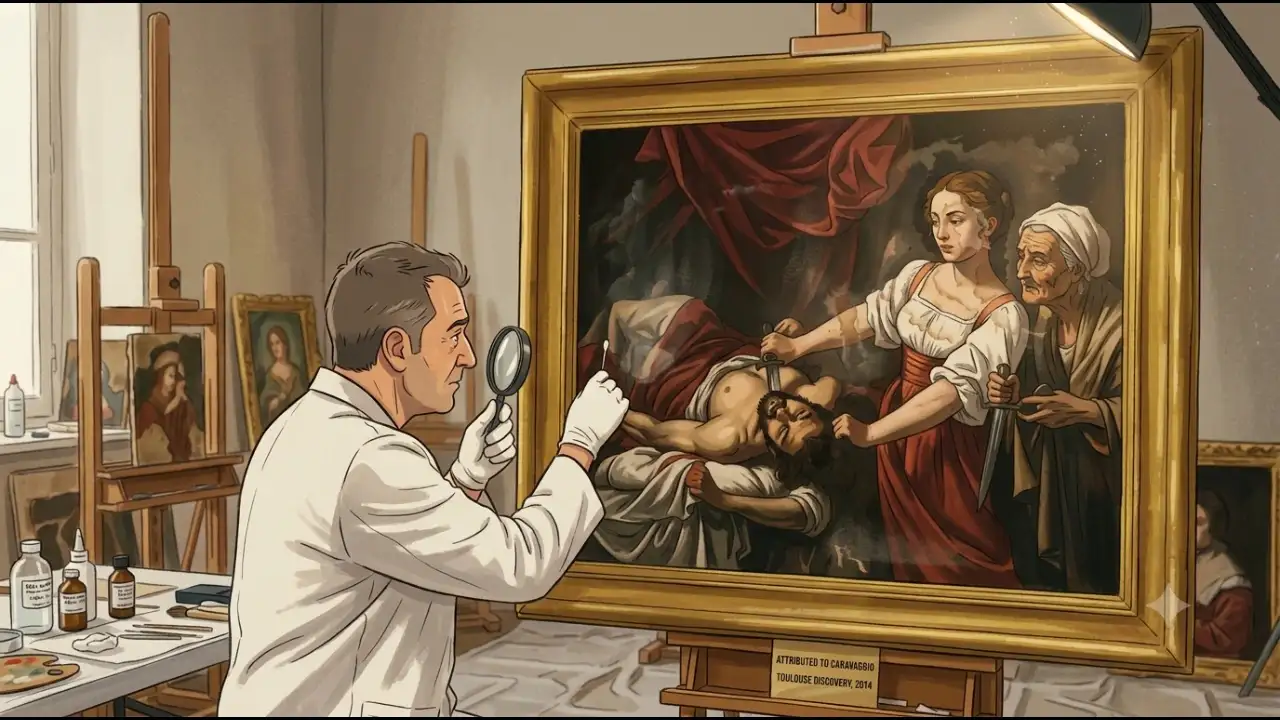
Caravaggio painting: A dusty painting discovered in the attic of a house near Toulouse, France, turned out to be the subject of a major art discovery in 2014. French art expert Eric Turquin identified the painting as a lost work by Italian master Caravaggio. The artwork depicts the biblical story of Judith beheading Holofernes. CNN reported that the painting could be worth more than $100 million if its attribution to Caravaggio was accepted.

Lost Caravaggio painting discovered in a French attic

The painting was discovered in the attic of a house near Toulouse in 2014. The artwork was covered in dust and had water stains when it was found. According to CNN, the owner said the painting had remained undiscovered for 150 years.

It shows Judith holding a sword while beheading Holofernes, the Assyrian general.

French auctioneer Marc Labarbe was involved in the discovery, and the painting was subsequently examined by Eric Turquin, who identified it as a lost Caravaggio.

READ ALSO: In 500 BCE, ancient people created vast animal and geometric figures in Peru's desert. 2,500 years later, the Nazca Lines remain one of archaeology's great enigmas

Experts examined the Caravaggio attribution

The identification was not universally accepted. Turquin argued that the painting was an authentic Caravaggio, while other experts remained more cautious about confirming its authorship.

The painting’s attribution was examined in connection with another work by Louis Finson depicting the same biblical subject. The original Caravaggio painting had been considered lost.

Painting valued at more than $100 million

The potential value of the painting was substantial. CNN reported that the artwork was estimated at €150 million in 2019, equivalent to about $170 million at the time. The valuation was reported in connection with the painting’s possible attribution to Caravaggio.

READ ALSO: In 478 BC, a temple was built to honour Confucius; centuries of rebuilding turned it into a complex with more than 100 buildings

France declared the painting a national treasure

French authorities placed restrictions on the painting while its attribution was being examined.

CNN reported that the French government declared the artwork a national treasure and imposed a 30-month export ban. The restriction prevented the painting from being exported during that period while further examination took place.

Lost Caravaggio sold before planned auction

The painting was scheduled to be sold at auction in France on June 27, 2019.

CNN later reported that it was sold to an unidentified foreign buyer two days before the planned auction. The reported valuation was €150 million, or about $170 million.

The painting's discovery in a French attic and its identification by Eric Turquin brought renewed attention to the question of whether it was a lost Caravaggio.

Who Was Caravaggio

Caravaggio was one of the leading Italian painters of the late 16th and early 17th centuries, known for the intense realism of his large-scale religious works. Born on September 29, 1571, in Milan or Caravaggio, Italy, he died on July 18 or 19, 1610, in Porto Ercole, Tuscany.

READ ALSO: In 1942, Hedy Lamarr co-patented a system to protect torpedo signals; 55 years later, the Hollywood star received recognition for her wireless innovation

Caravaggio’s Realistic Religious Paintings

Rather than following the elegant conventions of late Mannerist painting, Caravaggio presented biblical stories as vivid and often bloody dramas, as per a Britannica report. He frequently worked from live models and placed sacred figures in settings that appeared contemporary. His paintings emphasized the poverty and humanity of Christ, the Apostles, saints and martyrs, often showing ragged clothing and dirty feet.

Caravaggio’s Chiaroscuro Style

Caravaggio developed a distinctive use of chiaroscuro, creating extreme contrasts between light and darkness to highlight gestures and facial expressions. His approach had a major influence on later artists, including Rembrandt, Diego Velázquez and Théodore Géricault. His dramatic use of light and staging also influenced filmmakers such as Pier Paolo Pasolini and Martin Scorsese.

Caravaggio’s Life and Legal Troubles

His career was marked by both artistic success and legal troubles. He committed murder and violent assault during his years in Rome and spent much of his later career as a fugitive from justice.

READ ALSO: In 2023, an Australian city put 76,000 recycled bottles into its roads; 25 tonnes of crushed glass replaced virgin sand in a major resurfacing trial

Caravaggio’s Rise in Rome

Caravaggio moved to Rome in 1592, where he eventually gained the support of Cardinal Francesco Maria del Monte. His major public commissions included The Calling of St. Matthew and The Martyrdom of St. Matthew for the Contarelli Chapel, as per the Britannica report.

These works established him as a highly original painter in Rome and helped shape his lasting reputation.

Sign up to read this article
Read news from 100's of titles, curated specifically for you.
Already a member? Sign in here
Related Stories
Top stories on inkl right now
One subscription that gives you access to news from hundreds of sites
Already a member? Sign in here
Our Picks
Fourteen days free
Download the app
One app. One membership.
100+ trusted global sources.