
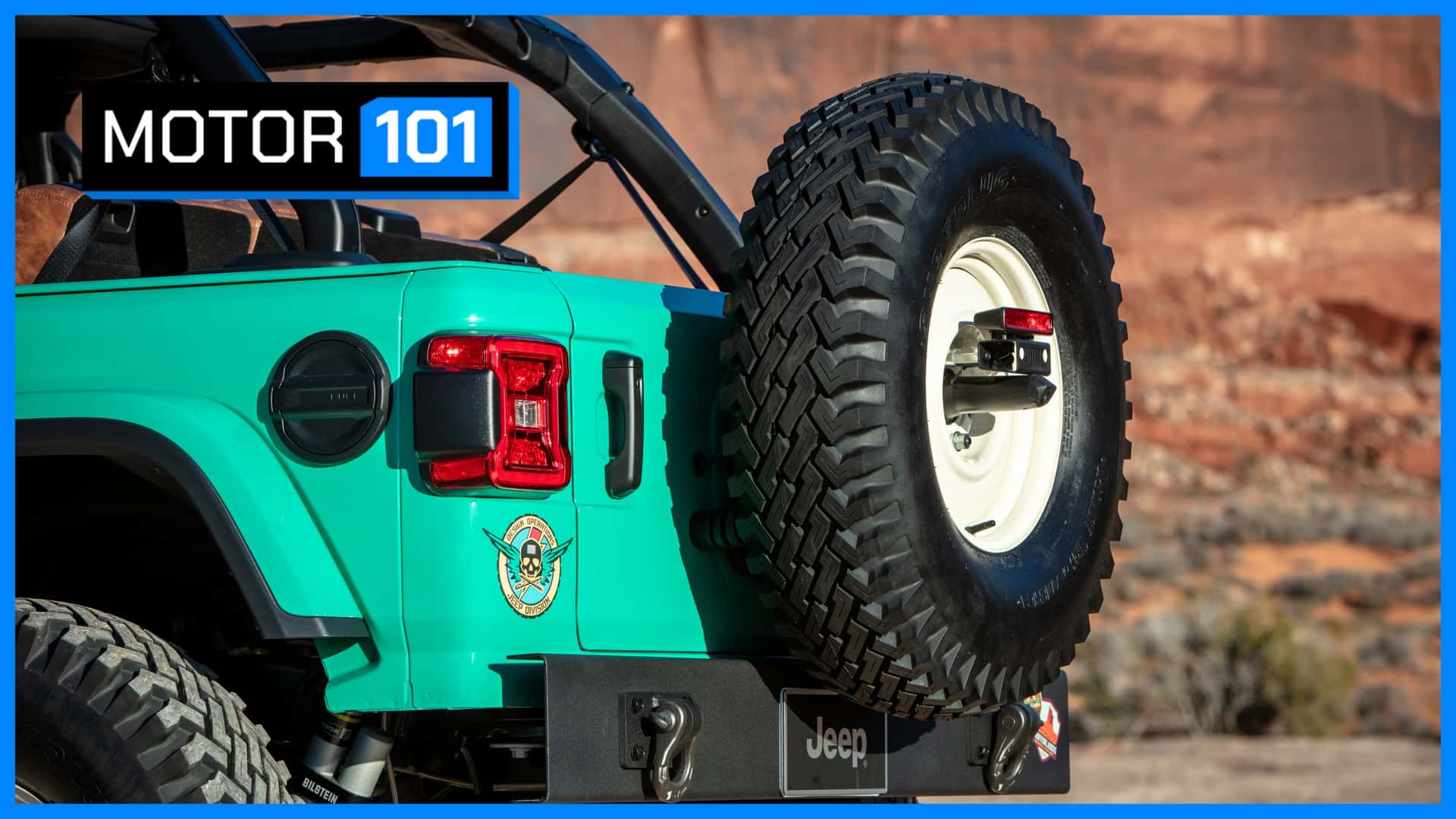
If you picture a rugged SUV, there's a good chance you also picture a big spare wheel hanging off its back. It's a familiar sight on vehicles such as the Jeep Wrangler, Mercedes-Benz G-Class, and some versions of the Land Rover Defender, and for decades it has been closely associated with serious off-roaders.
But that spare wheel is not there just to make an SUV look tougher.

There are some practical reasons manufacturers have historically put a full-size spare outside the vehicle, particularly on vehicles designed to carry people and gear into places where a puncture could be more than a minor inconvenience.
It Frees Up Valuable Space Inside The SUV
One of the simplest reasons for mounting the spare outside is that a full-size wheel takes up a lot of room. Putting it inside the cargo area means sacrificing space that could otherwise be used for luggage, equipment, or additional seating.
Moving the wheel to the rear allows manufacturers to retain that interior space while still carrying a full-size spare. That's particularly useful on off-road vehicles, where a full-size replacement tire can be important rather than relying on a temporary space-saver. Enthusiast discussions about the design frequently point to freeing up luggage space as one of the original reasons for the arrangement.
There's also an accessibility advantage. A spare mounted externally can be easier to reach than one tucked underneath the vehicle, particularly when the SUV is being used off-road. The trade-off is that the wheel itself can be heavy and awkward to remove or reinstall.
A Full-Size Spare Makes More Sense Off-Road
For a serious off-roader, the spare isn't just emergency equipment—it's part of the vehicle's ability to keep going when conditions get difficult.
A full-size spare means the replacement tire can match the vehicle's other tires rather than being a temporary solution intended only to get the driver to a repair shop. That's particularly relevant for four-wheel-drive vehicles, where maintaining appropriately matched tires can matter.
Furthermore, if the spare wheel is placed underneath the vehicle, it can drag, dent, or act as an anchor on steep departure angles or ledges. The higher the ground clearance and the departure angle are, the more capable an off-roader is, so placing the spare wheel on the tailgate makes a lot of sense from this perspective.
There are also packaging advantages to putting that large wheel outside the cabin. Modern off-road tires can be substantial, and storing one inside the vehicle can consume a significant amount of usable cargo space. Some enthusiasts therefore still prefer the external spare despite its drawbacks.
There Are Some Good Reasons To Put The Spare Somewhere Else
A tailgate-mounted spare is not perfect. In fact, the reasons manufacturers are moving away from the design become pretty obvious once you start using the SUV every day.
- It adds weight to the rear door: A full-size wheel and tire can make the tailgate considerably heavier, requiring stronger hinges and supporting hardware
- It can make the tailgate harder to operate: The extra weight is especially noticeable with large off-road tires
- It can obstruct rear visibility: Cameras have reduced this problem, but the spare still occupies part of the driver's rear view
- It adds rear overhang: The spare extends beyond the body, which can matter when maneuvering in tight spaces
- It can complicate cargo access: On vehicles with side-opening rear doors, the spare moves with the door and can require additional clearance behind the SUV
Those compromises become increasingly important as SUVs become heavier, more luxurious and more likely to be used as everyday transportation.
The Spare Wheel Became Part Of The SUV's Identity
There's also a historical reason the design has survived for so long: it became visually associated with rugged vehicles.
The original Jeep military vehicles carried their spares externally, and later generations of Jeeps retained the basic idea. Over time, the exposed spare became an identifying feature of the classic off-road vehicle. Modern examples such as the Wrangler continue that tradition, even though today's vehicles have far more options for storing a spare.
That helps explain why the feature can survive even when an engineer could find another place to put the tire. For many enthusiasts, the spare is not just equipment—it communicates what the vehicle is supposed to be. A rugged SUV with a wheel hanging off the back immediately looks ready for an adventure, whether its owner actually takes it off-road or not.
Drivers Have Plenty To Say About Tailgate-Mounted Spares
Reddit discussions show that the tailgate-mounted spare is more than a styling choice for many off-road owners. In a 2025 r/unpopularopinion thread, one user complained that rear-mounted spares hurt an SUV's appearance and obstruct visibility. Other commenters pushed back, arguing that on vehicles designed for off-road use, accessibility and practicality can matter more than aesthetics.
The weight issue comes up repeatedly, especially when Jeep owners install larger tires. In a 2026 r/JeepWrangler discussion, owners discussed moving spare tires away from the tailgate because of the additional weight. One owner said a tire and wheel could weigh around 150 pounds, while another explained that a bumper-mounted carrier can keep that weight off the tailgate.
Modern SUVs Are Starting To Leave The Spare Behind
The biggest clue that the tailgate-mounted spare is a compromise comes from manufacturers that have started moving the wheel elsewhere.
Mitsubishi recently explained why its new Pajero/Montero moved away from the traditional external spare. The company pointed to the weight added to the tailgate and the resulting need for stronger hinges, along with the fact that many owners use their SUVs as daily drivers. The company also noted that the previous external spare could interfere with the practical use of the rear of the vehicle.
That doesn't mean the rear-mounted spare is disappearing from serious off-roaders. Vehicles such as the Wrangler and G-Class still demonstrate why the layout can make sense. But as SUVs become more focused on comfort, cargo convenience, and powered tailgates, mounting a heavy tire on the rear door becomes harder to justify.
To make a long story short, tailgate-mounted spare wheels are not purely decoration. The design solves a real packaging problem and keeps a full-size spare accessible, but it also adds weight and compromises convenience. What started as a practical solution eventually became one of the clearest visual signatures of the modern off-road SUV, and while some new models are ditching it, it's safe to say hardcore off-roaders will keep it for many years to come.