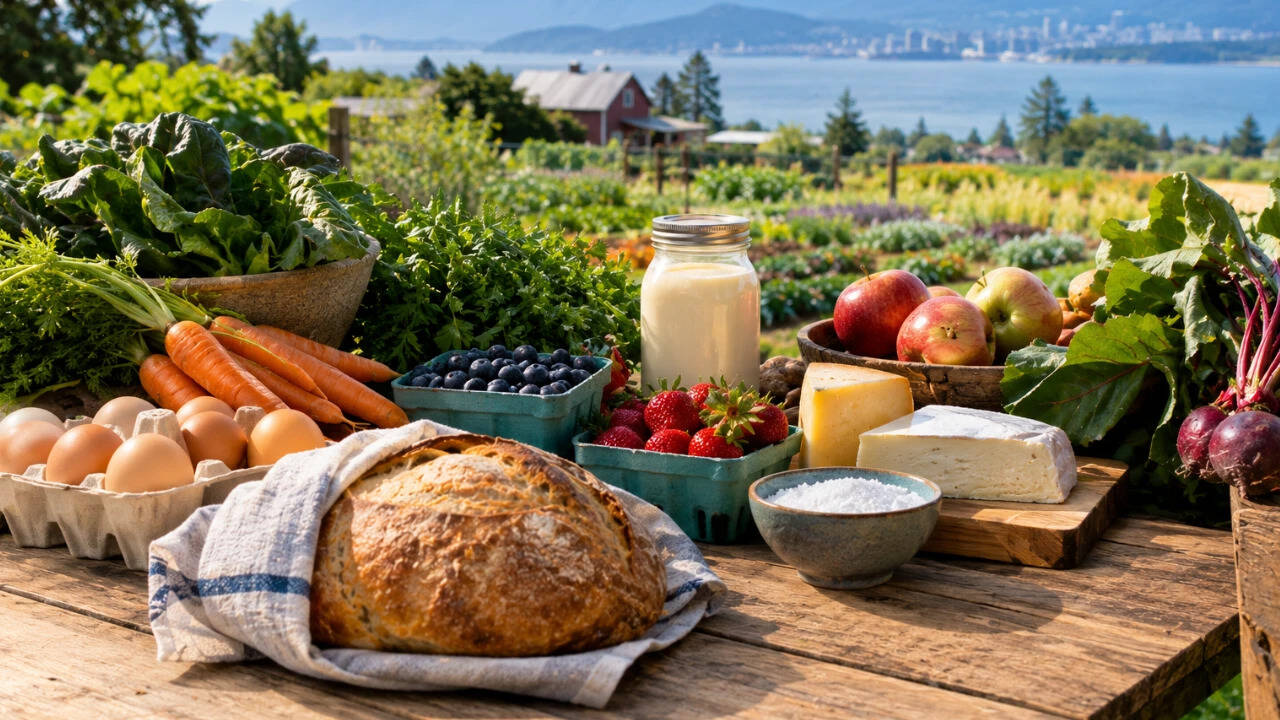
On March 21, 2005, Vancouver writers Alisa Smith and J.B. MacKinnon began a year-long experiment. They would buy food and drink for home consumption only if it had been produced within 100 miles of their Vancouver apartment. Grist reported that they completed the trial on March 20, 2006. The experiment drew heavy media attention. Grist reported that the couple's column about the 100-Mile Diet, first published on TheTyee.ca, attracted about 40,000 readers and was linked, reprinted and blogged about across the internet. "This is what it's like to witness the birth of a movement," MacKinnon said, and the couple soon launched the website 100MileDiet.org. Salt was the one known exception to their rule, and their book ends with a trip to Bamfield, where they boiled down seawater to make their own salt.
Get breaking news anytime, anywhere. Download the TOI app now!

The 100-mile rule, March 21, 2005 to March 20, 2006
Their 100-mile circle was centered on their Vancouver apartment. The Tyee began publishing their series on June 28, 2005, and described it in a 2020 retrospective as a series that sparked a global phenomenon. The same retrospective noted that "locavore" was named 2007 Word of the Year by the New Oxford American Dictionary.
Foods given up: sugar, Cheerios, olive oil, rice and beer
The book's description lists sugar, Cheerios, olive oil, rice, Pizza Pops and beer among the foods the couple did without. A 2008 Washington Post review of their memoir, Plenty, noted that they started with little gardening expertise, little money and little access to grocery stores selling local food. In a 2007 Grist interview, Smith said wheat was a big surprise for her. She explained that locally grown wheat flour was hard to find because wheat was traditionally grown on the West Coast before specialization shifted production to the prairie areas. Until they found locally milled flour, Smith said, they were unintentionally following the Atkins Diet.
They made judgment calls about production methods. Smith said they accepted eggs from the UBC farm because they knew how the hens were raised and fed. MacKinnon said they accepted vegetables from non-organic growers after learning what the growers had applied and when. He also said local seafood was surprisingly difficult to obtain, despite their location at the mouth of a major salmon river. Even so, he called it the most varied year of eating either of them had ever had.
Salt was the one item in their cabinets that did not come from what they called home. The Last Bastille's review noted that the first meal described in the book had only one non-local ingredient, salt from a bag from Oregon, several hundred miles away. In a 2020 interview with The Tyee, MacKinnon said the story ends with a visit to Bamfield, where they boiled seawater to make salt, and that he would now buy salt from Vancouver Island Salt Co. in Black Creek.
Food-miles study, 2008: transport 11 percent of emissions, production 83 percent
The study Food-Miles and the Relative Climate Impacts of Food Choices in the United States, published in Environmental Science & Technology in 2008, reported that food travels 1,640 kilometers (1,020 miles) on average for final delivery and 6,760 kilometers across the life-cycle supply chain. Even so, production accounted for 83 percent of the average American household's food-related greenhouse gas emissions. Transportation as a whole made up 11 percent, and final delivery from producer to retail only 4 percent.
The authors found that shifting less than one day per week's worth of calories from red meat and dairy products to chicken, fish, eggs or a vegetable-based diet would cut more emissions than buying all food locally. The research covered the average American household, not Smith and MacKinnon specifically. Grist noted that the diet began as an effort to reduce dependence on the fossil fuels used by the conventional food system, then grew into an exploration of community, seasons and flavor.
USDA report, 2010: no generally accepted definition of local food
The USDA Economic Research Service report Local Food Systems: Concepts, Impacts, and Issues found no generally accepted definition of local in terms of the distance between production and consumption. The report also found that local food systems made up only a tiny fraction of US agricultural output, even though their share was growing. It noted that small farmers earned more from direct-to-consumer sales than larger farmers did, and it found conflicting evidence on local food's contribution to development, nutrition and greenhouse gas reductions.
Direct sales from farmers to consumers made up only 0.4 percent of all agricultural sales in 2007, a narrow measure of local food. The report identified limits to the sector's growth, including the small capacity of farms and the lack of systems to deliver local foods to traditional markets. Its evidence on the effects of local food on the economy, health and nutrition was inconsistent.
After March 2006: farmers' markets, a community garden plot and winter preserving
Grist reported that after the year the couple planned to keep shopping at farmers' markets, tend their community garden plot and preserve local produce for the winter. MacKinnon said their first meal after the experiment was potatoes and eggs, and that they went out for Indian food later that night. Beer, chocolate, olives, lemons and olive oil returned to their diet, but he said some of the foods they had given up did not come back.