Get all your news in one place.
100's of premium titles.
One app.
Start reading
International Business Times UK
World
Marty Vergel Baes

Xi Jinping's Chinese Underground Christian Churches Crackdown Now Targets Children, Lawyers and Online Worship

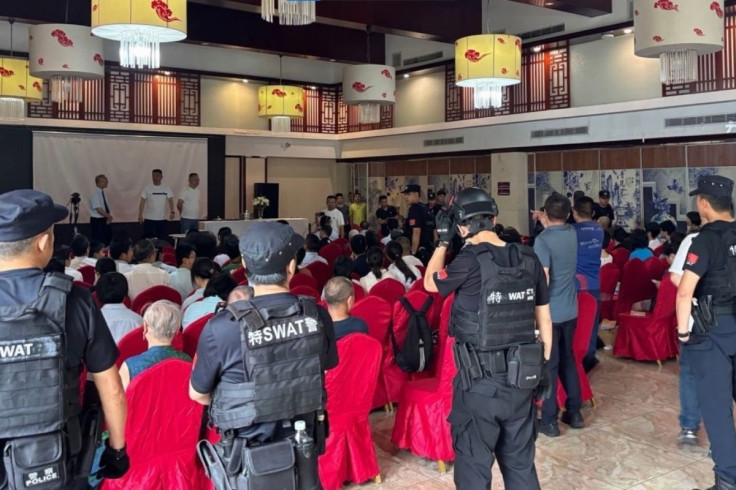
Chinese police raided Early Rain Covenant Church during a Sunday service as part of China's crackdown of undergorund Christian churches. (Credit: China Aid/YouTube)

China's campaign against underground Christian churches has entered a more aggressive phase. Rights groups say the crackdown now extends beyond pastors and church buildings to children attending services, lawyers representing detained Christians, and online worshippers, as President Xi Jinping's government tightens control over religious life under its long-running 'Sinicisation' campaign.

The latest concerns stem from documentation by Amnesty International and Human Rights Watch, which say authorities are broadening enforcement against unregistered 'house churches' across China. Police raids, surveillance and legal restrictions have intensified, while regulations introduced over the past year have sharply limited online preaching and religious education. The measures have drawn renewed international criticism over freedom of religion in the world's second-largest economy.
View this post on Instagram

A post shared by ChinaAid (@chinaaid)

Why Beijing's Campaign Against Underground Churches Is Expanding

China officially recognises five religions, but expects religious organisations to operate within state-approved bodies. Many Protestant 'house churches' and underground Catholic communities reject that arrangement, choosing instead to worship independently of government oversight.

Under Xi Jinping, officials have steadily expanded the policy known as the 'Sinicisation' of religion. Supporters inside the government argue the policy promotes national unity, reduces foreign influence and ensures religious organisations comply with Chinese law. Critics, however, say it has become a mechanism for political control that restricts religious freedom guaranteed under international human rights standards.

The pressure has become increasingly visible through police raids, prolonged surveillance, criminal investigations and the closure of unofficial congregations. High-profile churches such as Beijing's Zion Church and Chengdu's Early Rain Covenant Church have faced repeated enforcement actions over recent years, with several pastors imprisoned or detained.

View this post on Instagram

A post shared by ChinaAid (@chinaaid)

Children, Lawyers, and Digital Worship Are Increasingly Under Pressure

'Over the past year, authorities have intensified control over religious activities through unlawful surveillance, raids and unfair prosecutions under anti-"cult" and security provisions,' Brooks said, adding that the pattern amounted to 'repeated attacks on individuals solely for peacefully exercising their right to religious freedom'.

Human Rights Watch has also documented increasing pressure on underground Catholic communities, saying authorities have sought to persuade or compel clergy to join the state-controlled church while restricting travel, communication and religious education. 'Catholics in China face escalating repression that violates their religious freedoms,' said Yalkun Uluyol, HRW's China researcher.

Beijing, however, has consistently maintained that religious freedom exists in China provided groups comply with national laws. A foreign ministry spokesperson said the government 'oversees religious affairs in accordance with the law and protects citizens' freedom of religious belief and normal religious activities'.

Rights Groups Warn of Growing Restrictions on Religious Freedom

'Over the past year, authorities have intensified control over religious activities through unlawful surveillance, raids and unfair prosecutions under anti-'cult' and security provisions,' Brooks said, adding that the pattern amounted to 'repeated attacks on individuals solely for peacefully exercising their right to religious freedom'.

Human Rights Watch has also documented increasing pressure on underground Catholic communities, saying authorities have sought to persuade or compel clergy to join the state-controlled church while restricting travel, communication and religious education. 'Catholics in China face escalating repression that violates their religious freedoms,' said Yalkun Uluyol, HRW's China researcher.

Beijing, however, has consistently maintained that religious freedom exists in China provided groups comply with national laws. A foreign ministry spokesperson said the government 'oversees religious affairs in accordance with the law and protects citizens' freedom of religious belief and normal religious activities'.

Observers note that the campaign reflects a broader pattern of regulating organisations viewed as operating independently of Communist Party oversight. Whether involving religious groups, lawyers or online communities, critics argue the government's approach increasingly seeks to ensure that every organised social institution remains accountable to the state.

The scale of the pressure is illustrated by the case of Zion Church founder Ezra Jin, who was released from detention in Beihai and arrived in Los Angeles on 4 July 2026 after nearly nine months in custody. However, his daughter says eight members of the church remain detained in China. For millions of Chinese Christians who worship outside officially recognised churches, the latest developments suggest that the pressure is no longer confined to church leaders. As enforcement expands to children, legal advocates and digital ministries, the space for independent religious practice appears to be narrowing even further.

Sign up to read this article
Read news from 100's of titles, curated specifically for you.
Already a member? Sign in here
Related Stories
Top stories on inkl right now
One subscription that gives you access to news from hundreds of sites
Already a member? Sign in here
Our Picks
Fourteen days free
Download the app
One app. One membership.
100+ trusted global sources.