
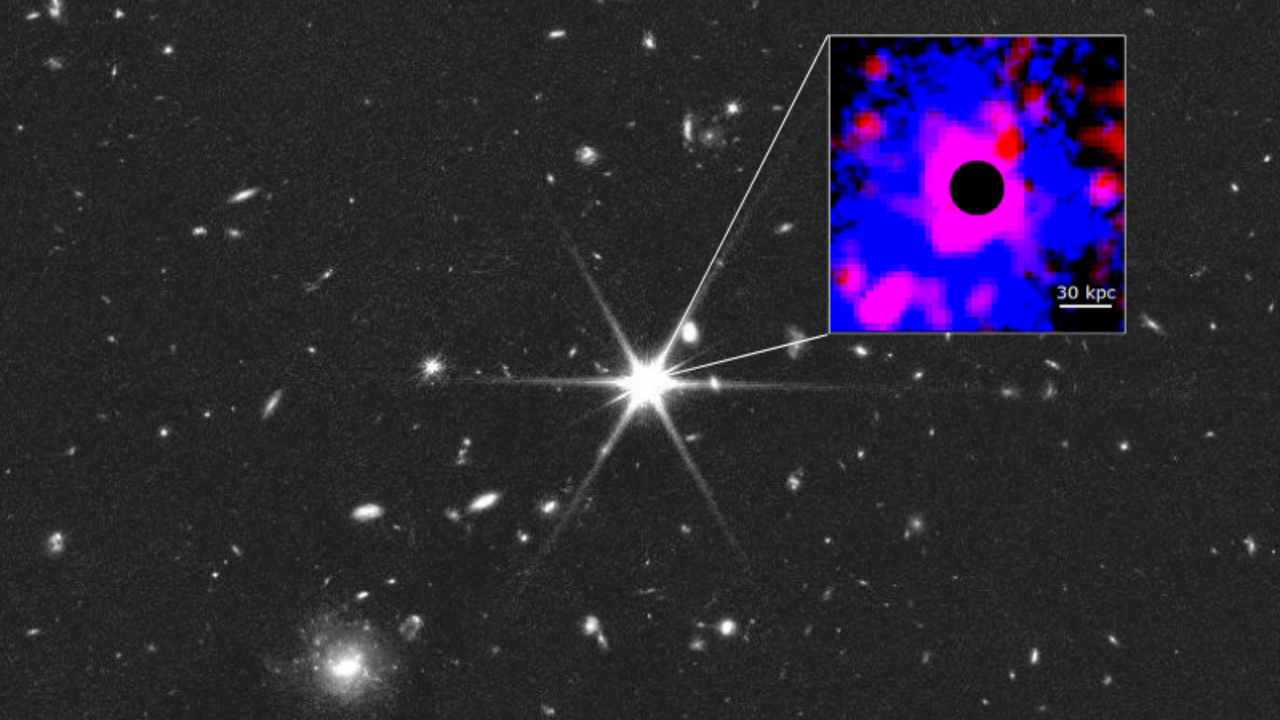
Using NASA's Chandra X-ray space telescope, astronomers have spotted the blisteringly hot exhaust fumes of one the earliest quasars, cosmic "breath" with temperatures as great as 36 million degrees Fahrenheit. This intensely bright titan is powered by a feeding supermassive black hole engine.
The Chandra X-ray telescope observed a relatively silent quasar that existed 2.1 billion years after the Big Bang. The cosmic "exhaust fumes" from this black hole engines extend out for around 100,000 light-years around a quasar at the heart of a still-forming galactic cluster, or "proto-cluster" called MQN01. These blisteringly hot gas structures will eventually become the atmospheres that envelope modern clusters of galaxies, known as the intracluster medium (ICM).