Get all your news in one place.
100's of premium titles.
One app.
Start reading
The Economic Times
The Economic Times

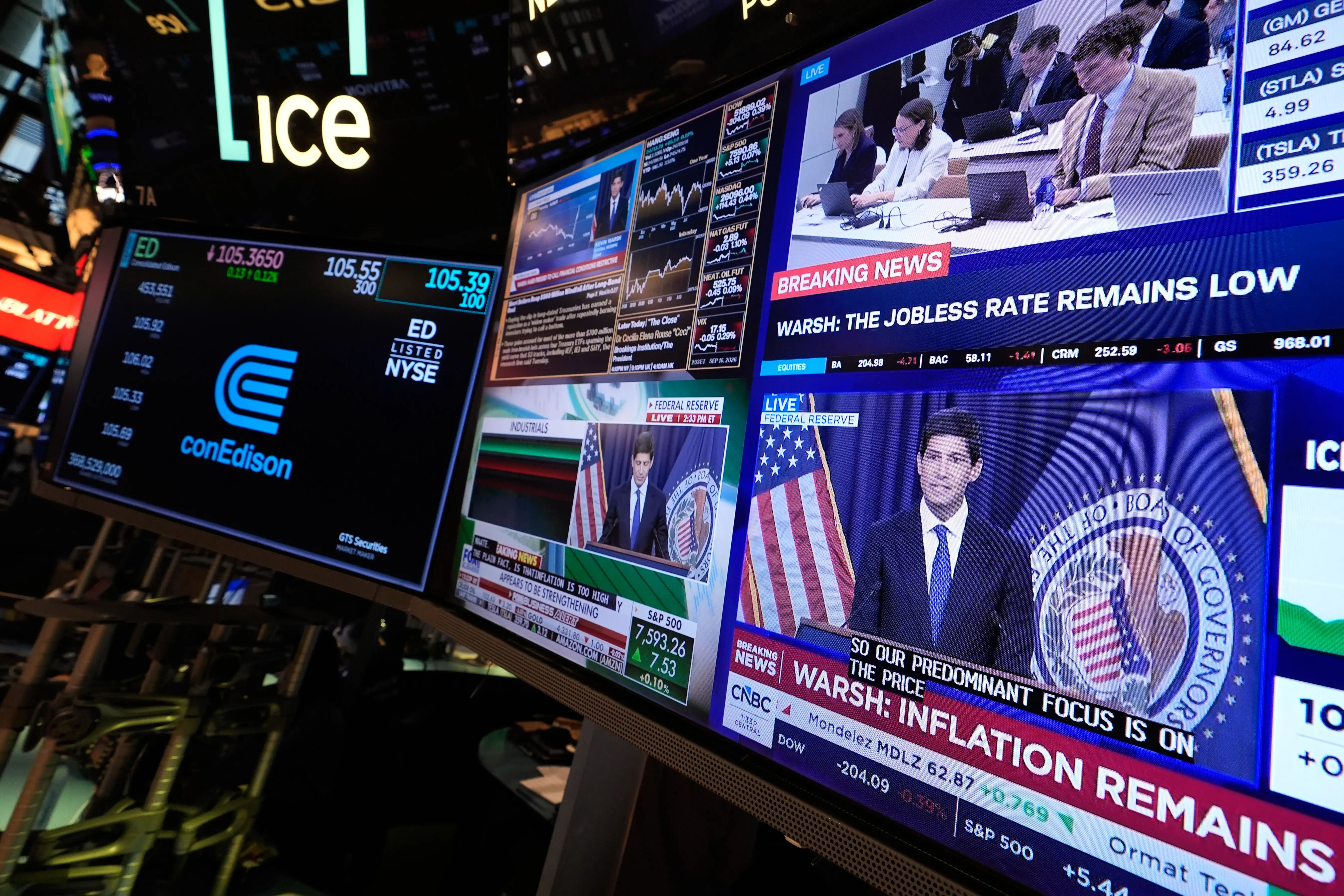
Why US stocks are down: Dow, Nasdaq slide as Iran tensions push oil, yields higher amid Trump-Xi talks

US stocks fell on Thursday as uncertainty over a potential resolution to the Middle East conflict pushed oil prices and Treasury yields higher, weighing on risk appetite as a closely watched US-China summit got underway, Reuters reported.

The Dow Jones Industrial Average was down 208.36 points, or 0.40%, at 51,303.23; the S&P 500 lost 24.04 points, or 0.30%, to 7,681.99 and the Nasdaq Composite fell 159.54 points, or 0.58%, to 26,778.64.

US and Iranian leaders traded barbs at the UN General Assembly this week, sending Brent crude above $100 a barrel. Concerns over a possible ban on US diesel exports also added to investor caution.

Technology stocks led declines on the S&P 500, with chipmakers Nvidia, Broadcom and Micron each falling more than 1%.

Oracle dropped 5.5% after a report said the company had issued a “force majeure” notice to a New Mexico data centre. Shares of Blue Owl, the project’s developer, also declined 5%.

Rising Treasury yields further pressured riskier assets, with the 30-year Treasury yield climbing to its highest level since 2004 as investors priced in the possibility of a prolonged conflict and higher borrowing costs.

“Investors may have been less willing to chase stocks, but they didn’t appear particularly eager to sell either,” said Steve Sosnick, chief market analyst at Interactive Brokers, according to Reuters.

Six of the 11 major sectors on the benchmark index closed in negative territory, though energy stood out with a 1% advance.

The CBOE Volatility Index, sometimes referred to as Wall Street's fear gauge, climbed to a one-week top of 15.7 points.

Attention now shifts to the upcoming summit, where discussions are expected to centre on AI regulation, the Middle East conflict, and Taiwan. Top US executives are also set to meet with Trump and Xi. Separately, Treasury Secretary Scott Bessent said Wednesday that the US and China have agreed to extend their trade truce through January 10.

Rising energy prices, combined with data pointing to robust business activity, pushed investors toward pricing in further Fed rate hikes. The CME Group's FedWatch Tool showed the odds of at least a 25-basis-point increase next month jumping to 71%, up sharply from about 50% just a day earlier.

New York Fed President John Williams, a voting member of the FOMC, reinforced that view, saying it was reasonable to expect additional rate increases before year-end.

On the labour front, weekly jobless claims declined, a sign the job market remains resilient.

In corporate news, Meta Platforms drew attention after unveiling Charm, a handheld device designed to work with its Muse AI assistant; the stock rose 1.1%. MGM Resorts, meanwhile, tumbled 10% after Barry Diller's People Inc. pulled its bid to acquire the casino operator.

Market breadth was weak, with decliners outpacing advancers by a ratio of roughly 1.84-to-1 on the NYSE and 1.73-to-1 on the Nasdaq. The S&P 500 recorded seven new 52-week highs against 20 new lows, while the Nasdaq Composite saw 17 new highs versus 103 new lows.

(Disclaimer: This article is based on inputs from agencies. These do not represent the views of The Economic Times)

Sign up to read this article
Read news from 100's of titles, curated specifically for you.
Already a member? Sign in here
Related Stories
Top stories on inkl right now
Our Picks
Fourteen days free
Download the app
One app. One membership.
100+ trusted global sources.