Get all your news in one place.
100's of premium titles.
One app.
Start reading
The Times of India
The Times of India
World
TOI World Desk

Why this Spanish city has remained in Africa for more than 500 years despite being surrounded by Morocco

Perched on a narrow peninsula on the northern coast of Africa, Ceuta lies just 17 kilometres (11 miles) across the Strait of Gibraltar from mainland Spain. Although it shares an 8-kilometre land border with Morocco, the city has remained under Spanish rule for more than five centuries and is officially part of Spain and the European Union. Its unique position makes Ceuta one of only two land borders between the EU and Africa, while Morocco continues to claim the territory as its own, keeping one of the region's longest-running sovereignty disputes alive.

Get breaking news anytime, anywhere. Download the TOI app now!

Its strategic location has made it both a military stronghold and one of Europe's most heavily fortified borders. High-security fences topped with razor wire separate Ceuta from Morocco, symbolising not only a territorial dispute but also one of the EU's busiest external frontiers. In June 2022, the city came under intense international attention after a mass border crossing attempt ended in tragedy, leaving at least 37 people dead, according to human rights groups and international organisations. The incident renewed global scrutiny of Ceuta's unique political status and the human cost of migration at Europe's borders.

Why Ceuta has remained Spanish territory in Africa for more than 500 years

Ceuta's strategic location has made it a coveted settlement for centuries. The city was successively controlled by the Carthaginians, Romans, Vandals, Byzantines and Arabs before being conquered by Portugal in 1415. It came under Spanish rule when the Portuguese and Spanish crowns were united in 1580.

After Portugal regained its independence in 1640, Ceuta chose to remain loyal to Spain, a decision formally recognised in the Treaty of Lisbon in 1668. As the BBC notes, Ceuta has remained under Spanish sovereignty ever since and today is one of Spain's two autonomous cities on the North African coast, while also forming part of the European Union.

Why Morocco claims Ceuta while Spain insists the city is an integral part of its territory

Despite centuries of Spanish administration, Morocco has never accepted Spain's sovereignty over Ceuta.

After the gaining of freedom by Morocco from France and Spain in 1956, it is the stand of Rabat that Ceuta and Melilla are supposed to be part of Morocco since both cities lie in the African continent.

This view is opposed by Spain which states that Ceuta has belonged to Spain long before the creation of the modern-day Moroccan state. The citizens of Ceuta also claim that their identity is Spanish and want to remain Spanish.

As a result, Ceuta has become one of Europe's longest-running territorial disputes, although both countries continue to cooperate on trade, security and migration despite their disagreement.

How Ceuta became one of the European Union's most heavily fortified external borders

Although Ceuta lies in Africa, it is legally part of the European Union, making its land border with Morocco one of the EU's external frontiers.

To reduce irregular migration, Spain has constructed a sophisticated border system stretching approximately 8 kilometres along the frontier. The barriers consist of double six-metre-high fences, surveillance cameras, motion sensors, floodlights and regular patrols by Spain's Civil Guard.

For many migrants travelling from sub-Saharan Africa, reaching Ceuta represents entry into European territory. Consequently, thousands have attempted to climb the fences or swim around coastal barriers in hopes of reaching the city.

The fortified border has become one of the most recognisable symbols of Europe's efforts to manage migration across its southern frontier.

What happened during the deadly 2022 Ceuta border crossing that shocked the world

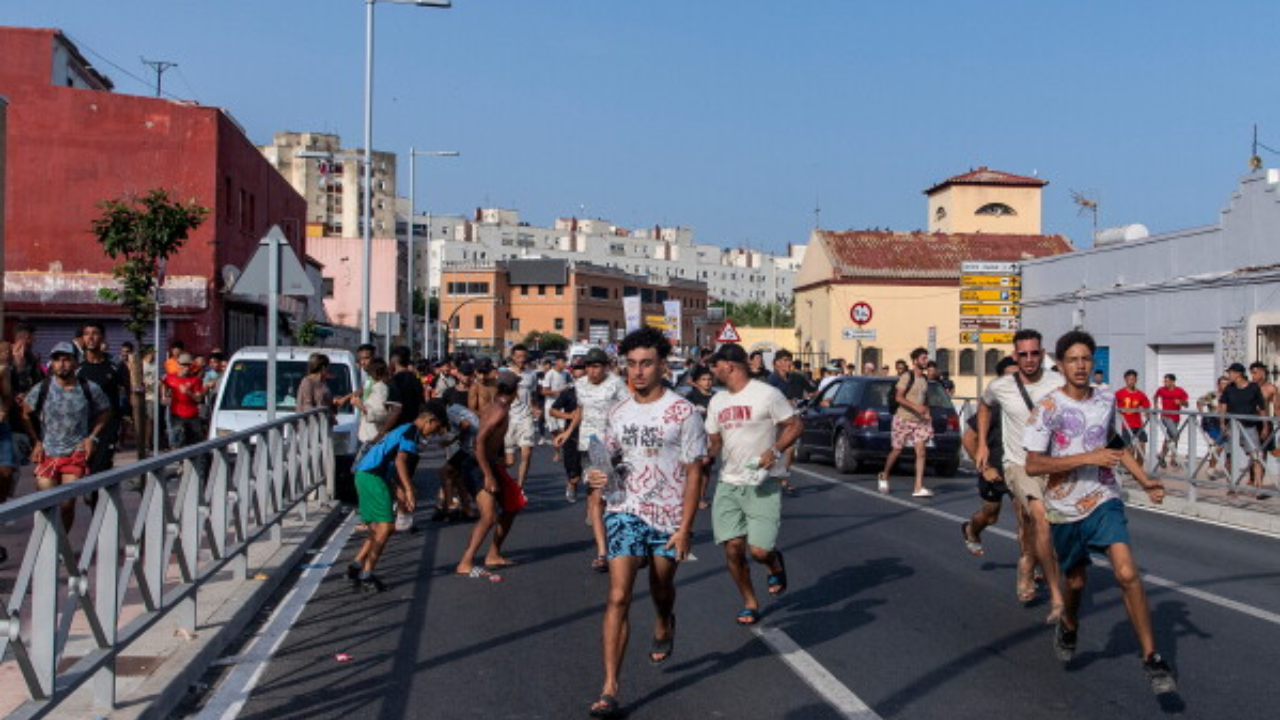
On 24 June 2022, one of the deadliest migration incidents in recent European history unfolded at the Ceuta border. Thousands of migrants, many originating from Sudan and other African countries, attempted to cross from Morocco into Ceuta.

The resulting crush of people at the fenced crossing led to chaos, with security forces from both sides responding as large crowds became trapped in confined spaces.

As quoted by The Guardian, Moroccan authorities reported 23 deaths. With dozens more injured or reported missing. Graphic images from the scene drew widespread international condemnation and prompted investigations by human rights organisations, the United Nations and the European Parliament.

The tragedy highlighted the enormous humanitarian pressures surrounding Europe's external borders and intensified debate over migration policies on both sides of the Mediterranean.

Why Ceuta remains strategically important to both Europe and North Africa

Ceuta's importance extends far beyond its small size. In ‘ Building Fortress Europe? Schengen and the Cases of Ceuta and Melilla ,’ political scientist Jaume Castan Pinos argues that the city occupies a uniquely strategic position because it represents one of the only places where Africa and the European Union meet by land. This has made Ceuta a focal point of EU migration policy, border security and relations with Morocco.

Rather than viewing it simply as a fortified frontier, Castan Pinos suggests that Ceuta functions as a "gated community", a space where strict border controls coexist with continuous economic, social and political interaction between Spain and Morocco. While its fences have become one of the most recognisable symbols of the so-called "Fortress Europe", the border also remains selectively permeable, allowing regulated cross-border movement that is vital to the surrounding region. This delicate balance between security and cooperation has made Ceuta one of the European Union's most strategically significant border territories and a key testing ground for its external border policies.

Why the future of Ceuta continues to shape debates over sovereignty, migration and Europe's borders

Ceuta will continue to be at the heart of the most complicated political disputes in Europe since it has come to represent much more than a land dispute. As pointed out by Jaume Castan Pinos, it represents the point where questions of sovereignty, migration and the integration of Europe meet.

While for Spain, it is a part of its own national territory and also the external border of the European Union, for Morocco, it is a Spanish outpost in Africa that has sovereignty in dispute. The heavily fortified border area of the city also represents the efforts of the European Union to control irregular migration within the context of humanitarian concerns and cooperation across the border.

According to Castan Pinos, it exemplifies the problem of modern European borders that while fortifying themselves against irregular migration, have to stay sufficiently open to conduct economic affairs and diplomacy, along with the normal lives of people on both sides.

Sign up to read this article
Read news from 100's of titles, curated specifically for you.
Already a member? Sign in here
Related Stories
Top stories on inkl right now
One subscription that gives you access to news from hundreds of sites
Already a member? Sign in here
Our Picks
Fourteen days free
Download the app
One app. One membership.
100+ trusted global sources.