Get all your news in one place.
100's of premium titles.
One app.
Start reading
Sports Illustrated
Sports Illustrated
Sport
Kevin Sweeney

Why the NCAA’s New Eligibility Guidelines Have Created Chaos for International Players

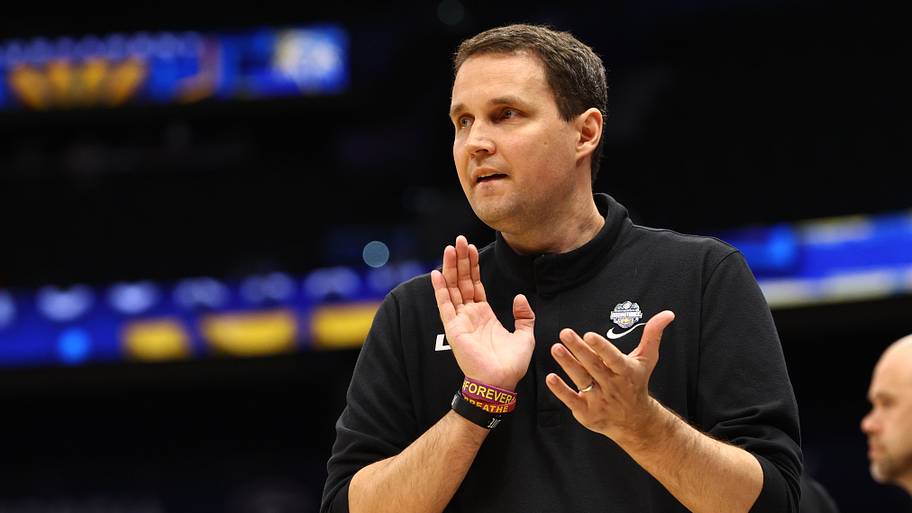
In a winding news conference last week that saw him at one point compare his roster-building tactics to the beginnings of Airbnb and Uber, LSU head coach Will Wade revealed that 23-year-old big man Márcio Santos would not be joining the Tigers after initially committing in the spring. When asked when and why the former Maccabi Tel Aviv forward’s plans changed, Wade grinned.

“You’d have to ask the NCAA on that,” Wade said, sarcasm dripping from his voice. Santos later signed a two-year contract with Spanish club Baskonia, officially ending his college pursuit.
The Santos situation is emblematic of an increasingly common frustration in college basketball circles. Many international prospects who were critical commitments for college teams this spring are still awaiting clearance from the NCAA, with some exhibitions already underway and real games a little more than a month away.

International recruiting has exploded thanks to the rapid increase in compensation available to players at the highest levels of college basketball. Players who previously would never have considered college that had secured strong contracts in top European leagues (like Santos, who was born in Brazil and climbed from the top German league in 2024–25 to the prestigious EuroLeague in ’25–26) wanted to come to the U.S. en masse.

To slow that down, the NCAA published updated eligibility guidance in early May that added additional scrutiny for players who played in certain high-level leagues and reemphasized the organization’s rules regarding compensation above “actual and necessary expenses” from professional teams overseas. The latter part was a notable change given, according to conversations with several coaches who heavily recruit internationally, the NCAA had largely waved through players who earned above that threshold with little to no issue in recent years.

“The Association is modernizing the rule book in several ways to ensure college sports are played by college athletes and not used as a fallback for professional athletes,” an NCAA spokesperson told Sports Illustrated in May.

But making those changes after schools had in large part finalized their rosters and signed those players to lucrative NIL/revenue-sharing contracts left many coaches frustrated, unsure what the impact would be on their respective rosters.

Murray State signed two international players who played professionally in France for the 2025–26 season. Wing Roman Domon had played in the top division of French basketball with BCM Gravelines-Dunkerque, while Mathis Courbon played in the second division with Chorale Roanne Basket. Murray State coach Ryan Miller said those players were pushed through the eligibility process by the NCAA quickly. Domon earned Missouri Valley Rookie of the Year honors, so the Racers doubled down internationally and signed four players this spring from Europe. Talis Soulhac and Jonas Boulefaa played in the French second division (the same league Courbon did), while Pavle Nikolić and Mark Padjen played in the Adriatic League (where several key players at Illinois played prior to college enrollment). Padjen and Soulhac have been cleared (Soulhac only in the last few days), Boulefaa and Nikolić continue to wait. Miller says each made in the ballpark of €30,000 last season, pennies compared to their college earnings potential.

“We were expecting business as usual,” Miller says. “We spent a lot of money recruiting, going overseas. ... We have paid rev-share contracts to these guys under the presumption that business would be as usual. So to have the NCAA send out guidance that directly impacts [that] is kind of disheartening and makes our jobs very difficult.”

Coaches describe a slow-moving, tedious process working with the NCAA eligibility center to get players cleared under the new guidance, with feedback taking weeks or months to receive each time new documentation is presented. Years of player contracts need to be submitted, and if the player earned above what the NCAA deems “actual and necessary expenses” then further vetting is required. One school tells Sports Illustrated they were asked to send more than 70 pages of unredacted bank statements (translated into English by the school) for review. The player in question had earned around €30,000 and had played in his country’s second division; he’ll make around 10 times that in rev share this season. Meanwhile, players who earn far more than that to play at top American prep schools (AJ Dybantsa reportedly received at least $600,000 to play for Utah Prep) don’t face much if any scrutiny.

Another key change was an NCAA crackdown on what are known as “NGB waivers,” an attestation from a player’s national basketball federation that their college enrollment was delayed as part of national team obligations. The practical implication of the waiver is essentially giving players an extra year in their window of college eligibility. The new NGB waiver guidelines are far more stringent and have caused problems for other older players looking to enroll in college. For instance, 24-year-old Boris Tisma, a Washington commit, recently was ruled ineligible by the NCAA and is now headed back to Europe to play in Spain.

Another 24-year-old still waiting on clearance is Auburn’s Mantas Rubštavičius, who last played with Žalgiris in Lithuania. Auburn coach Steven Pearl says Rubštavičius’s age has been the primary sticking point, something that the NGB waiver would’ve mitigated.

“He was a perfect candidate for [an NGB waiver] given the criteria that had been allowed in the past,” Pearl says.

Also in limbo at Auburn is French big man Narcisse Ngoy, who made headlines this summer when he was surprisingly drafted in the second round by the Clippers. As a 22-year-old international player, Ngoy was automatically eligible for the NBA draft despite already committing to Auburn, and Ngoy indicated immediately he had no plans of heading to the NBA. The Clippers can hold his rights while in college, making him the first college “draft-and-stash” player. Ngoy has yet to be cleared by the NCAA, but his draft status isn’t expected to play a role in whether he’s eligible. He’s situated similarly to others who played pro in France; Ngoy played this past season with Poitiers in the second division.

“We feel good because we recruited, committed and signed [both guys] before that May 8 guidance came out,” Pearl says. “We don’t feel like they should be retroactively punished because we did what anyone would’ve done in our situation and made sure that there were other student-athletes that are playing in college currently that had very similar profiles. I support the direction the NCAA is heading with these new rules and guidelines, but not at the expense of our current student-athletes who would have been eligible under the rules in place just last year.”

There’ve been recent signs that the NCAA’s resistance could be waning. Gonzaga recently got 23-year-old French point guard Nathan De Sousa cleared by the NCAA last week after he played in the top league in France last season, while Arkansas forward Miikka Muurinen recently received eligibility after playing with EuroLeague club KK Partizan in Serbia last year. Other key players who’ve been cleared include 24-year-old Nolan Adekunle (Virginia), 23-year-old Juan Fernández (South Carolina) and 22-year-old Domen Petrovic (Florida).

But other key players remain without answers. Quinn Ellis, who signed at St. John’s for a reported sum north of $4 million, hasn’t been cleared yet after being a starter for EuroLeague club Olimpia Milano last season. Three LSU international prospects (Saliou Niang, Michael Ružić and Brice Dessert) hired attorney Don Jackson to prepare a legal battle against the NCAA should they not be cleared. And other key prospects have essentially abandoned NCAA pursuits due to eligibility issues, such as Utah’s Noam Yaacov, BYU’s Jakub Urbaniak and Arizona’s Bakary Dibba.

All this comes as international athletes in college sports have increasingly become a political issue. Earlier in September, Senators Tommy Tuberville (R-Ala.) and Jon Husted (R-Ohio) introduced the TEAM USA Act, which would cap the percentage of international students on a college roster at 20%. The bill, which would be hugely damaging in many nonrevenue sports where international student-athletes are often paying their own tuition to play, illustrates the thorny environment for those athletes weighing college options right now.

While that bill is a ways away from a vote, time is of the essence from a competitive balance standpoint for schools to get answers on many of these key players still awaiting a decision from the NCAA. With college basketball’s expanded preseason, coaches are hoping to get early looks at their complete rosters in the coming days in exhibitions. That means anxiety for final answers is on the rise. But in an offseason that has featured unprecedented roster uncertainty due to the age-based eligibility lawsuits that have dominated the sport’s news cycle all summer, not knowing who is or isn’t eligible just days before games tip off may be a new (albeit unsettling) normal.


MORE COLLEGE BASKETBALL FROM SPORTS ILLUSTRATED

Sign up to read this article
Read news from 100's of titles, curated specifically for you.
Already a member? Sign in here
Related Stories
Top stories on inkl right now
One subscription that gives you access to news from hundreds of sites
Already a member? Sign in here
Our Picks
Fourteen days free
Download the app
One app. One membership.
100+ trusted global sources.