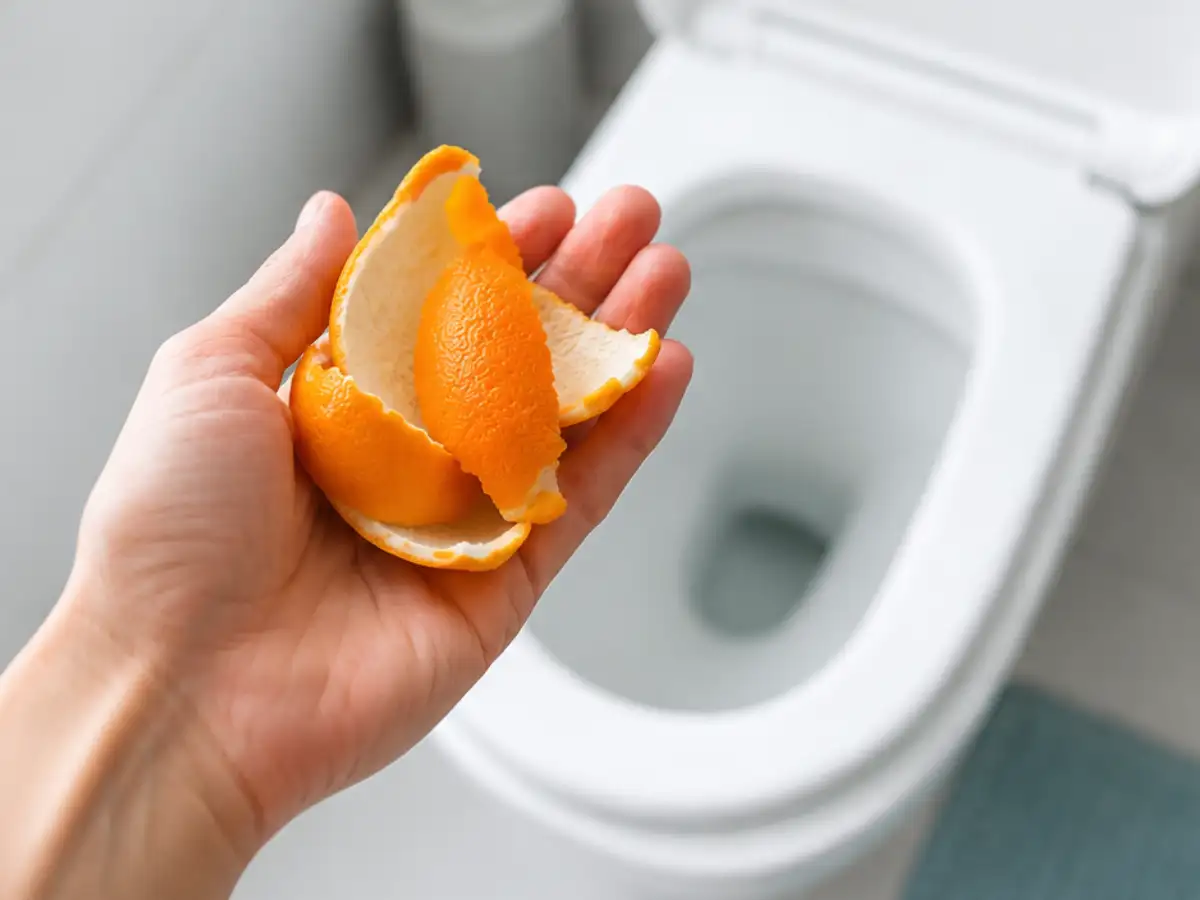
If you’ve been seeing a lot of orange peel toilet hacks on your For You Page lately, you’re not alone. The trend is simple: drop a few pieces of orange peel in the toilet bowl, let them sit for a while, and flush. People swear it makes the bathroom smell fresher and never needs a single squirt of bleach or chemical spray.
There is real science behind why this works. According to research, ‘Journey of Limonene as an Antimicrobial Agent,’ published in the Journal of Pure and Applied Microbiology, orange peels contain a natural compound called limonene, the same oil that gives that sharp, sunny citrus scent. Researchers reviewed several studies and found that limonene does not just smell good; it also has measurable antimicrobial properties, meaning it can help fight some of the bacteria associated with odors.

The review points to earlier lab work showing that limonene is especially effective against common food-borne and respiratory pathogens, and that its efficacy is greatest in a concentrated or purified form rather than as a vague “citrus smell.” It also notes a recurring theme in the literature: limonene is being studied not as a standalone cure, but as a low-toxicity compound that may help to slow down microbial growth and biofilm formation.
That’s a big part of why this kitchen scrap has become a practical cleaning hack, not just another wellness myth.
The chemistry behind that fresh citrus smell
Limonene is what is known as a monoterpene, a natural oil produced by citrus fruits, mostly in their peels. The limonene begins to off-gas as the peel gets wet when it is soaked or left in toilet water. This oil gives an instant feeling of freshness, because it covers other smells in the room for a while.