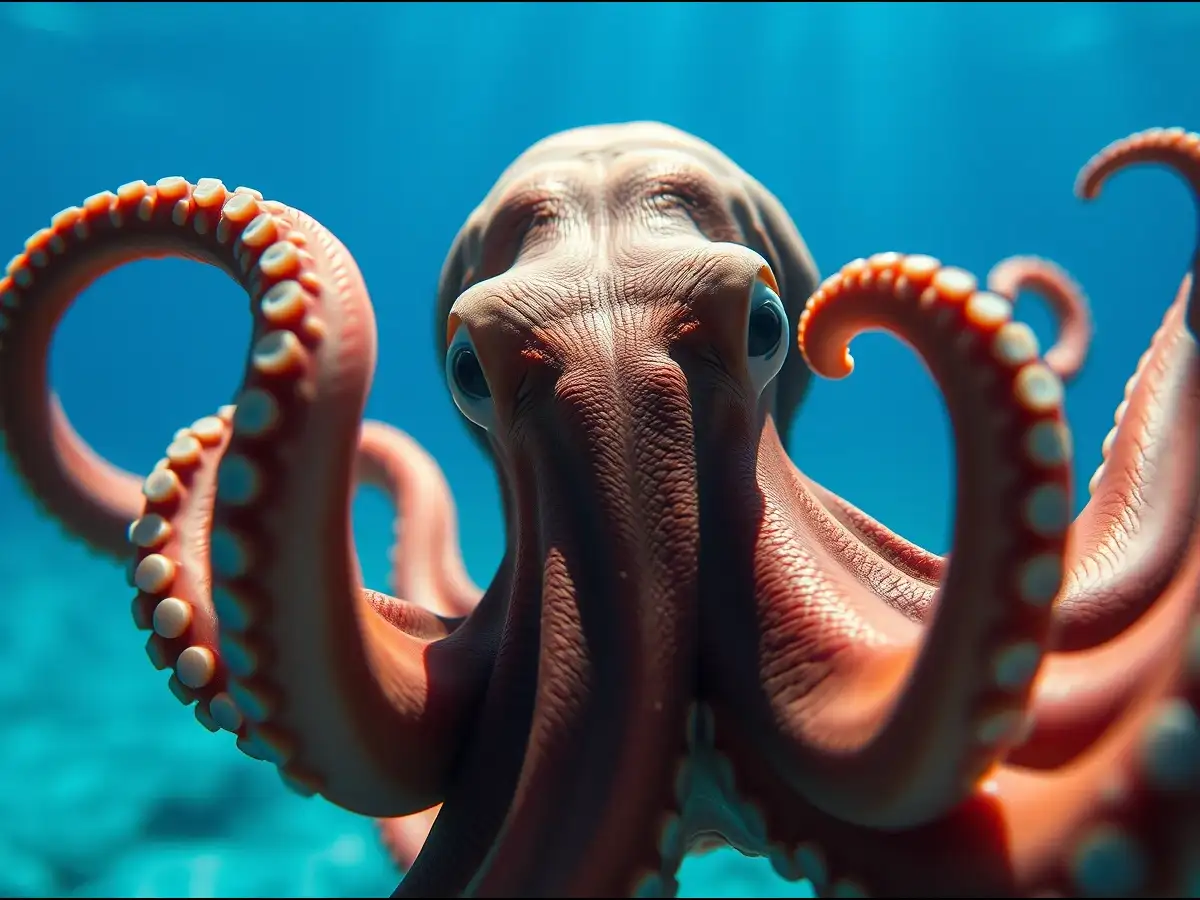
An octopus may rest upon a piece of coral or blend into the sand or the surface of a rock by changing its skin almost instantly. This camouflage is highly accurate, involving not only colour changes but also changes in the texture of the skin.
There is, however, one very curious puzzle behind this well-known phenomenon: octopuses seem to perceive colours differently from humans.

This has been the subject of numerous studies.
If an octopus does not experience colour as humans do, how can it produce such carefully matched camouflage? The answer is more complicated than simply saying that octopuses “see” their surroundings and copy them.
Their skin contains several types of specialised cells, their nervous system can control those cells with extraordinary speed, and their eyes process visual information in a way that differs substantially from ours.
The result is one of the more unusual sensory puzzles in animal biology.
Their skin works like a sophisticated biological display
An octopus does not rely on one mechanism to hide.
Its skin is equipped with special organs that enable it to change its appearance in various ways.
Chromatophores carry pigments and can either expand or contract in order to form certain patterns. Some other organs that help in reflecting and scattering light include iridophores and leucophores. It is through these mechanisms that the octopus can create certain combinations of colour, brightness, and contrast similar to the environment.
The animal can also change the physical appearance of its skin. Muscles attached to structures called papillae can raise portions of the skin, creating bumps and ridges. A relatively smooth animal can therefore take on a much rougher appearance when it settles against a textured surface.
This matters because camouflage is not simply about matching a colour. A convincing disguise also depends on edges, shadows, patterns, brightness and surface texture.
For an octopus hiding on the seafloor, all of those details can make the difference between remaining unnoticed and becoming an easy target.
The colour mystery begins with their unusual eyes
Humans have three main types of cone cells that allow us to distinguish a broad range of colours. Octopuses have a very different visual system.
Their eyes are highly developed and are excellent at detecting light, contrast and patterns, but most octopuses are thought to have monochromatic vision , meaning their visual system does not distinguish colours in the same way that a human eye does.
That creates the apparent contradiction.
The animal can produce elaborate colour patterns despite lacking the kind of colour vision humans use to identify red, green or blue objects.
Scientists have proposed several explanations. One possibility involves the way light interacts with the octopus's environment and its skin. Another line of research has examined whether the animal might obtain information about colour indirectly through optical effects that are different from conventional colour vision.
There is also evidence that the unusual shape and structure of the octopus pupil could provide information that helps with aspects of visual processing.
None of this means the octopus simply “sees nothing” in terms of colour. Rather, its visual experience may be fundamentally different from ours.
That distinction is important. Scientists know a great deal about the machinery responsible for camouflage, but understanding exactly how visual information is converted into the final skin pattern remains an active area of research.
Its nervous system can turn perception into camouflage almost instantly
The speed of an octopus's camouflage is another part of the puzzle.
Many animals alter their appearance through physiological processes influenced by hormones. Octopus camouflage is different. Much of the control is handled directly by the nervous system, allowing changes to occur extremely rapidly.
Signals from the brain can control networks of muscles and specialised skin cells, coordinating patterns across the body.
The octopus also has an unusually distributed nervous system. A considerable number of its neurons exist in parts of its body other than the central brain, including many in connection with its arms.
Those arms are not simply extensions which wait for commands; there exists complicated neural circuitry within them which enables them to react to their environment.
This setup makes for a very different kind of interconnection between sensation, motion, and decision-making.
When the octopus perceives a threat, several functions may be simultaneously performed; vision detects stimuli, the nervous system interprets the environment, and messages are relayed to its skin to change its appearance.
The striking part is not merely that the animal changes colour. It is that an entire visual pattern can be assembled with remarkable speed.
Scientists know the machinery, but not every step of the disguise
The issue of camouflage in octopuses is less about whether octopuses can change colours; there is plenty of proof of that—but rather about how their sensory apparatus chooses what colour to create.
Scientists are able to conduct research on the chromatophores, trace the neural pathways and see what the octopus does when exposed to different background colours.
The mystery remains deeper inside.
What exactly does the animal extract from the visual scene? How does it distinguish useful information from irrelevant detail? How is that information translated into a pattern involving thousands of independently controlled skin elements?
But above all, how does an animal with an unusual type of colour vision manage to produce something which comes so close to colour matching?
Perhaps the answer will one day reveal that advanced camouflage does not need an animal to see things the way we do.
This is why the octopus is a fascinating creature to study from a sensory point of view. Its camouflage is not a deception produced by the skin. It is the output of a precisely balanced process which involves vision, nervous processing, muscles, and special cells.
The octopus does not necessarily perceive the colourful surroundings of a reef the same way as a human diver would. But somehow, it can react to them with incredible accuracy.
FAQ
1. Do octopuses have colour vision?Most octopuses are monochromatic in that they cannot see colours like humans do; they have exceptional eyesight that helps detect light and contrast, but research is being conducted on how they get the data necessary for camouflage.
2. How do octopuses manage to change colours quickly?
They employ a skin mechanism named chromatophores, together with iridophores and leucophores, which are other mechanisms reflecting light. Through the use of nerve impulses, this can be done within a very short period of time.
3. Can octopuses change their skin texture too?
Yes, muscular projections known as papillae make the skin change texture, giving it bumps and other patterns similar to rocks or corals in the vicinity.
4. Are scientists aware of how octopuses decide on the camouflage pattern?
Yes, the biological processes are known to scientists. However, exactly how visual information is transformed into a precise colour and pattern response remains an area of ongoing research.