“शिवो हरिर्हरिः शिवः”
Shiva and Vishnu are not separate. They are two forms of the same divine truth.
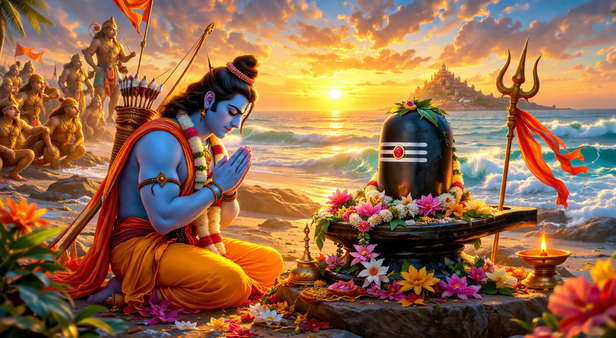
Before the great war of Lanka began, when the ocean stood in front of him and Ravana waited on the other side, Lord Rama did something that surprises many people even today. Instead of immediately preparing for battle, he stopped to worship Lord Shiva.
For many people, this moment raises an important question. If Lord Rama himself was an avatar of Lord Vishnu, why did he worship Lord Shiva?
The answer lies not just in religion, but in the deeper values of humility, devotion, and dharma. Lord Rama's worship of Shiva before going to Lanka was not an act of weakness. It was an act of wisdom, surrender, and respect for the divine order.
1. Lord Rama Wanted Divine Blessings Before War
The battle against Ravana was not an ordinary war. Ravana was one of the most powerful kings in the world, blessed with immense knowledge, strength, and boons from the gods. He was also a great devotee of Lord Shiva.
Lord Rama understood that defeating Ravana would require more than physical strength and military strategy. He knew that when the battle is against adharma, divine blessings become necessary.
According to tradition, Lord Rama stopped at Rameshwaram and prayed to Lord Shiva before beginning the journey to Lanka. He wanted Shiva's blessings for victory, protection, and success in restoring dharma. Many texts and traditions mention that Shiva blessed Rama before the war.
2. It Showed That No One Is Above Humility
One of the greatest lessons from this story is humility.
Lord Rama was not just a king or warrior. He was Vishnu himself in human form. Yet, even with all his power, he did not think he was above worship, prayer, or seeking blessings.
This is why Rama is called Maryada Purushottam. He always followed the ideal path, even when he had the power to do otherwise. By worshipping Lord Shiva, Rama showed that true greatness comes from humility, not ego.
Even today, many people remember this moment because it teaches that before beginning any major task, whether it is a new job, marriage, business, or difficult challenge, seeking blessings and staying humble is important.
3. Rama Wanted To Respect Shiva, Ravana's Ishta Devta
Ravana was one of the biggest devotees of Lord Shiva. He had performed severe penance and received great powers because of Shiva's blessings. In fact, many stories describe Ravana as a brilliant scholar and a powerful Shiva bhakt.
Before going into battle against such a devotee, Rama first bowed to Lord Shiva. This act had a deep spiritual meaning. Rama was not fighting Ravana because of personal hatred. He was fighting against Ravana's wrong actions.
By worshipping Shiva, Rama made it clear that this war was not against devotion or religion. It was against arrogance, kidnapping, injustice, and misuse of power.
This is one reason why the Ramayana is seen not just as a story of war, but as a lesson in righteousness and balance.
4. The Shivling At Rameshwaram Became Sacred Forever
One of the most famous parts of this story is the स्थापना of the Shivling at Rameshwaram.
According to popular belief, Lord Rama asked Hanuman to bring a Shivling from Kailash for worship. But Hanuman took time to return. Since the auspicious time for worship was approaching, Sita made a Shivling out of sand near the seashore, and Rama worshipped it. This lingam later became known as Ramanathaswamy or Rameshwaram Jyotirlinga.
The name Rameshwaram itself means “Lord of Rama.” It became one of the holiest pilgrimage sites in India and is counted among the twelve Jyotirlingas of Lord Shiva. Even today, lakhs of devotees visit Rameshwaram because it is believed to carry the blessings of both Lord Rama and Lord Shiva.
5. The Story Symbolises Unity Between Shiva And Vishnu
Many people see Shiva and Vishnu as different, but Hindu philosophy often teaches that they are different forms of the same supreme reality.
The story of Rama worshipping Shiva beautifully shows this unity. Shiva is often shown chanting Rama's name, while Rama is shown worshipping Shiva. Both respect and honor each other.
This is why many saints say there should never be division between Shiva devotees and Vishnu devotees. The two are connected deeply.
The famous phrase “Ram ke Shiv aur Shiv ke Ram” reflects this bond. Shiva is incomplete without Rama, and Rama is incomplete without Shiva in the hearts of devotees.
This story teaches that the divine does not divide. Humans divide. The gods themselves show harmony, respect, and oneness.
6. Different Traditions Tell The Story In Different Ways
There are different versions of this event in different scriptures and traditions.
Some versions say Lord Rama worshipped Shiva before the war to gain victory. Other versions say he worshipped Shiva after killing Ravana to seek forgiveness for taking the life of a Brahmin king, because Ravana was born into a Brahmin family. Some later texts and Puranas describe the स्थापना of the Shivling in greater detail.
Valmiki Ramayana does not directly describe the full story in the same way later traditions do, but it does mention that Lord Shiva blessed Rama before the war near the ocean. Later scriptures like Adhyatma Ramayana, Shiva Purana, and Skanda Purana expand this story further.
Because of this, the story has become an important part of Hindu belief and devotion across India.