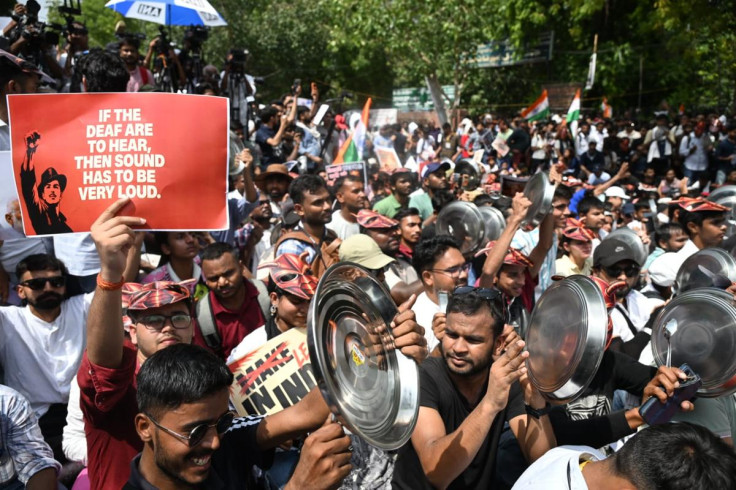
Thousands of protesters flooded the streets of Delhi on Monday in one of the largest anti-government demonstrations seen in India in recent years, demanding the resignation of Education Minister Dharmendra Pradhan over repeated exam paper leaks and alleged failures in the country's education system.
Despite police refusing permission for the march, imposing a ban on public gatherings, barricading roads and shutting down the internet in central Delhi, demonstrators gathered in their thousands and attempted to march towards parliament.
The protest was organised by the Cockroach Janta Party (CJP), a youth-led political movement that began as satire but has quickly grown into a force attracting students and young people frustrated by exam scandals, limited job opportunities and what they describe as a government unwilling to listen.
Protesters also condemned the treatment of education activist Sonam Wangchuk, whose hunger strike became a rallying point for the movement.
Education Crisis and Youth Anger
Large crowds, made up mainly of students and Gen Z protesters, began gathering in central Delhi from early Monday morning, with hundreds having camped overnight ahead of the march. Their central demand was for Education Minister Dharmendra Pradhan to step down following another medical entrance exam leak, which forced more than two million candidates to prepare for retaking one of India's toughest examinations after it was scrapped.
The controversy has fuelled anger among young people, with protesters linking the exam fiasco to more than 20 student suicides. Many argued the government had failed to protect students from repeated failures within the education system while offering little accountability.
Attempts by demonstrators to move towards parliament were met with police action, including batons and teargas. Authorities had already denied permission for the march, banned public gatherings and blocked roads across the city, while internet services in central Delhi were suspended.
Twenty-two-year-old Rhythm Katoch rejected accusations that the protest was unlawful.
'They are calling this protest illegal, they are calling us anti-national,' Katoch said. 'But I am 22 years old and I am standing here to fight for our education system, for the rights of the young people and for our democracy. Is it too much to ask for the government to listen to us?'
Among those marching was 18-year-old Harion Sharma, who was forced to retake the medical entrance examination after it was cancelled because of the leak.
'This is a government that does not care about education, it does not care about the pressures and pain of young people,' Sharma said. 'Because of those leaks, students have died. So we are here to call for accountability and for the education minister to resign. We are young but we are powerful.'
The Cockroach Janta Party was founded in May by graduate Abhijeet Dipke as a satirical movement but has rapidly attracted support from young Indians frustrated with the education system and employment prospects. For weeks, supporters had maintained a protest camp less than a mile from parliament, although the government had largely ignored their demands.
Wangchuk Hunger Strike Adds Pressure
The demonstrations gained further momentum after engineer and education activist Sonam Wangchuk began a hunger strike in support of students, refusing food and water for 21 days while demanding that Pradhan resign.
Public anger increased after Delhi police removed Wangchuk on Sunday morning. Footage of officers taking him away spread widely, with Wangchuk later claiming he was being 'held hostage' at a government hospital.
His wife, Gitanjali Angmo, criticised the police presence surrounding him.
'It is not medical care,' she said. 'It is illegal detention.'
Following Wangchuk's removal, organisers of the Cockroach Janta Party also launched a hunger strike and urged supporters to join Monday's march. Wangchuk described the demonstration as 'India's second freedom movement'.
Amrita, 27, said she had taken time off work to attend the protest because of how Wangchuk had been treated.
'We have a coward government who is afraid of the young people and afraid of Sonam Wangchuk,' she said. 'He is a brilliant brain, and he has put his life on the line for young people. How he is being treated is a shame on India. That's why the Gen Zs have come out today to speak out.'
The large turnout appeared to force a response from the government. After previously dismissing the protesters and with Pradhan describing CJP supporters as 'terrorists', the Modi government invited several representatives from the movement for talks.
Before the march began, Wangchuk said he would end his hunger strike if the government accepted accountability for what he called failures in the education system, addressed the issue of exam leaks in parliament and sent senior political leaders to meet him in hospital.
By Monday afternoon, those conditions had not been accepted by the BJP government, and Prime Minister Narendra Modi had already left parliament for the day. The protesters, however, made clear they intended to continue pressing for accountability, insisting that young people had shown they were prepared to take to the streets in large numbers despite restrictions and police action.