Get all your news in one place.
100's of premium titles.
One app.
Start reading
Cycling News
Cycling News
Sport
Patrick Fletcher

Why going in the breakaway is actually a crafty way to beat the heat at the Tour de France

Breakaways Mathias Vacek, Jan Tratnik and Alex Kirsch during stage 4 of the 2026 Tour de France.

In temperatures that push towards the 40-Celsius mark, the peloton might seem to be the safest place to be, staying in the wheels and avoiding any over-exertion in the Tour de France furnace.

Attacking to get in the breakaway and then racing full-gas for the stage win, by contrast, might have seemed like a daunting prospect as the riders filled their jerseys with ice in an already-sweltering Carcassonne at the start of stage 4.
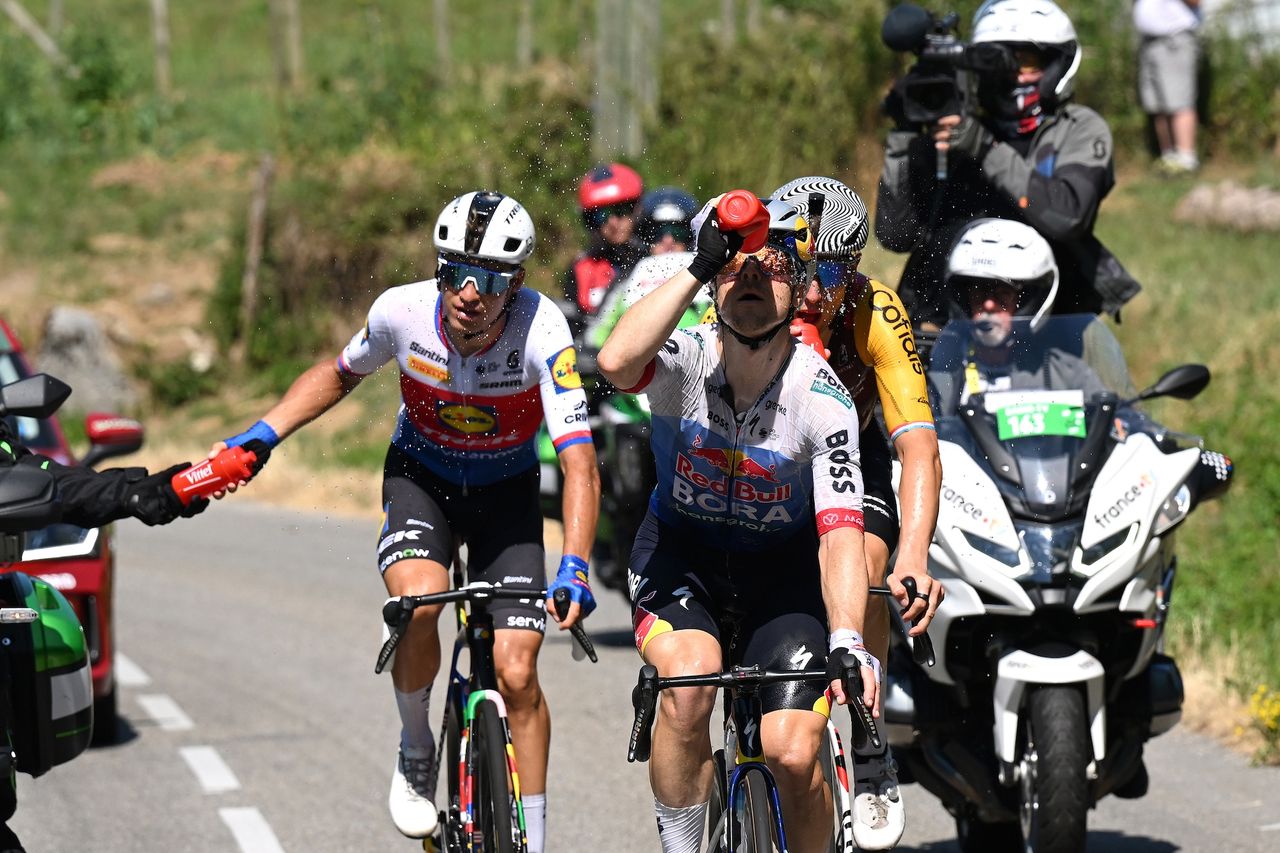
However, the opposite might just be true, as the eventual winner Mads Pedersen explained.

“[The heat] is really tough for sure but actually being in the breakaway it’s a bit easier, because you have the car close to you the whole time,” the Lidl-Trek rider said after pulling on the green jersey.

The car he’s referring to is his Lidl-Trek team vehicle, which help supply riders with food, drinks, and mechanical assistance. Teams have two cars in the race and if a rider makes it into the breakaway, that team is allowed to send one of their cars up the road to drive directly behind the break.

All other team cars drive in convoy behind the peloton, in order of the general classification, so if you’re in the peloton and you call for assistance, it can take a long time just for the car to move up through the convoy.

Then, the riders potentially have to drop from the front to the back of what can be a long peloton just to receive any supplies, before then having to move back up through the bunch.

Up in the breakaway, meanwhile, there are fewer riders and fewer teams represented, meaning the cars are much closer at hand. There are also dedicated hydration motorbikes from water sponsor Vittel.

“Honestly, being in the breakaway with the cars that close all time, that makes it easier to cool down,” Pedersen said.

“You can all the time go back to pick up water and ice, so it makes it easier to have the car that close. So when it’s warm it’s nice to be in the break.”

Pedersen did also note that he had the added advantage of having two teammates in the break, who could largely do that work on his behalf. It was also not lost on him the way Mathias Vacek and Quinn Simmons expertly controlled the break to tee up his stage win.

“When talking about a team effort it’s not just on the bike - there were so many people on the road with water and ice to cool down. We went through a few bottles today but it definitely helps to have a good team," he concluded.

The world’s biggest bike race deserves world-class coverage. Subscribe to Cyclingnews for unlimited access to our unrivalled reporting of the 2026 Tour de France. From Barcelona through to Paris, our experienced team will bring you breaking news, expert insight, and in-depth coverage from every stage as the battle for the yellow jersey plays out. Plus, access the Cyclingnews app to follow the action on the go! Find out more.

Sign up to read this article
Read news from 100's of titles, curated specifically for you.
Already a member? Sign in here
Related Stories
Top stories on inkl right now
One subscription that gives you access to news from hundreds of sites
Already a member? Sign in here
Our Picks
Fourteen days free
Download the app
One app. One membership.
100+ trusted global sources.