
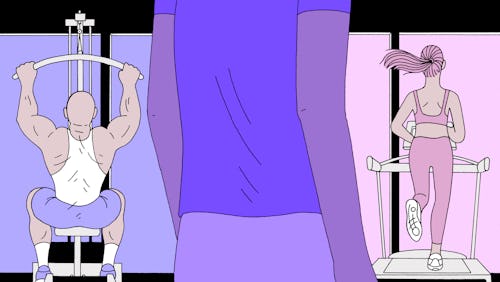
I am one of 1.2 million Americans who identify as nonbinary. The things is that, while “nonbinary” is slowly becoming another box you can check on a dropdown list of gender options, what it means for each individual who identifies as such can be really different. For me, it means not limiting my gender identity to “M” or “F.” I am a bonafide fitness junkie, but it feels like every time I try to experiment with new ways of moving my genderfluid body, I find that even the most supposedly inclusive fitness spaces rely on gendered cultural norms as a way to prescribe and measure wellness.
The fitness industry feels gendered right from the jump. If, for example, you sign up for an exercise app, one of the first questions you will be asked is whether you are male or female. This may seem innocuous, but it doesn’t actually feel that way. I am looking to explore who I am in my body, but instead I am immediately forced to remember that there are only two choices about who I can be in this body. “The exclusivity in the limited options for identity on apps — and everywhere else — in effect erases people, and can make them feel invisible, unimportant, and nonexistent,” says Dulcinea Pitagora, a New York City-based psychotherapist who works with people with marginalized sexual and gender identities.