
Get all your news in one place.
100's of premium titles.
One app.
Start reading
T3
T3
Technology
Chris Hall

Which flip phone should I buy? Samsung Galaxy Z Flip 8 or Motorola Razr 70 Ultra?

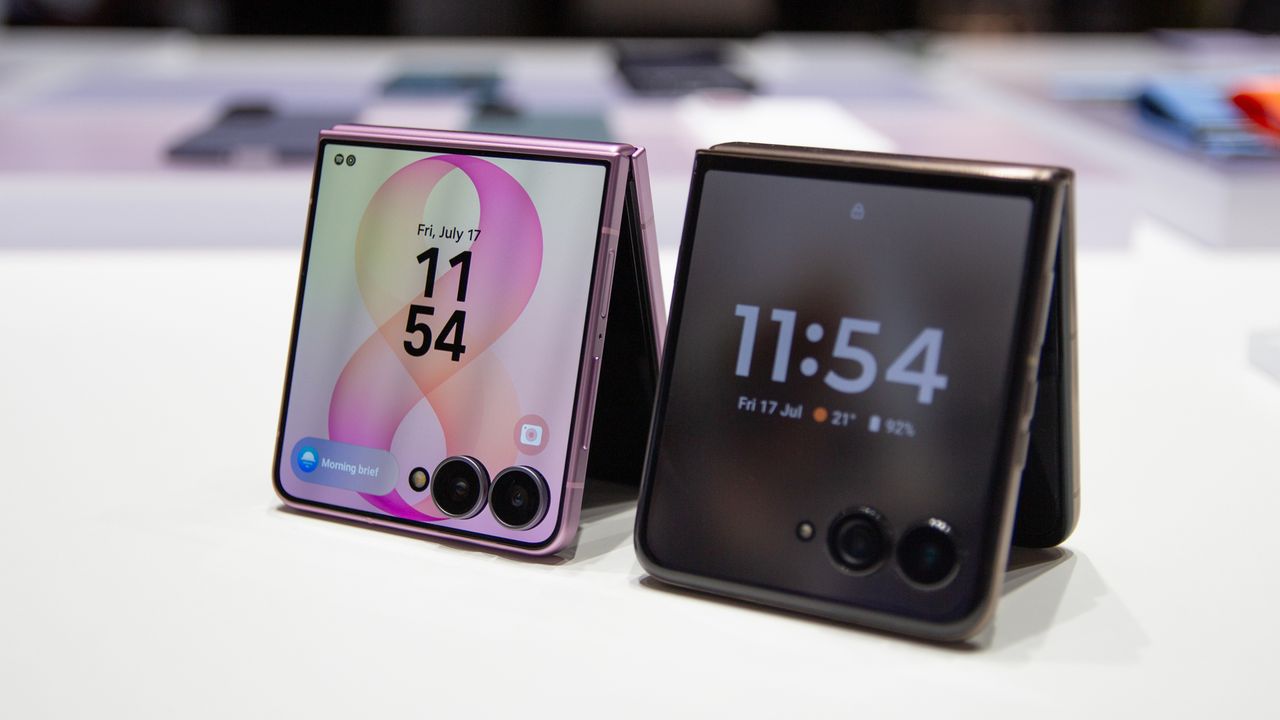
Samsung Galaxy Z Flip 8 and Moto Razr 70 Ultra.

Samsung has just updated its Galaxy Z Flip, alongside the new Galaxy Z Fold 8 (the wide model) and the Galaxy Z Fold 8 Ultra. But in the world of flip phones, Samsung faces a big rival in the form of Motorola and its Razr family.

The Motorola Razr 70 Ultra was announced earlier in the year, and it has something in common with Samsung's phone: neither of these devices changed significantly from the previous generation. On one hand, that might point to smartphone stagnation. On the other hand, it could just be that phones don't need to be updated every year.

With that said, both these phones also increased their prices, something that's a trend in tech right now. With that in back of mind, and having used both of these phones ahead of Samsung's Galaxy Unpacked event, just how do they compare – and which one should you buy?

Price

The Samsung Galaxy Z Flip 8 has just been announced, with a launch price of £1149 for the 256GB version. Currently, I don't have confirmed pricing for the US or other regions.

It's expected that pre-orders will open immediately, with general sales from 4 August.

The Razr 70 Ultra launched at £1199 in May 2026 and it's still listed at that price, although Motorola is offering free Buds Loop if you order direct. Note that this is for the 512GB version, so technically, it's 'cheaper' than the Galaxy Z Flip 8. Prices have been really stable, with no discounts so far.

In the USA the (differently named, but effectively the same device) Razr Ultra 2026 is priced at $1499, while in Australia it's AU$1999 (albeit for the 256GB model in that instance).

Design

Z Flip 8

Razr 70 Ultra

Dimensions

Unfolded: 166.9 x 75.4 x 6.1mm

Folded: 85.7 x 75.4 x 13.1mm

Unfolded: 171.48 x 73.99 x 7.19mm

Folded: 88.12 x 73.99 x 15.69mm

Weight

180g

199g

Colours

Cream, Graphite, Pink, Mint (Samsung exclusive)

Pantone Cocoa, Pantone Orient Blue

(Image credit: Future / Chris Hall)

With neither of these phones changing much generation on generation, I could direct you to my comparison of the Z Flip 7 and Razr 70 Ultra – as much is going to be the same. The design of the new Samsung phone is essentially the same as it was before, but it's now only 6.1mm thick and drops to 180g in weight.

It remains more compact than the Razr, which is 7.19mm thick when unfolded and weighs in at 199g. That's close to 20g difference in weight, but it's the overall bulk that separates these phones – and you don't get more screen space on the Motorola as a result of the increased size (but you do get something else as I'll get to below).

The design language is different, too, with Samsung's approach being more industrial. Flat sides meet a flat back, while the Razr 70 Ultra hangs on to some curves. Samsung has made a tiny adjustment in the Flip 8, with a bevelled edge that makes it a little easier to open than the previous model. Motorola, thanks to its slightly more rounded frame, has always been a little easier to flip open.

While Samsung sticks to a glass back on the Galaxy Z Flip 8, this is where the biggest point of difference comes in: Motorola remains committed to using unique colours and materials. The Razr 70 Ultra comes in Pantone Cocoa, which has a wood veneer finish, while the Pantone Orient Blue is an opulent Alcantara.

This lends a completely different feel to these devices. While they principally have a similar folding design, Motorola's Razr has a slightly warmer feel about it. Both will turn heads, but the Razr will draw more questions – and I applaud that.

Much as it was before, this is a choice between industrial precision from Samsung or a slightly more lifestyle look from Motorola. My only concern is that the Razr 70 Ultra comes in just two finishes, at the moment, which is fewer than previous years.

Samsung offers four colours – although one is a Samsung.com exclusive.

Displays

Z Flip 8

Razr 70 Ultra

External

4.1-inch AMOLED

4.0-inch AMOLED

Internal

6.9-inch AMOLED

6.96-inch AMOLED

Brightness peak

2600 nits (both)

5000 nits (internal), 3000 nits (external)

Refresh rate

120Hz (both)

165Hz (both)

(Image credit: Future / Chris Hall)

Motorola stole an early lead from Samsung with its cover display: while Samsung was still offering an odd-shaped window on the Galaxy Flip 5, Motorola's Razr wrapped it right around the cameras on the Razr 40 Ultra. That set a new trend, which now sees these two going head-to-head on the cover screen.

The playing field has levelled, with Samsung offering a 4.1-inch screen compared to Motorola's 4.0-incher. That fractional difference in size makes a difference, especially when you consider that Samsung's phone is smaller: the Razr has wider bezels around the edge. Again, Samsung's precision comes through here.

Motorola is known for pushing the display specs, though, and the Razr 70 Ultra has a 3000 nits cover screen with 165Hz refresh rate and high pixel count. Samsung hasn’t confirmed the Z Flip 8 specs at the time of writing, but to me it looked just like the previous version.

That applies to the main display too: the Z Flip 8 has a 6.9-inch internal display, while Motorola is 6.96-inches. Motorola offers 165Hz – although I'm not sure you'll ever use more than 120Hz – while it also has a peak brightness of 5000 nits.

(Image credit: Future / Chris Hall)

Finally, Samsung's crease is a little less visible than Motorola's. That's about all that separates these displays, although Motorola probably retains the brightness advantage.

But there's one other levelling factor: Motorola's advantage has long been the ability to use apps in full on the cover screen. Samsung is now offering the same on the Z Flip 8, moving on from the widget-based experience that it previously offered. I compared a couple of apps and Samsung might just have the edge now, offering a little more visible app space.

Performance

Z Flip 8

Razr 70 Ultra

Processor

Qualcomm Snapdragon 8 Elite Gen 5 (USA) / Samsung Exynos 2600 (UK)

Qualcomm Snapdragon 8 Elite

RAM

12GB

12GB

Battery

4300mAh

5000mAh

Charging

45W

68W

(Image credit: Future / Chris Hall)

If you're looking for stagnation, Motorola's decision to stick with the Snapdragon 8 Elite in 2026 (the same as 2025) might cost it: Samsung updates to the Gen 5 version (in the USA; it's Exynos 2600 in some other regions, including the UK).

But before you get too excited, it's not simply a case of 'newer is better': the Snapdragon 8 Elite remains powerful hardware and many prefer to have a Snapdragon in their phone. While I haven't been able to fully test the Galaxy Z Flip 8, previous tests on the Exynos 2600 suggested that it was outperformed by the older Snapdragon hardware in some areas.

But let's keep this in check: this isn't a gaming phone, so absolute performance probably doesn't matter. In that sense, what happens in the battery department is probably more important.

The Motorola Razr 70 Ultra has a 5000mAh battery, while Samsung sticks to 4300mAh. Samsung battery now uses silicon-carbon (Si-C) tech, which is the same as Motorola. Samsung's motivation for moving to Si-C seems to be to support the 45W charging, which is very welcome.

Motorola, meanwhile, offers 68W charging and, let's face it, that's a world apart from Samsung's offering. I found the battery life of the Razr 70 Ultra to be really solid.

Cameras

Z Flip 8

Razr 70 Ultra

Main camera

50MP, f/1.8

50MP, f/1.8

Ultrawide camera

12MP, f/2,2

50MP, f/2.0

Selfie camera

10MP, f/2.2

50MP, f/2.0

(Image credit: Future / Chris Hall)

When the Motorola Razr 70 Ultra launched, all the talk was about the introduction of a 'LOFIC' sensor, the first time the tech had been used in a folding phone. That's designed to strengthen the performance of the main camera – and it's a pretty good performer.

It leads a trio of 50-megapixel cameras, including an ultrawide (that's a little blurry towards the edges) and a front camera (that's pretty inconsistent in my experience). It's a so-so camera experience.

Samsung doesn't appear to have made any changes to its camera in the Z Flip 8, so there's a 50-megapixel main, supported by a 12-megapixel ultrawide and a 10-megapixel selfie camera. Motorola wins on the spec sheet, but I can't really judge which is better until I get to test them both.

There are clever features, like multiple ways to use the external display, the option to use the rear cameras for selfies, as well as clever features like camcorder mode and twist-to-zoom on the Motorola device.

Both lack a telephoto camera, which is the biggest downside at this price point when compared to a regular non-folding phone.

Software and support

Z Flip 8

Razr 70 Ultra

Software version (launch)

Android 17 + One UI 9

Adnroid 16 + Hello UI

Software support

7 years, ends 2033

3 years OS, 5 years security, ends 2030

(Image credit: Future / Chris Hall)

This section is worth paying attention to and we'll start with the fact that Samsung offers 7 years of software support for its flagship devices, while Motorola has only promised three OS updates and 5 years of security updates on the Razr 70 Ultra. Whichever way you cut it, Samsung is better in this regard.

Samsung Galaxy Z Flip 8 has the benefit of launching on Android 17 (almost the first phone to offer it – the Google Pixel literally updated the week before launch), along with One UI 9. During my time exploring the Z Flip 8, I didn't spot huge changes – except for the cover display features that I've already mentioned.

Samsung with One UI remains one of the best experiences on Android – and that remains the case for the Galaxy Z Flip 8. Motorola, on the other hand ,isn't quite as slick.

The move to Hello UI has seen Motorola introduce a lot of preinstalled apps, while making changes to insert Moto AI in places you might not want it. Most annoying is the attempt to shoehorn a news feed into the apps tray, along with a search function that can draw on Perplexity to give you more waffly answers.

Thankfully you can turn off a lot of these intrusions, but it does take some effort. Samsung instead offers Galaxy AI, which always gets a high billing, but doesn't appear to offer much more than Google's Gemini – which both these phones offer as standard.

The caveat with Samsung's AI is that you have to use the Samsung Keyboard to get it to function – if you choose to use Google Gboard, for example, you basically void the Galaxy AI features.

Which should you buy: Samsung or Motorola?

Samsung has a couple of things stacked in its favour: it has a tighter and more compact design, which is lighter; it offers longer software support; and many will prefer the One UI experience over Motorola's Hello UI. But for the price, you get half the storage.

Motorola offers more unique finishes, with higher spec displays in some areas and a battery that's significantly higher capacity, with much faster charging. Motorola also offers 512GB storage for only a little more cash, so it's also better value for money.

But between all these things, I think it boils down to two factors: pick Samsung if you want the more compact device with a design that's slightly sharper; pick Motorola if you'd rather have longer battery life.

Sign up to read this article
Read news from 100's of titles, curated specifically for you.
Already a member? Sign in here
Related Stories
Top stories on inkl right now
Our Picks
Fourteen days free
Download the app
One app. One membership.
100+ trusted global sources.