
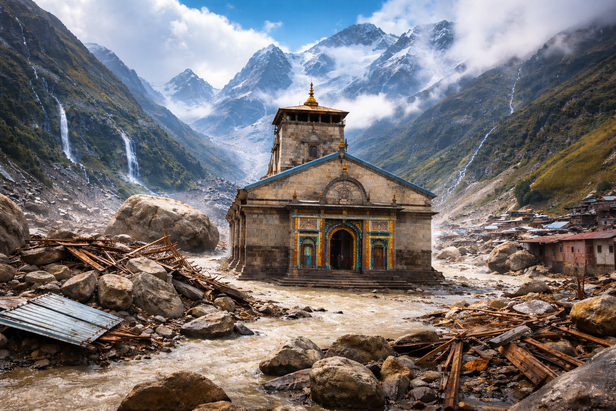
In June 2013, Uttarakhand witnessed destruction on a scale that reshaped both geography and memory. Days of relentless rain triggered cloudbursts, landslides, and a sudden glacial lake outburst that sent a violent mix of water, rock, ice, and debris racing through the Mandakini valley. Entire settlements vanished. Roads and bridges collapsed. Thousands of lives were lost.
When the floodwaters finally receded, one image stood out against the devastation. At the center of the destroyed town, Kedarnath Temple remained standing. Not untouched, but structurally intact. Science has since studied the disaster closely. It explains much of what happened that year. Yet when it comes to Kedarnath’s survival, explanation slowly gives way to uncertainty.

Below is what science understands, and where its answers begin to feel incomplete.
1. Extreme Weather Was the Primary Trigger
Science clearly explains how the disaster began. In mid June 2013, Uttarakhand received rainfall far beyond historical averages in an extremely short span of time. Cloudbursts caused intense, localized downpours that overwhelmed natural drainage systems.
At the same time, the sudden breach of Chorabari Lake released a massive volume of water into the Mandakini river. This was not a normal flood. It was a debris flow carrying rocks, ice, mud, and uprooted trees. Such flows possess far greater destructive power than water alone. From a scientific standpoint, widespread destruction was inevitable under these conditions.
2. Fragile Himalayan Geology Amplified the Damage
The Himalayas are young mountains with unstable rock formations and steep slopes. When saturated by heavy rainfall, these slopes fail easily. Landslides added enormous volumes of debris into already swollen rivers, multiplying their force.
Scientific studies show that this geological fragility turned heavy rainfall into a cascading disaster. Rivers changed course, valley floors were scoured, and anything built on loose sediment became vulnerable within minutes.
3. Human Construction Increased Vulnerability
Science also points to human choices. Large scale construction had taken place along riverbanks and floodplains, areas naturally meant to absorb excess water. Many buildings rested on alluvial soil rather than bedrock.
Modern construction materials behaved poorly under lateral impact from debris laden water. Concrete cracked, steel twisted, and mixed materials failed at stress points. This explains why so much infrastructure collapsed so quickly.
In short, science explains why destruction was so widespread.
4. Location and Design Gave Kedarnath an Advantage
Science does explain some reasons for Kedarnath’s resilience. The temple is not built directly on the main river channel and sits on slightly elevated ground. This reduced direct hydraulic pressure.
Its construction uses massive interlocking stone slabs without cement. Such structures absorb shock differently from modern buildings, distributing force through weight and balance. The foundation is anchored into stable rock rather than loose sediment, reducing the risk of undercutting.
These factors matter. They clearly contributed to survival. But they do not tell the whole story.
5. The Bhim Shila Boulder Challenges Probability
One of the most discussed scientific observations is the role of the Bhim Shila, a massive boulder that came to rest behind the temple during the floods. Scientifically, it acted as a barrier, absorbing and diverting debris flow away from the structure.
Yet probability raises questions. A boulder of such size moving through chaos could just as easily have struck the temple or destabilized it. Instead, it stopped in a position that shielded the shrine almost perfectly.
Physics explains how a barrier works. It does not explain why that barrier arrived exactly when and where it did.
6. Structural Survival Exceeded Expected Limits
Engineering models suggest that debris flows of the 2013 magnitude should cause at least partial structural failure, even in well built stone structures. Cracking, displacement, or foundation stress would normally be expected.
Post disaster surveys, however, showed minimal structural damage to the temple. Walls remained upright. Foundations showed little movement. This outcome lies at the extreme edge of what current models predict.
Science can say the survival was possible. It struggles to explain why it was so complete.
7. Topography Explains Some Protection, Not Selective Survival
The glacial valley around Kedarnath helped disperse some flood energy through uneven terrain. This reduced peak force at specific points.
But nearby buildings existed within the same valley and at similar elevations. They were destroyed. If topography alone were sufficient protection, survival would have been more evenly distributed. Instead, it was not.
This selective endurance is where scientific explanations begin to thin.
8. When Multiple Improbabilities Align
Science excels at isolating individual factors. It explains location, construction, orientation, and geology. What it cannot fully explain is convergence.
At Kedarnath, every protective factor aligned at once. The flood path shifted. The boulder lodged in the right place. The structure absorbed shock without cracking. The foundation held firm.
Individually, these events are explainable. Their perfect alignment during one of the worst Himalayan disasters in recorded history is not.