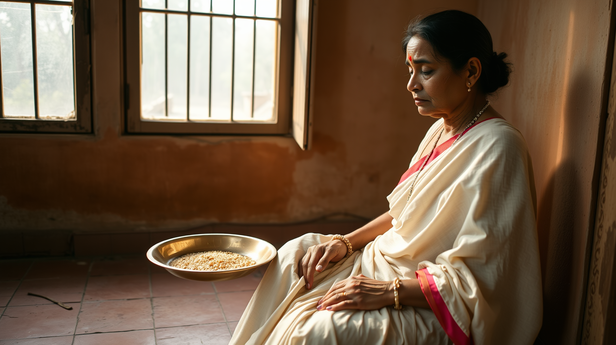
The sixteen days and what you put down
The new salwar sits in its polypropylene wrap. The gold earrings go back in the steel box. For sixteen days across the Krishna Paksha of Bhadrapada, the lunar fortnight Hindus call Pitru Paksha, the household observes: no new clothes, no jewellery, no adornment of any kind. The ancestors are being fed. The living are meant to look like they know it.

The custom is real and old. Shraddha rituals, which form the backbone of Pitru Paksha observance, draw on the idea that the dead require active remembrance, not passive grief but performed devotion. Food, water, sesame seeds offered to the pitru. And from the living: a withdrawal from pleasure. The Garuda Purana, which deals extensively with the state of the dead and the duties of the living, frames this withdrawal as part of the mourner's correct orientation. You turn away from the world of the living, briefly, to face the world of the ancestors.
Where the withdrawal lands
In most households, this lands on women. The logic is not stated, it rarely is. But watch who actually stops wearing what. The woman of the house puts down her bangles. She wears older, plainer saris. She does not open the new kurta she bought last week. Her husband may wear a white dhoti for the shraddha puja itself, but the daily texture of his appearance does not change the way hers does.
This is not a conspiracy. It is something older and more structural. Women in Hindu domestic life are the keepers of auspiciousness, the mangalsutra, the sindoor, the bangles are not merely ornament. They are status markers of a living, intact household. When mourning is required, the reversal of those markers is the most legible signal available. A woman without her bangles reads as grief. A man in the same plain clothes he wears every day reads as nothing in particular.
The custom, then, does not ask equally. It asks more of the person whose body already carries the household's symbolic weight.
The logic the restriction is built on
The theological frame is tamasic withdrawal. Tamas, the guna of inertia, darkness, dissolution, is not inherently bad in Hindu thought. It has its season. Pitru Paksha is one of them. The ancestors occupy a liminal state; the shraddha rituals are meant to ease their passage. The living align with that liminal quality by stepping back from rajasic energy, ambition, desire, acquisition. New clothes are acquisition. Jewellery is desire made wearable. The restriction is coherent on its own terms.
What the restriction does not account for is that the body doing the withdrawing is not a neutral body. It is a woman's body, already encoded with meaning it did not choose. Asking her to strip the markers of auspiciousness is not the same as asking her husband to skip a shopping trip. It is asking her to temporarily perform the state of a widow, a state that, in the cultural memory this very tradition carries, is one of the most freighted conditions a woman can occupy.
What it actually asks
Grief made visible on the body is still grief. That is worth saying plainly, because the alternative reading, that these customs are merely oppressive, misses something true about what mourning through the body can do. There is a reason people wear black to funerals. There is a reason the Iyengar widow's white and the Punjabi mourner's plain cotton exist across such different communities. Wearing your grief changes how you move through the day. It signals to the people around you that you are in a different register. It can, genuinely, deepen the quality of attention you bring to the rituals.
The question Pitru Paksha customs raise, the one the theology does not answer, is why that visible grief is predominantly asked of women. The shraddha puja itself is performed by the eldest son, or a male relative. He does the ritual work. She does the embodied work. He enacts the devotion. She wears it.
That asymmetry is not a reason to abandon the custom. Many women observe Pitru Paksha restrictions with genuine feeling, not compulsion, and find in the sixteen days a quality of stillness that the rest of the year does not offer. The plain sari, the absent bangles, for them, it is not performance. It is actual mourning, worn on the surface so it can go deeper.
But the asymmetry is worth seeing clearly, because seeing it is what makes the choice to observe real rather than automatic. A custom you follow without knowing what it costs is not devotion. It is habit wearing devotion's face.
The pitru are owed remembrance. The women who carry that remembrance on their bodies are owed, at minimum, the acknowledgement that they are carrying something the men around them are not.