Get all your news in one place.
100's of premium titles.
One app.
Start reading
The Conversation
The Conversation
Lifestyle
Kathrin Wagner, Associate Professor in Art History, Liverpool Hope University

What historic art showing open water swimming can tell us about gender, race and power

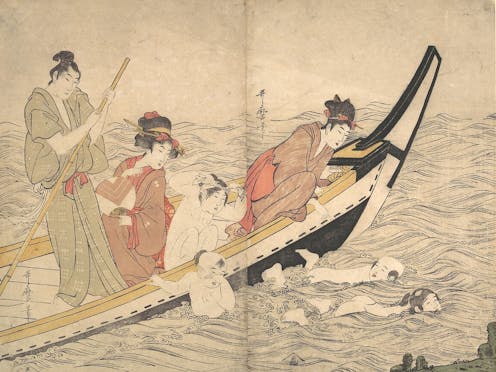
Boating Party with Children Swimming by Kitagawa Utamaro (late 18th century). H. O. Havemeyer Collection, Bequest of Mrs. H. O. Havemeyer

What do we see in a historical painting or photograph that shows a person in open water? Most likely, in the first instance, someone who is engaging with swimming or bathing in a natural environment. But at second glance, these images can teach us many things about a society’s attitudes towards the human body, perceptions of the western and wider world and political supremacy.

For starters, there is the issue of nudity. Artists need to decide about how much of the human body they want to reveal and for what reason. We often think that semi or full public nudity is a modern phenomenon, but there is evidence that during the Middle Ages and the pre-modern period in western Europe, naked bodies were an integral part of society.

Sign up to read this article
Read news from 100's of titles, curated specifically for you.
Already a member? Sign in here
Related Stories
Top stories on inkl right now
One subscription that gives you access to news from hundreds of sites
Already a member? Sign in here
Our Picks
Fourteen days free
Download the app
One app. One membership.
100+ trusted global sources.