Imagine discovering an organism so unusual that its scientific name takes almost an entire line - or several - to write. Scientists give species standardized names so researchers around the world can identify the same organism without confusion. This system, known as binomial nomenclature, usually produces relatively manageable names such as Homo sapiens. But occasionally, scientists have a little fun with the process. One extraordinary example is an oomycete with a scientific name stretching to 181 letters, making it the longest currently recognized binomial name. Even more remarkably, the creature was discovered in Germany, but its enormously long name was based on the ceremonial name of Bangkok, Thailand. The history behind such an extraordinary name is fascinating and makes one realize that the field of taxonomy is not only about biology and evolution but also about linguistics and humor.
WHAT ARE BINOMIAL NAMES?
The process of giving two names to an organism for scientific purposes is known as binomial nomenclature. In this system, the first word refers to the genus, whereas the second word is called a specific epithet. Collectively, they are referred to as the binomial name of the species. It is this standardized method that makes it possible for scientists to identify organisms irrespective of the common names used in different countries or languages.
READ ALSO: What is 'serial cyclone clustering'? Back-to-back Arctic storms can double sea ice loss, study finds
WHICH SPECIES HAS THE LONGEST SCIENTIFIC NAME?
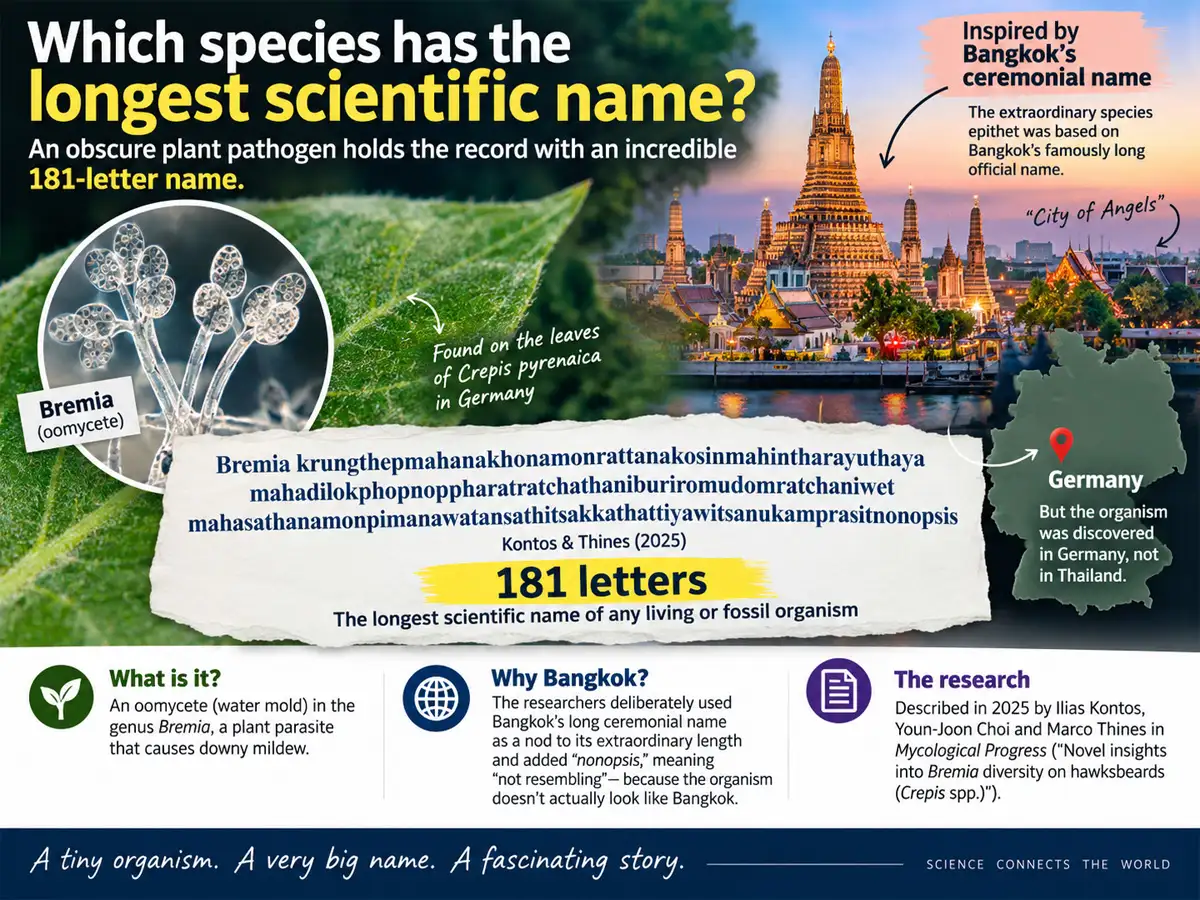
According to Britannica, the record belongs to the oomycete Bremia krungthepmahanakhonamonrattanakosinmahintharayuthayamahadilokphopnoppharatratchathaniburiromudomratchaniwetmahasathanamonpimanawatansathitsakkathattiyawitsanukamprasitnonopsis. Its full binomial contains 181 letters.
The species was described in the 2025 Mycological Progress study 'Novel insights into Bremia diversity on hawksbeards (Crepis spp.)' by researchers Ilias Kontos, Youn-Joon Choi, and Marco Thines. Their research examined Bremia infecting hawksbeard plants in Germany and identified five new species using microscopy and phylogenetic analysis.
Before the Bremia oomycete claimed the record, the title of the longest binomial name belonged to the bacterium Myxococcus llanfairpwllgwyngyllgogerychwyrndrobwllllantysiliogogogochensis, with 73 letters. The bacterium was isolated from soil collected in the Welsh village of Llanfairpwllgwyngyllgogerychwyrndrobwllllantysiliogogogoch and was named after the village where it was discovered.
WHY BANGKOK IF IT WAS FOUND IN GERMANY?
Here's where the story gets unusual. The organism is a plant parasite associated with Crepis pyrenaica, commonly known as Pyrenean hawksbeard, and was identified from Germany, but its enormous epithet was modeled on Bangkok's famously long ceremonial name. The researchers reportedly then added 'nonopsis', conveying 'not resembling', because the organism does not resemble Bangkok. In other words, the record-breaking name was intentional scientific wordplay - not an indication that the species originated in Thailand.