Get all your news in one place.
100's of premium titles.
One app.
Start reading
The Conversation
The Conversation
Environment
Matthew Savoca, Research scientist, Stanford University

Whales are recovering from near extinction, but industrial fishing around Antarctica competes for their sole food source

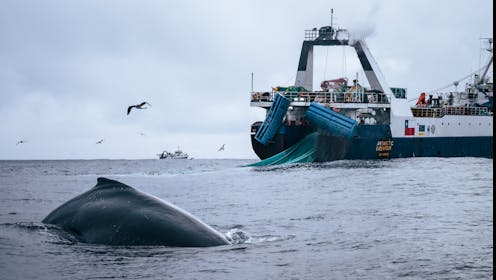
A humpback whale surfaces near two trawlers. All are pursuing Antarctic krill. Youenn Kerdavid/Sea Shepherd Global, CC BY-ND

The Southern Ocean encircling Antarctica is the world’s largest feeding ground for baleen whales – species like humpbacks that filter tiny organisms from seawater for food. In the 20th century, whalers killed roughly 2 million large whales in the Southern Ocean. Some populations, like the Antarctic blue whale, were reduced by more than 99% and have been struggling to recover, even though most nations ended commercial whaling in the mid-1980s.

Today a new threat is emerging: industrial fishing for Antarctic krill – tiny swimming crustaceans, roughly 2 inches (60 millimeters) long. In a newly published study, colleagues and I found that competition with this burgeoning fishery may impede whales’ recovery.

Sign up to read this article
Read news from 100's of titles, curated specifically for you.
Already a member? Sign in here
Related Stories
Top stories on inkl right now
One subscription that gives you access to news from hundreds of sites
Already a member? Sign in here
Our Picks
Fourteen days free
Download the app
One app. One membership.
100+ trusted global sources.