Simon Yates' decision to suddenly retire from professional cycling came as a shock, but there was widespread support and understanding amongst his fellow riders due to the growing mental and physical fatigue that riders face in the modern peloton.
More and more riders are ending their careers prematurely due to the pressures and expectations of the sport, with burnout a constant risk. Twenty-three-year-old Fem van Empel was a three-time cyclocross world champion and expected to become a multi-discipline star of the women's peloton, but she opted to retire in December.

"At the moment, both the motivation and the enjoyment I have had in cycling for years are missing," she said.
During the Visma-Lease a Bike media day, Jonas Vingegaard was not afraid to reveal he has been close to burnout during his career. Last year, his wife, Trine, suggested that Visma demanded too much from her husband.
“I think for everyone it’s a very demanding sport, also for me. I’ve also been close to burning out, because it is tough with all the altitude camps and everything," Vingegaard admitted.
He will target the Giro d'Italia and Tour de France in 2026, but will race sparingly to avoid a racing and training overload.
Professional cycling has changed massively in the last 15 years. Team Sky drove the theory of marginal gains and invested massively in performance, then everything changed and accelerated again after the COVID-19 pandemic. Salaries and team support are higher and better than ever, but so is the pressure to conform and perform.
There are no more training races; everyone is close to 100% fitness for every race they ride. Modern high-carb nutrition strategies mean the decisive action begins far sooner in each race, making it more demanding and more stressful. Tadej Pogačar's exuberant and aggressive racing style is the new benchmark that everyone is trying to live up to.

Now, every aspect of scientific sports performance is pushed to the limit to help teams find a competitive advantage and to keep up with their rivals. Riders spend more time on the road than at home. They perhaps race less than in the past, but now spend blocks of up to three weeks at altitude training camps, even pre-season, as well as before Grand Tours and the Classics, to boost the oxygen-carrying capacity of their red blood cells. They have to log their location for anti-doping controls, and every hour of their daily routine from wake-up to their early bedtimes follows a pre-planned schedule.
Riders weigh their food and use a food app to balance their carbs, proteins and fats. Almost every training ride is structured and disciplined, optimised and measured. Riders send their training data to their coaches, even doing lactic acid testing on the home trainer.
They then have to somehow balance all their cycling obligations with their private life and family. All while making life look glamorous on social media. It is easy for anxiety, stress and burnout to creep into a rider's life.
Growing awareness of the demands and risks
Teams are aware of the problem and are taking steps to help their riders. Team Sky could count on the support of consultant psychiatrist Steve Peters, some leading teams have mental coaches and Lidl-Trek have Elisabetta Borgia as Head of Psychology. Teams have realised they need to protect their biggest assets – the riders – from mental fatigue and burnout.
"Now it feels like big brother is watching you," Fabian Cancellara said in support of his Tudor Pro Cycling riders, admitting he would have struggled with the 'digitalisation' of modern cycling and its constant demands, where everything is logged and recorded.
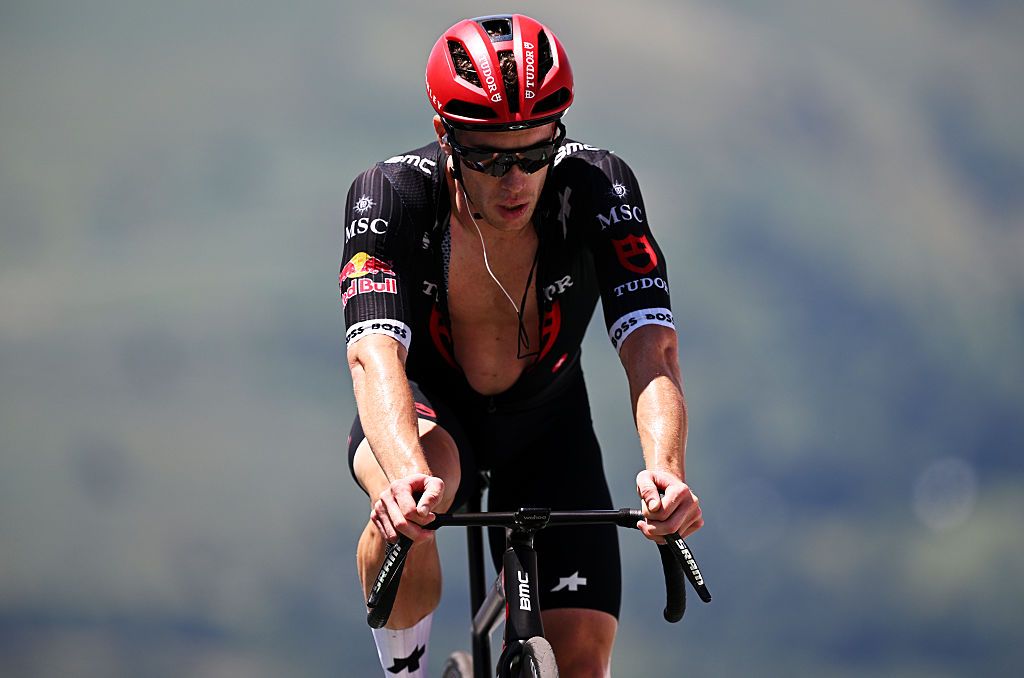
Stefan Küng has moved to Tudor for 2026 and will lead the Swiss team at the cobbled Classics. He has spent most of the winter away from his Switzerland home so that he can train in ideal conditions, even combining a block of training in Gran Canaria with a family Christmas holiday. He has years of experience and broad shoulders, but admitted he is feeling the pressure to perform and the risk of burnout.
"Compared to when I became a professional 12 years ago, it's very different. If we were at 100% in 2015, now we're probably at 130% more in terms of the time that you actually spend doing your job," he said during the recent Tudor media day.
"There are so many different aspects of it: altitude training, heat training, then there's aero testing, wind tunnel sessions, everyone goes to the gym and does different recovery methods. It all adds hours on top of your bike riding. We have the whole staff behind us, that makes it easier for us, but It's very intense.
"For example, my last race was the Chrono des Nations on October 18, afterwards I flew directly to Switzerland and didn't even go home, to spend five days with the new team. On Sunday, I was on the plane to England to go to the wind tunnel all day on Monday. By the time I actually went on holiday, I'd already used up eight days of my off-season."

Küng has learnt to really enjoy the rest days in his packed schedule.
"My training days are planned around everything I have to do, but I have two young kids, so on a rest day I don't ride at all anymore, just in order to switch off completely. One day a week, I plan my life around my family and not the other way," Küng revealed.
Cancellara was once a high-level athlete, a team leader, Classics winner and time trial world champion. Now, as the Tudor team owner, he sees the pressures his riders face and is trying to help them.
Another Tudor rider, Larry Warbasse, revealed to Cyclingnews how Cancellara makes a concerted effort to ask his riders if they are happy. Tudor are trying to compete at WorldTour level but are also trying to help and support their riders as much as possible.
"Now I see how tough being a rider in modern cycling really is," Cancellara said.
"Science is important, but at the end of the day, we're all human and that's important for us, we need to protect our riders.
"Riders are turning pro much younger, even at 18 and 19, but they are still kids. A lot of agents are trying to sign them, teams want them, money often becomes a factor because teams are ready to pay for a potential talent."
'Successful companies are always centred around their people'
Ricardo Scheidecker is the little-known Head of Sports at Tudor, but he is a vital central cog in the team. He is responsible for managing the riders and staff, their performance, results and their well-being.
Tudor is a ProTeam thanks to their 2025 ranking and will race virtually a full WorldTour programme in 2026, but each individual rider will race less and have more staff to help them after the lesson learnt during Tudor's 2025 season, when illness, injury and the pursuit of UCI ranking points stretched the team's limits.
"I worked outside of cycling for several years and soon realised that successful companies are always centred around their people. If you don't help your people, you're not going to get the best out of them, and you're not going to be successful. In cycling, you have to care about your riders and about your staff too," Scheidecker explained.
"Caring is giving a training and racing programme that makes sense, that doesn't squeeze them. Caring is giving the riders the resources they need, the nutrition, medical and coaching support."

It's an added effort and concern for teams, but they see the payoff as worth it, because the consequence of getting this wrong can be as extreme as riders stopping entirely.
"We try to do this in a very constructive and human way, because we consider the psychological impact on the athletes," Scheidecker added. "We've seen more and more examples of riders who were huge talents but ended their careers because they didn't have the support to help them deal with all their needs and responsibilities.
"We cannot be like that as a sport, and Tudor definitely won't be like that. We have to protect our riders from burnout."