Get all your news in one place.
100’s of premium titles.
One app.
Start reading
The Times of India
The Times of India
World
TOI World Desk

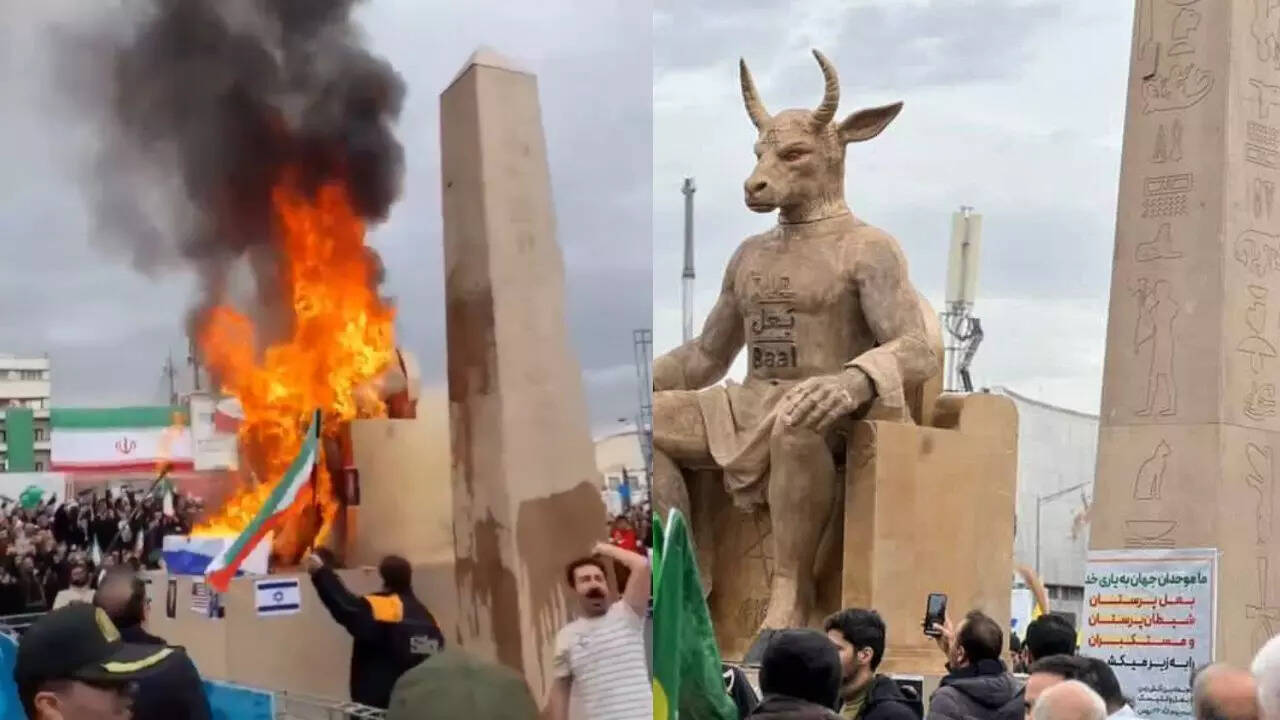
Watch: Iranian protesters burn ‘Baal’ Effigy marked with Star of David, chant ‘death to Israel’ at rally

At a state-organised rally in Iran marking the anniversary of the 1979 Islamic Revolution, protesters burned an effigy labelled “Baal,” depicted with horns and marked with the Star of David.

Chants of “Death to Israel” and “Death to America” echoed through the crowds as images of the burning figure circulated widely on social media.

The demonstration came amid heightened tensions between Iran, Israel and the United States, following recent regional conflict and renewed political friction.

Iranian state media described the rallies as a show of national unity against “imperial powers,” while footage released by outlets affiliated with the Islamic Revolutionary Guard Corps showed effigies symbolising the US and Israel being set ablaze.

In Tehran, symbolic coffins bearing the names of senior US military officials were displayed, alongside missiles and wreckage from drones reportedly downed during previous confrontations. President Masoud Pezeshkian addressed crowds, calling for unity in the face of what he described as foreign conspiracies.

The burning of the Baal effigy stood out for its use of ancient religious imagery blended with modern political messaging. By inscribing the Star of David on the figure, protesters appeared to equate Israel with corruption, evil and satanic symbolism, a move critics say risks inflaming religious hostility.

Who was Baal?

Baal was an ancient Canaanite deity worshipped thousands of years ago in the Levant. The name “Baal” means “lord” or “owner” in Semitic languages. In Ugaritic texts, he is described as a storm and fertility god associated with rain, agriculture and power.

Archaeological discoveries from Ugarit in modern-day Syria depict Baal as a warrior figure, often shown wearing a horned helmet and wielding a weapon. He was central to Canaanite religious practice and was believed to reside on Mount Zaphon.

In the Hebrew Bible, Baal is portrayed as a rival to Yahweh and a symbol of idolatry. Over time, in Jewish and Christian traditions, Baal and related figures such as Baal-Zebub (later rendered as Beelzebub) became associated with demonic imagery. This evolution contributed to the broader perception of Baal as a false or evil deity in later religious narratives.

Baal’s link to Jeffrey Epstein: Fact vs speculation

In recent years, Baal’s name has surfaced in online conspiracy theories tied to disgraced financier Jeffrey Epstein. A document from the so-called “Epstein files” that circulated online appeared to show the term “baal.name” in a banking reference field.

Some social media users interpreted this as evidence of occult symbolism or cult worship. Posts claimed Epstein named a bank account after Baal, fuelling narratives linking elite crime with satanic imagery.

However, fact-checkers have disputed these claims. Analysts have suggested that “baal.name” was likely a garbled or misread version of “bank name” in a scanned document. No verified evidence has established that Epstein had any connection to Baal worship.

Epstein, who was accused of running a sex trafficking network involving underage girls, died in federal custody in 2019. His crimes and the high-profile names associated with him have fueled widespread speculation online. For some, the association of elite abuse scandals with occult symbolism carries emotional resonance — even in the absence of factual proof.

Symbolism and political messaging

The use of Baal imagery at the Iranian rally reflects how ancient mythological symbols continue to be repurposed in modern political conflicts. In this case, the effigy appeared designed to merge religious demonology with contemporary geopolitical rivalry.

While supporters may view such displays as expressions of resistance against perceived adversaries, critics argue that blending religious symbolism with political anger risks deepening sectarian divides.

The episode underscores how history, faith and politics remain tightly interwoven in the region — and how ancient figures like Baal can resurface in unexpected and controversial ways in present-day discourse.

Sign up to read this article
Read news from 100’s of titles, curated specifically for you.
Already a member? Sign in here
Related Stories
Top stories on inkl right now
One subscription that gives you access to news from hundreds of sites
Already a member? Sign in here
Our Picks
Fourteen days free
Download the app
One app. One membership.
100+ trusted global sources.