Get all your news in one place.
100's of premium titles.
One app.
Start reading
The Economic Times
The Economic Times

Warnings ignored as Venezuela coastal towers faced quake forces they couldn't take, investigation reveals

Venezuela: Scientists had warned the government not to build along Venezuela's coastal strip of La Guaira.

The area's seaside Caribbean communities, not far from Caracas, were near a major fault line and a mountain range that had unleashed repeated, destructive natural disasters. The soil was poor, a type of silt that would only amplify shaking in an earthquake.

Ignoring the advice, the government threw up exactly the wrong kind of buildings for that location: tall concrete apartment complexes.

It was all a recipe for destruction, according to an Associated Press investigation that relied on interviews with dozens of engineers, seismologists and former government officials.

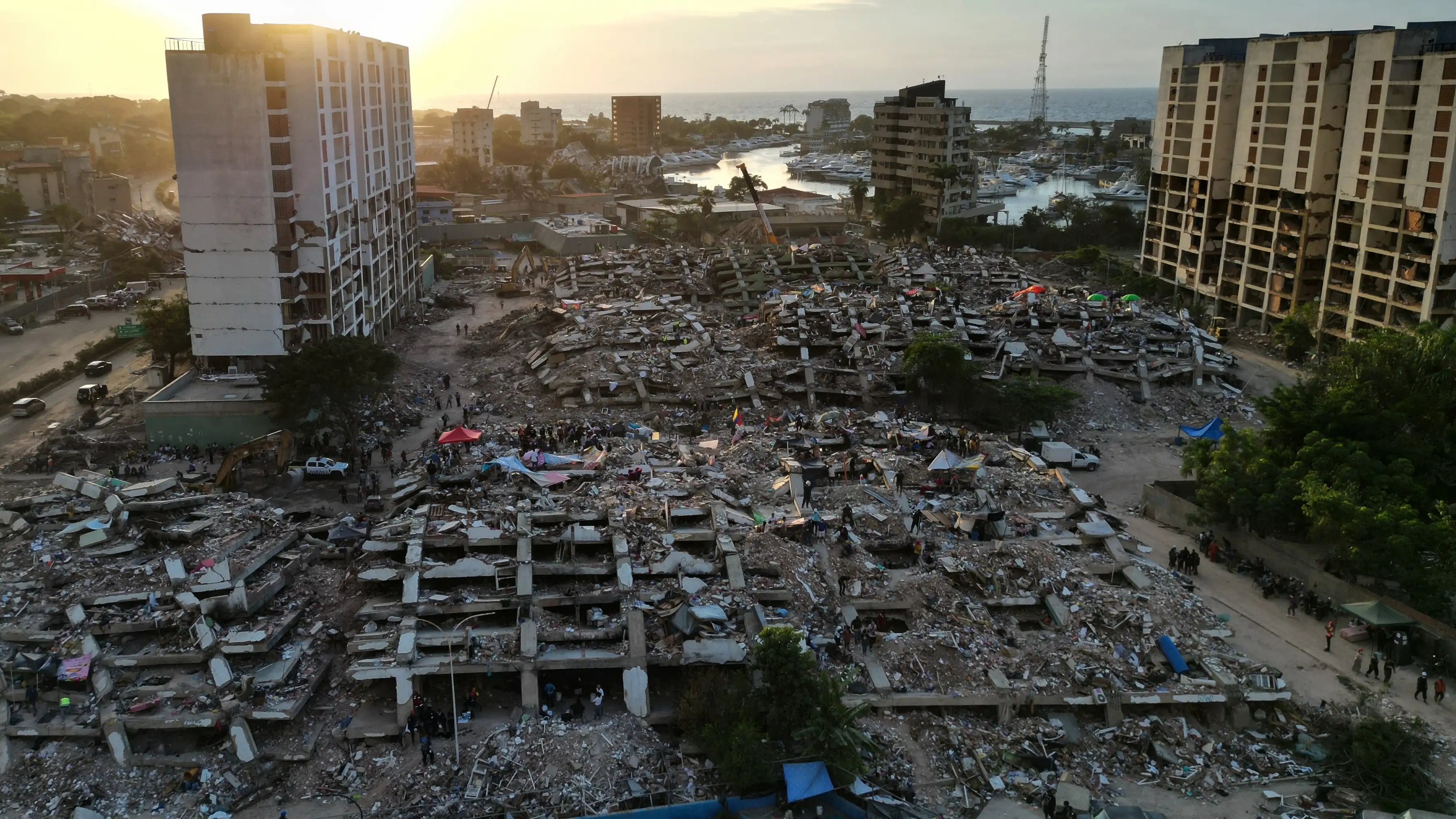
The people of La Guaira never stood a chance on June 24 when powerful, back-to-back quakes struck.

"They were defying nature" when government officials decided to build there, said Carlos Valdes, head of the seismology department at the Institute of Geophysics of the National Autonomous University of Mexico.

The quakes killed more than 6,500 people and left over 17,000 homeless. The government of acting President Delcy Rodriguez has done little to quell the rage of those who survived the quakes in the three months since that June evening - and she has failed to address why so many buildings collapsed and so many died.

The answer, in fact, can be traced back to 2010 and decisions made after mudslides and heavy rain displaced more than 100,000 people across the country, experts and former government officials told the AP.

That's when the Venezuelan government raced to ease a humanitarian crisis by constructing scores of apartments on the strip of land flanked by crystalline waters of the Caribbean Sea to the north and lush mountains to the south.

The setting was idyllic. The land beneath it was not.

An area prone to natural disasters and earthquakes

When Venezuela was rocked by the 7.2- and 7.5-magnitude earthquakes, at least 14 apartment towers in La Guaira fell nearly at the same time, pancaking one floor on top of another, trapping hundreds inside. Fires broke out as gas tanks exploded. People screamed for help. Few survived. Bodies were recovered from what used to be bedrooms, stairs, hallways and kitchens. Many were found hugging.

The area, in northern Venezuela, is no stranger to natural disasters.

A deadly 6.6-magnitude earthquake hit the area in 1967, prompting among other actions the design of quake-resistant construction guidelines and the creation of the Venezuelan Foundation for Seismological Research, a counterpart of the U.S. Geological Survey. Similar to June's earthquakes, it destroyed buildings in La Guaira's parish of Caraballeda and Venezuela's capital, Caracas.

But no disaster had devastated La Guaira like the floods and mudslides that killed tens of thousands of people in 1999. After the tragedy, President Hugo Chavez's government chose engineer and then-science minister Carlos Genatios to helm a reconstruction plan.

His team worked with local and international experts to develop a hazard-mitigation program for the state, which included land-use restrictions along the coastal strip primarily to reduce the dangers associated with rains and, to a somewhat lesser extent, earthquakes, Genatios told AP in an interview.

"There are areas, tracts of land, that should not have been used because they are prone to flooding during major surges; in such places, one should place very lightweight structures, parks, sports courts or similar facilities that do not cause major damage and, above all, do not result in fatalities," Genatios said.

Genatios said scientists warned officials that the area's history of mudslides and floods would enhance the risks posed by earthquakes. That's because any buildings would be constructed on the loose, rocky soil that had been deposited there over centuries by floods and mudslides.

The area was also near the major San Sebastian Fault line that runs off the coast and right underneath La Guaira state.

The government disregarded the dangers. In 2011, at Chavez's direction, it kicked off a massive push to expand public housing to assist people who had been displaced by torrential rains that led to deadly floods and mudslides in late 2010. The government had relocated the displaced - many among them supporters of Chavez's self-described socialist movement - to public schools, government buildings, military facilities and even the presidential palace.

The government lacked enough land to build its projects, which led to expropriations and to Chavez himself encouraging Venezuelans to help the state compile a list of abandoned lots. As buildings went up, trade and watchdog organizations raised concerns about the projects' compliance with construction standards, including seismic-resistant design requirements, and the quality of materials used such as cement and steel.

The rise of apartment complexes

Housing towers reminiscent of East Germany's prefab communist era high-rises were built in Caraballeda as part of the Great Housing Mission Venezuela program. Each tower became known as an "O-P-P," a shortened version of "O-P-P-P-E," the Spanish acronym of the office Chavez tasked with carrying out the program. All but four of the 43 towers erected in the state of La Guaira were in Caraballeda.

A state-owned newsletter published a photo of one of the towers with the caption that proclaimed it "proudly stands as a symbol of revolutionary justice."

People assigned apartments in Caraballeda were delighted when they finally received the keys. Many had lived with relatives or in shelters after being displaced by the 2010 torrential rains. Adults and children finally had bedrooms of their own. Bathrooms came with doors. The beach was a short walk away.

However, they noticed problems right after moving in: Potable water service was essentially nonexistent; elevators stopped working; and trash chutes were breeding grounds for rats and cockroaches.

And they were unaware of the risks during an earthquake. Apartment complexes that were between 10 and 20 floors could end up swaying at the exact same rate as the seismic waves, in a phenomenon known as resonance. The syncing results in the building swaying farther and longer, putting additional pressure on columns and increasing the likelihood of damages and collapse, experts said.

It is unknown whether government contractors followed Venezuela's building codes. It is also unknown whether officials conducted soil studies before construction began, or whether those studies were ignored. The government has not made public blueprints, soil studies, inspection records or the "descriptive memorandum," a document that should include engineering and architectural specifications.

Francisco "Farruco" Sesto, who headed the office responsible for Chavez's housing mission, did not respond to an interview request from AP.

Less than two weeks after the earthquakes, he told an influencer affiliated with the government that land chosen for public housing projects underwent soil studies. He did not show proof to back that assertion, but he did push back on post-earthquake criticism, claiming it is part of an "insidious, malicious campaign" against the housing mission, and he seemingly tried to shift responsibility to the private sector.

"I want to point out that the vast majority of homes built by the state are actually constructed by the private sector as well," Sesto said. "The state acts as the great organizer - the great planner, if you will ... Who performs these soil studies? Primarily, specialized private companies."

Engineers feared the powerful blow June's quakes delivered

Venezuelans were shocked to see the collapsed buildings by the sea. Scientists were devastated, too, but not surprised. The earthquakes were not just powerful. They dealt the very type of blow engineers fear most - a near-fault pulse.

"It was truly instantaneous - very, very, very violent, very fast," said Central University of Venezuela geologist Michael Schmitz, who was formerly affiliated with the country's earthquake-monitoring agency.

Schmitz explained that when the fault shifted, seismic energy stacked up at the front of the rupture as it moved eastward, delivering "a very strong blow to the building's base." That pulse, he said, "abruptly knocked the support out from under the building, leaving it unable to dissipate the energy in the way it was designed to do."

In contrast, buildings on the opposite side of the mountain range, in Caracas, that also have sediment amplification withstood the earthquakes because they were able to sway to dissipate the energy.

Study revealed the quake was particularly devastating

Eduardo Miranda, a Stanford University professor of civil and environmental engineering, and a team of researchers visited Venezuela days after the quake to see if they could determine why the earthquakes had been so devastating.

Without any local instruments or data to determine the intensity of the shaking, Miranda and his team of scientists turned to analyzing video captured by two security cameras near a bowling alley in Caraballeda, the most affected community in La Guaira. The video footage is dramatic: In less than a second, eight buildings collapse simultaneously.

By carefully tracking the motion frame by frame, the team was able to reconstruct how the earthquake produced the motion seen on camera, according to a paper produced by Miranda's team that was shared with AP.

That analysis revealed one of the largest ground motions ever documented in the world and has provided the only quantitative information of the ground motion of the quake near the rupture. Miranda said it would have been difficult for structures meeting safety standards in Japan, which has among the strictest building codes, to have survived what happened June 24.

The paper under peer review for publication in The Seismic Record, the online journal of the Seismological Society of America, determined that buildings in Caraballeda were pushed so far in one direction for so long that they hit their breaking points, Miranda said.

"The number one reason for the large impact in La Guaira is definitely how strong the ground motion was," Miranda said in an interview. "Typically, collapses are the result of a number of factors, but that's an overwhelming main factor of the problems that were there."

Miranda has yet to share the study's results with the Venezuelan government, but his team has made officials aware of the analysis.

"It's clear that they need to raise the level of design," he said.

Experts worry the government may make the same mistakes again

Styrofoam found among the rubble prompted many residents to accuse the government of using substandard materials to reduce costs. Their accusations were also based on well-documented corruption schemes in which officials and contractors colluded to overbill the state, use cheaper materials than reported and pocket the difference.

The government has not provided any information regarding on-site forensic analyses that experts say are crucial to determine the causes and responsibilities, but its cleanup work, including dynamiting damaged buildings, is underway and so is a rebuilding effort.

The government has estimated that more than 17,000 people were displaced by the earthquakes. Thousands of them have since lived in shelters, encampments or sidewalks near their former homes. Some have also been given homes in public housing buildings in Caracas. The government, however, has also promised to rebuild La Guaira, announcing weeks after the earthquake that it had already located land in that state where construction could soon begin.

Experts said they hope the Venezuelan government doesn't simply repeat the mistakes of 15 years ago and instead takes a careful and considered approach to its rebuilding efforts. They also said that the additional design and construction work needed to build high-rises capable of resisting earthquakes in the region will likely dissuade the state and some private investors from developing certain areas.

"The question here is: at what cost?" Valdes said. "I would put it another way: how much is a life worth?"

Sign up to read this article
Read news from 100's of titles, curated specifically for you.
Already a member? Sign in here
Related Stories
Top stories on inkl right now
One subscription that gives you access to news from hundreds of sites
Already a member? Sign in here
Our Picks
Fourteen days free
Download the app
One app. One membership.
100+ trusted global sources.