Wall Street opened the new month on the back foot Tuesday after the United States carried out fresh strikes on Iranian military sites, an escalation that pushed oil sharply higher, sent a key bond yield to its highest point in nearly two years and strengthened bets that the Federal Reserve will raise interest rates later this month.
A war that never fully ended
What is unfolding this week is not a fresh standoff so much as a relapse. Israeli and American warplanes opened hostilities against Tehran on February 28, killing Iran's supreme leader in the opening wave and setting off a conflict that has now passed the six-month mark. Iran retaliated by sealing off the Hormuz waterway to commercial traffic, and Washington spent the following months running a naval blockade and bombing campaign aimed at forcing it back open. Fighting had gone quiet for roughly a month before it flared again over the weekend.
On Sunday, American forces struck two Iranian rocket launchers on Larak Island after intercepting what the military described as preparations to lay sea mines. Iran responded within hours, firing missiles and drones toward U.S. positions in Jordan and an Emirati air base; Jordan's military said at least eight incoming missiles were shot down, and neither side reported casualties. President Trump promised more to come. "We're going to hit them hard. There will be a response," he told a Fox News correspondent by phone.
That response arrived Tuesday. Hours after two oil tankers, one Saudi and one South Korean, were struck by unidentified projectiles as they left the strait, U.S. Central Command confirmed it had struck Iranian Revolutionary Guard Corps positions again, this time in the country's south. It was the second American strike inside 48 hours and the clearest sign yet that the ceasefire-like lull of the past month is over.
Oil jumps, Wall Street retreats
The renewed fighting rattled energy markets immediately. Brent crude, the international benchmark, climbed toward the mid-$90s a barrel during Tuesday's session, while U.S. crude traded in the high $80s — both up sharply from where they stood a day earlier and among the strongest one-day moves in weeks.
Equities felt it too. All three major indexes were solidly lower for the session, with the Dow Jones Industrial Average giving up roughly 400 points at its weakest point of the day, the S&P 500 down around seven-tenths of a percent and the Nasdaq Composite off close to a full percentage point, extending Monday's decline of nearly 375 points. The moves left the Dow hovering in the low-53,000s, a level that had looked like solid ground just a session earlier.
Yields — and Warsh — raise the stakes
Behind the equity selloff sits the bond market. The yield on the 10-year Treasury note pushed above 4.75%, its highest level since January 2025 and roughly a 20-month peak, as investors priced in both the oil shock and a Federal Reserve that sounds less inclined to cut.
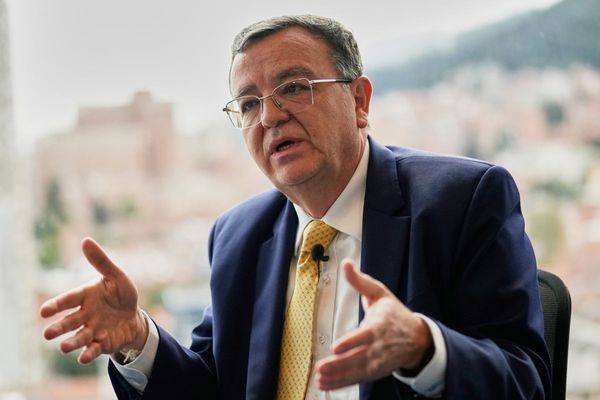
That shift traces back to Kevin Warsh, the Fed chairman, who used his first Jackson Hole address since taking the gavel in May to strike a notably cautious tone. Warsh said this summer's inflation readings, while better than forecast, "do not tell me that underlying trends have meaningfully improved," even though he sounded upbeat about the broader economy's staying power. Warsh stopped short of committing to any specific move, but traders read the tone as hawkish enough to lift the odds of a hike at the Fed's September 16 meeting. Estimates of just how likely that is vary by the hour and by tracker — the CME's FedWatch tool has shown odds anywhere from the high 50s to the high 60s in percentage terms over the past two days — underscoring how fluid the calculation remains heading into the meeting.
Two mega-deals cut through the gloom
Even as stocks fell, dealmaking around artificial intelligence infrastructure kept moving. Anthropic agreed to a $35 billion, six-year computing deal with Lambda — an Nvidia-financed cloud provider — to secure capacity at a roughly 350-megawatt data center in Nueces County, Texas being built by Hut 8, a company that started out mining bitcoin. Nvidia is reported to hold the underlying lease on the facility. The agreement adds to a $45 billion commitment Anthropic struck weeks earlier with cloud provider Nscale for a campus in West Virginia; none of the four companies involved in the Lambda deal has confirmed it publicly, with reporting attributed to people familiar with the matter.
Separately, oilfield-services giant SLB agreed to buy Kelvion, a German maker of industrial cooling systems, for roughly $4.1 billion from its private-equity owners, betting that data centers will need far more thermal-management capacity as AI workloads grow. "AI is driving the most significant infrastructure investment cycle in our lifetime," SLB chief executive Olivier Le Peuch said of the deal, which regulators still need to clear before it wraps up sometime before mid-2027.
Washington secures cheap Venezuelan crude
Amid the market turmoil, the State and War Departments filled in the details of an oil agreement with Venezuela first announced last week. Under the arrangement, the privately held North American Blue Energy Partners will grant Washington the right to buy a fifth of its output at production cost, plus first refusal on everything else it produces. In exchange, Venezuela's interim government handed the company 100-year concessions across 17 fields holding an estimated 65 billion barrels in reserves. A term largely absent from earlier coverage of the deal: the Pentagon's Office of Strategic Capital is also taking a 35% equity stake in the firm's parent company, even as NABEP — headed by oil executive Alejandro Betancourt — keeps its hands on the wheel day to day.
Marco Rubio, running U.S. diplomacy, and Pete Hegseth, atop the renamed Department of War, helped broker the pact, which the administration is framing as a way to refill the country's Strategic Petroleum Reserve on the cheap. That reserve has slid under the 300-million-barrel mark, a depth not seen since the early 1980s, after months of drawdowns tied to the Iran war. Neither Washington nor Caracas has set a timetable for when, if ever, the extra barrels would translate into lower prices at the pump.
What it means for Latino communities
The oil rally lands at an awkward moment for Hispanic households in New York-New Jersey, Chicago, Los Angeles, Houston and South Florida, where daily commutes run on gasoline and a pricier bond market means costlier mortgages and small-business loans — a financing channel many Latino entrepreneurs depend on. The Venezuela agreement carries its own local resonance in South Florida, home to the country's largest Venezuelan diaspora and concentrated in cities like Doral, and in Houston, a historic hub of the energy industry. For now, both governments are staying quiet on when — or whether — any of this reaches the pump.