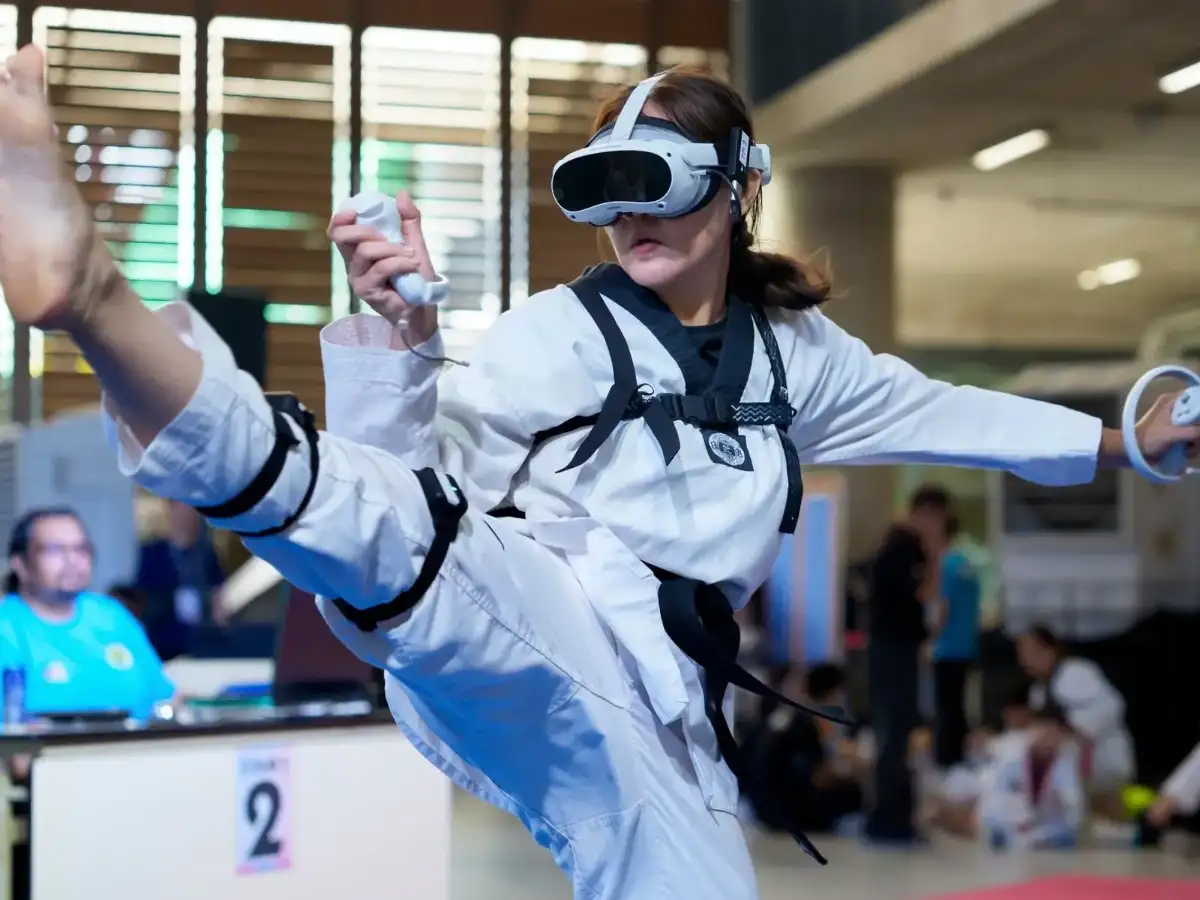
The Olympic Council of Asia has confirmed that Virtual Taekwondo will feature at the 20th Asian Games Aichi-Nagoya 2026, adding a futuristic, technology-driven version of the traditional combat sport to the continental multi-sport event.
Also Read: Asian Games 2026: 10 Indian athletes to watch as India chases another 100-medal haul

How does Virtual Taekwondo work?
Virtual Taekwondo combines traditional taekwondo movements with virtual reality technology. Athletes wear VR headsets and motion-tracking devices that allow them to compete against virtual opponents.
Instead of physically striking each other, competitors score points based on the power and accuracy of their virtual attacks. The winner is the athlete with the highest score on the power gauge when the match ends.
The competition will feature mixed-gender individual bouts in a 16-player knockout format.
Padel and teqball also join Asian Games
Virtual Taekwondo is among the new sports being introduced at the Aichi-Nagoya Asian Games. Padel and teqball, a sport that combines elements of football and table tennis, will also make their debut.
World Taekwondo has said Virtual Taekwondo has attracted strong participation in Asia and is also gaining popularity in North America and Europe. However, the sport remains relatively unfamiliar even within the traditional taekwondo community, with some Korean coaches at a recent tournament saying they had not heard of it until its inclusion in the Asian Games was announced.
Also Read: India’s biggest medal hopes at the Asian Games: The athletes most likely to make the podium
Virtual Taekwondo is very different from traditional sparring
The virtual format requires athletes to approach the sport differently from conventional taekwondo. Competitors tend to favour front kicks over side kicks because they can produce stronger strikes and higher scores in the virtual environment.
Traditional taekwondo bouts often involve athletes circling each other, assessing their opponent and waiting for opportunities to attack. Virtual matches, by contrast, involve competitors jumping and kicking almost continuously.
Coaches and athletes have said the constant movement can demand greater stamina than traditional matches. Mr Ong, the American coach of the virtual taekwondo team that represented the United States at the Chuncheon tournament, also highlighted the physical demands of the format, reported The New York Times.
The Games will run from September 19 to October 4, although competition began on September 10 with the men's basketball tournament. Japan is hosting the Asian Games for the third time, having previously staged the event in Tokyo in 1958 and Hiroshima in 1994. Japan was also among the 11 participating countries at the first Asian Games in 1951.
Organisers had initially budgeted for around 15,000 athletes and officials from 45 participating countries and regions, but registrations rose to about 17,000, putting pressure on accommodation availability. A total of 469 medal events will be held across 43 sports, up from the 40 sports contested at the previous edition in Hangzhou three years ago.
Competitions will be spread across Aichi Prefecture and other parts of Japan, with Tokyo hosting the swimming events and Osaka among the cities staging the football tournament. The Aichi-Nagoya Games will feature several Asian Games newcomers, including mixed martial arts, padel and surfing, along with virtual taekwondo and teqball, which combines elements of football and table tennis.