Get all your news in one place.
100’s of premium titles.
One app.
Start reading
The Conversation
The Conversation
Matt Wilde, Lecturer in Human Geography, University of Leicester

Venezuelans are reacting to Maduro’s capture with anger, fear, hope and joy

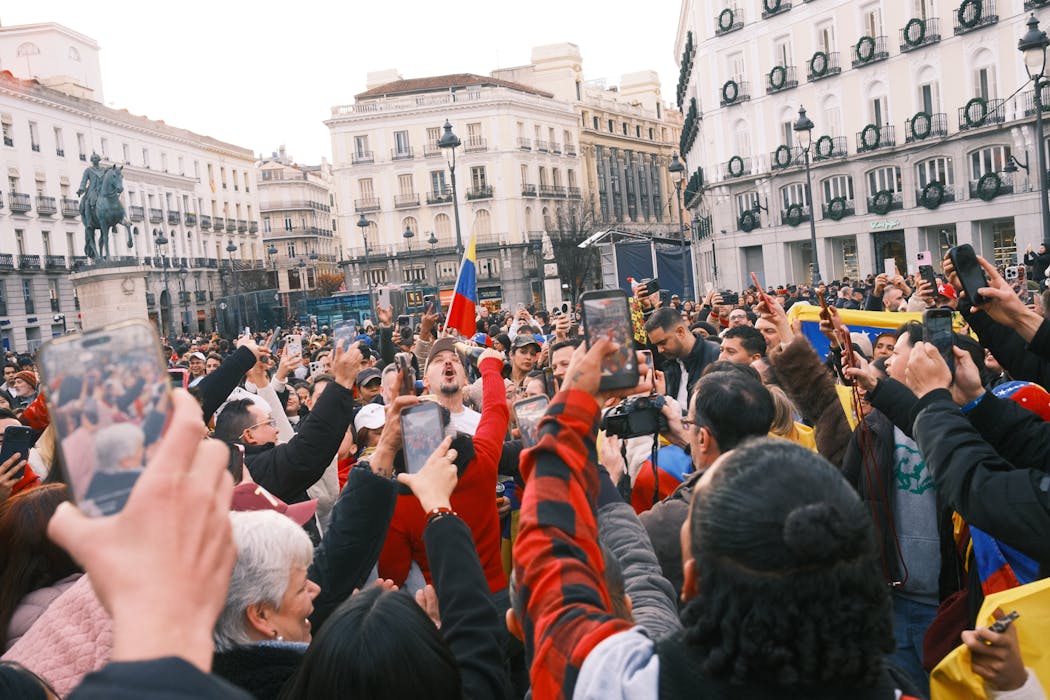
Venezuelans celebrate the news of Nicolás Maduro's capture in Puerta del Sol, Madrid, on January 3. Harry Rodgers

When the news broke of Nicolás Maduro’s arrest following a US attack on Venezuela on January 3, que locura (“what madness”) was the line that seemed to capture the moment. As Venezuelans around the world reached for their phones and anxiously followed the news, they grappled to make sense of what they were seeing.

Drawing on our long-term ethnographic research with Venezuelans living in Spain, the US and Venezuela itself, the insider accounts and interviews detailed below show the diverse ways in which these events are being experienced and understood.

In the Spanish capital of Madrid, many Venezuelan migrants celebrated what they saw as a long-awaited turning point. But across Venezuela’s diaspora and inside the country, others described an uneasy quiet and deep fears about what might come next. These contrasting reactions reveal a moment shaped as much by uncertainty and suspicion as by relief and hope.

At the Puerta del Sol square, home of Madrid’s regional government, we joined hundreds of Venezuelans as they met to celebrate the news that Maduro had been taken into US custody. After beginning as a small gathering, the numbers soon swelled and a party atmosphere took hold.

Anti-government chants such as y ya cayó, y ya cayó, este gobierno ya cayó (“it fell, it fell, this government fell”) and se fue, se fue, (“he’s gone, he’s gone”) reverberated around the square.

Venezuelans, many of whom have claimed political asylum in Spain, hugged, shouted, cried and danced under a 32-metre-high Christmas tree, enjoying a welcome moment of reprieve. One older Venezuelan woman dressed as the US president, Donald Trump, handed out fake dollar bills as a “reward” for capturing Maduro.

Another attendee, a 26-year-old delivery rider, described how he partied until the early hours of the morning in a bar hung with Venezuelan flags. “I’m very, very happy,” he said. “They finally captured that dictator.”

A woman dressed as Donald Trump during celebrations in a public square in Madrid.
A woman dressed as Donald Trump during celebrations in the Puerta del Sol square in Madrid, Spain. Harry Rodgers

But these jubilant scenes were not the only reaction. Other Venezuelans we spoke to expressed a more cautious and contingent hope. In an interview conducted over the weekend in Madrid, a Venezuelan woman called Araceli described how she didn’t feel comfortable attending the Puerta del Sol celebrations.

“I just feel very sad. I am happy Maduro’s going to be in jail, but I know the repercussions. I know what a war means.” She continued through tears: “I just want my family to be safe. I just want the simple things. I can’t celebrate until I know my family are safe.”

Such sentiments were echoed by Guillermo, a Venezuelan man we interviewed online who is currently living in the US city of Chicago. “It’s confusing. I’m happy that Maduro has lost power, but scared because I fear the consequences of the US taking over my country.”


Read more: Donald Trump's raid on Venezuela foreshadows a new 'great power' carve-up of the world


Many Venezuelan migrants want the chance to return home to a stable country, but are concerned about how Venezuela’s heavily militarised regime will respond to the US attack. Since Maduro’s capture, security forces and pro-government motorcycle gangs known as colectivos have patrolled the streets of Venezuela’s capital, Caracas.

They are also deeply suspicious of Trump’s motives. In the aftermath of Maduro’s abduction, Trump said the US would “run” Venezuela, though several prominent Republicans swiftly backpedalled on this assertion.

Reaction inside Venezuela

This sense of caution is playing out on Venezuela’s streets as well. Ernesto, a small business owner in the central city of Barquisimeto, described to us how his friends and neighbours are responding to Maduro’s arrest.

“A lot of anticipation and uncertainty. There’s joy that Maduro has been taken away, but no one is celebrating in public. Lots of people won’t go out because they’re worried that they’ll be stopped and robbed of their car and money if they’re out on the street. Others have gone out to stock up on groceries and gas in case of shortages.”

The removal of Maduro is also bringing longstanding political tensions to the fore. Luis, originally from the Venezuelan city of Valencia, sent us a voice note describing how he had to leave family WhatsApp groups to avoid political arguments. “Oh, you’re the best Donald Trump, oh thank you so much! Make Venezuela Great Again! It makes me so sad and angry,” he recounted sarcastically.

A woman waves the Venezuelan flag during celebrations in Madrid.
A woman waves the Venezuelan flag during celebrations in Madrid. Harry Rodgers

Anger at what many perceive to be naked imperialism from the US is expressed by Venezuelans across the political spectrum, including those who never supported the Bolivarian Revolution that was initiated by Maduro’s predecessor, Hugo Chávez.

“I am sceptical,” says Jaime, a resident of Caracas. “I don’t know if I should be happy because I don’t like Trump’s tone. He continues with his theory that we stole his oil and it sets a terrible precedent. Losing our sovereignty over the resource that sustains Venezuela would be something terrible.”

Such concerns are shared by Valentina, a retired academic based in Valencia. She told us: “Imagine, we’re being invaded by the US! It’s horrible but we can’t do anything, just wait and see what their administration will be like.”

These diverse reactions show how geopolitical ruptures are lived through families, friendships and daily routines, shaping intimate decisions and relationships in the process. As Venezuela becomes the focal point for a seismic realignment of the global political order, ordinary Venezuelans once again find their lives being restructured by forces beyond their control.

Across Venezuela’s transnational population, the present moment is marked simultaneously by hope, fear and profound uncertainty about what the future holds.

The Conversation

The research for this article was funded by the British Academy (SRG2324\240415) and the Economic and Social Research Council (ES/2878167).

This article was originally published on The Conversation. Read the original article.

Sign up to read this article
Read news from 100’s of titles, curated specifically for you.
Already a member? Sign in here
Related Stories
Top stories on inkl right now
One subscription that gives you access to news from hundreds of sites
Already a member? Sign in here
Our Picks
Fourteen days free
Download the app
One app. One membership.
100+ trusted global sources.