Get all your news in one place.
100's of premium titles.
One app.
Start reading
Bangkok Post
Bangkok Post
National

Two new plant species discovered in Tak national park

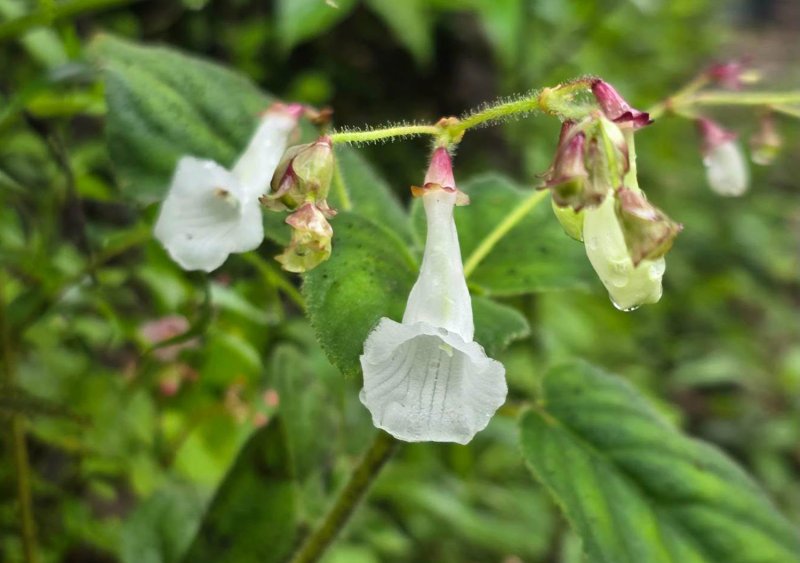
Didymocarpus niveus (Krading Khao Khun Phawo). (Photos: Department of National Parks, Wildlife and Plant Conservation)

Two plant species previously unknown to science have been discovered in Khun Phawo National Park in Tak province, the Department of National Parks, Wildlife and Plant Conservation (DNP) said.

The newly identified species belong to the Gesneriaceae family and the Didymocarpus genus. They have been named Didymocarpus niveus, or "Krading Khao Khun Phawo", and Didymocarpus vilaiwaniae, known in Thai as "Muang Sri Anusarn".

Both species were recently found in Khun Phawo National Park in Mae Ramat district during research carried out by botanists from the DNP and partner institutions. The work built on earlier plant surveys and herbarium specimens collected since 2011 by Thai researchers.

The discoveries were formally published last month in Thai Forest Bulletin (Botany), volume 54 (2). The publication formed part of a study documenting 10 newly discovered Didymocarpus species in Thailand. The findings raise the number of recorded species in the genus in Thailand to 35. (Story continues below)

Krading Khao Khun Phawo is named after its pure white flowers, which resemble snow. The herbaceous plant grows on soil and rocky surfaces, can reach 25 centimetres in height and enters a dormant period during the dry season. It produces white, funnel-shaped flowers about 3.5cm long.

The second species, Muang Sri Anusarn, was named in honour of Assoc Pro Vilaiwan Anusarnsunthorn, a former biology lecturer at Chiang Mai University’s Faculty of Science. The plant grows on soil and develops bright purple flowers during the rainy season. It has red to dark-red flower stalks and distinctive silver-haired leaves. (Story continues below)

Didymocarpus vilaiwaniae (Muang Sri Anusarn)

According to the DNP, both species are currently classified as Data Deficient (DD) under International Union for Conservation of Nature (IUCN) criteria because more field studies are needed to determine their population sizes and distribution in the wild.

The department added that the discovery not only adds to global botanical knowledge but also highlights the ecological richness of Khun Phawo National Park and the importance of continued conservation and research in the area.

Sign up to read this article
Read news from 100's of titles, curated specifically for you.
Already a member? Sign in here
Related Stories
Top stories on inkl right now
One subscription that gives you access to news from hundreds of sites
Already a member? Sign in here
Our Picks
Fourteen days free
Download the app
One app. One membership.
100+ trusted global sources.