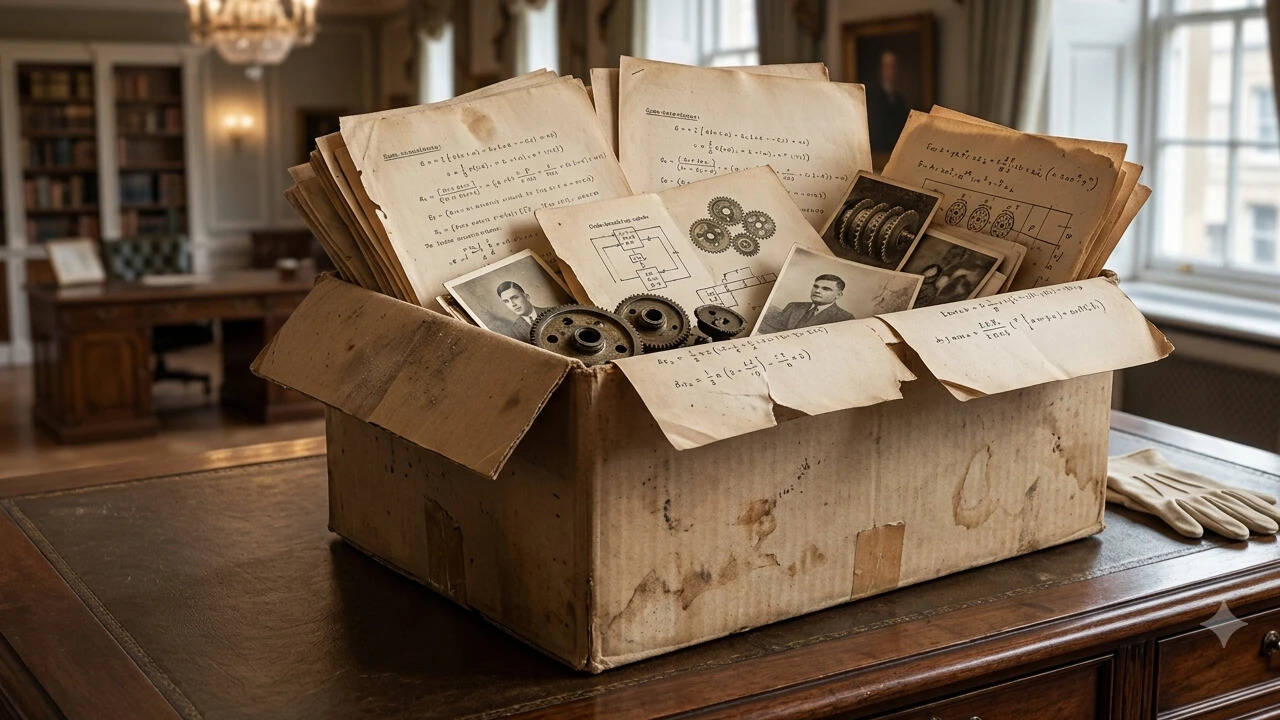
A collection of papers written by the British mathematician Alan Turing was discovered in November 2024, buried among the personal effects of Norman Routledge, a Cambridge mathematician. According to Hansons Auctioneers, the family had been on the verge of shredding the papers before deciding to have them assessed. Seven months later, in June 2025, the lot sold for £465,400 at Hansons Rare Book Auctions in Staffordshire, more than triple the presale estimate.
Get breaking news anytime, anywhere. Download the TOI app now!

Norman Routledge received the papers as gifts from Turing's mother
This set of papers had belonged to Norman Routledge, who was a mathematician and longtime friend of Alan Turing from his days at King's College, Cambridge University. Turing, a brilliant mathematician who studied at King's and obtained his PhD in 1938, worked as a codebreaker at Bletchley Park during World War II and is known as a pioneer of computer science, according to Bletchley Park's official history of his life . After Turing died in 1954, his mother, Ethel Turing, passed a number of his academic offprints and personal papers on to Routledge, including a handwritten letter in which she apologized for being unable to send along Turing's paper on morphogenesis right away, a paper she evidently did send on later, since it later turned up in the same collection at auction.
The papers sat untouched in a loft for years
Routledge passed away in 2013, leaving his sisters to deal with his possessions. Instead of throwing out the documents, one of his sisters decided to put the documents away in her loft, where they would go untouched for nearly ten years. She was later admitted to a care home, and when her daughters were sorting through her things, they came across the documents. According to Hansons Auctioneers, the daughters were seriously considering shredding the lot.
A family reunion led to a valuation, November 2024
It was only through the efforts of a cousin attending the family gathering in November 2024 that the documents were rescued; she recommended having the documents assessed before doing anything else. The family followed the recommendation by bringing the documents to a local valuation event in a carrier bag, and there the documents were evaluated by experts from the auction house Hansons, who referred the documents to their Rare Books Department in Lichfield, Staffordshire.
The auction result far exceeded its estimate, June 2025
The auction date was June 17, 2025, when bidding was done online, over the telephone, and face to face. Auctioneers had previously estimated that the most important pieces of the collection would go for £40,000 to £60,000 each, but the estimate was surpassed by the bidding very soon after its start. The original paper written by Turing in 1936 titled "On Computable Numbers, with an application to the Entscheidungsproblem," which was the paper that gave birth to the idea of the universal computer, was sold for £208,000.
The original copy of Turing's Ph.D. thesis, titled 'Systems of Logic Based on Ordinals' and completed in 1938, went for £110,500. Together with other items from the collection, the sale totalled £465,400 including the buyer’s premium, which Hansons Auctioneers described as one of the strongest results for Turing material.
The collection included Turing's only chemistry paper
The archive also included The Chemical Basis of Morphogenesis , Turing’s 1952 final paper and his only work in the field of chemistry. The auction house described the items as offprints, separate printings of scholarly papers produced in limited quantities for academic use. That scarcity helps explain why so few collections survive today.
An archive preserved for future study
Much of Turing's surviving written work, including drafts, letters, and lecture notes related to the papers sold in this collection, is preserved and catalogued at the Turing Digital Archive, managed by King’s College, Cambridge, which was not only the place where Turing studied but was also his fellowship. The collection is divided into eight groups covering his academic publications, wartime work on the Enigma machine, and personal correspondence, giving scholars a fuller view of his life than an auction listing can provide.