Get all your news in one place.
100’s of premium titles.
One app.
Start reading
Sports Illustrated
Sports Illustrated
Sport
Conor Orr

Tua Tagovailoa’s Long, Drawn-Out Decline Could Have Been Prevented

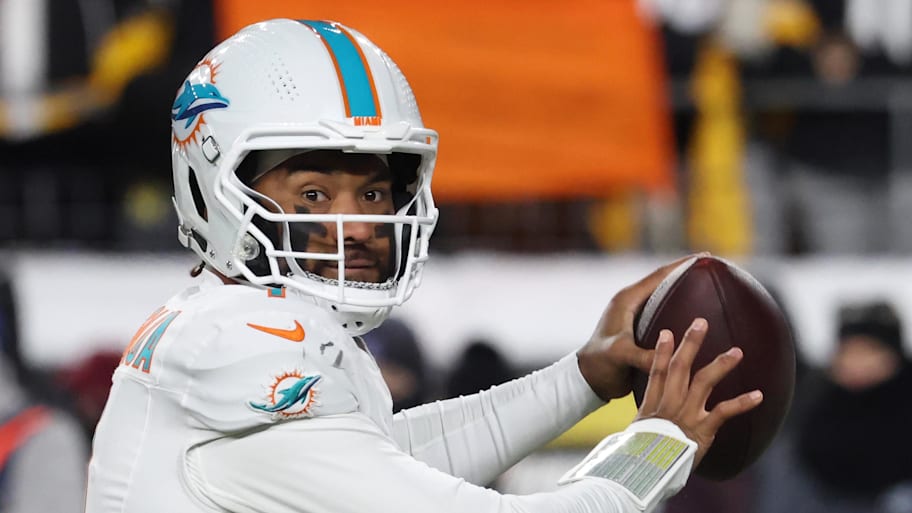
Tua Tagovailoa has been benched, having quite possibly played his last game with the Dolphins. While his position as the team’s emergency-only quarterback is largely symbolic—with his money for next season already guaranteed, it makes no difference whether he gets injured or not—the players in front of Tagovailoa tell a more important story. 

Starting against the Bengals this weekend is the team’s 2025 seventh-round pick, Quinn Ewers, and backing up Ewers is Zach Wilson, a reclamation project that never quite got off the ground. While Wilson’s athleticism and arm talent were initially viewed as an ideal fit for the boot-heavy Shanahan-style offense, Wilson has struggled to grasp the timing and rhythms of the NFL, either in a Shanahan scheme or with Sean Payton the year prior. While he expressed his frustration with not starting this weekend, it’s clear that, having not wedged his way into the conversation at any point during Tagovailoa’s worst season in years, Wilson was not more than a placefiller on this roster. 

MORE: NFL Mailbag: Is the Tagovailoa-McDaniel Era Over in Miami?

Ewers may be at the start of his own Brock Purdy-like journey, but the fact is that he’s just the second quarterback drafted in the McDaniel era, both in the seventh round (Skylar Thompson being the other). Even when Tagovailoa struggled heavily during his rookie season—among quarterbacks with at least 100 snaps his rookie year, he was 32nd in a composite of EPA and completion percentage over expectation, having been benched multiple times by then-head coach Brian Flores in favor of Ryan Fitzpatrick—the Dolphins didn’t backstop the pick in 2021 with a middle-round prospect. 

The lack of an in-house option that could regularly challenge Tagovailoa was the result of a general manager desperately needing to legitimize the selection, a feeling that only heightened after the team signed Tagovailoa to the richest contract in NFL history last summer (this despite one playoff appearance in which he barely completed 50% of his passes).

For reference, the Eagles took Jalen Hurts in the second round a year after signing Carson Wentz to an extension. Since making Hurts the full-time starter, the Eagles have drafted both Tanner McKee and Kyle McCord, traded for former first-round pick Kenny Pickett and signed former fourth-round pick Ian Book. 

Two years after drafting Josh Allen, the Bills selected Jake Fromm in the fifth round and signed former first-round pick Mitch Trubisky. The Ravens drafted a quarterback in the sixth round (Trace McSorley) the year after drafting Lamar Jackson. The Packers have drafted two quarterbacks since taking Jordan Love and signed Malik Willis, a former third-round pick who, in the lead up to the maligned 2022 quarterback draft, had some believing he could be a first-round caliber prospect. 

One could argue that nearly every season, Kyle Shanahan brings in a young-ish quarterback with upside to back up Purdy, who, himself as a young quarterback with upside, supplanted a failed first-round pick, Trey Lance. Interestingly enough, the arrival of Mac Jones has added legitimate competition to the room against Purdy, who, not so unlike Tagovailoa, was the subject of rabid debates about his financial worth versus true market value for a No. 1 quarterback. Jones is going to be making $4 million in San Francisco next year when he could fetch roughly five times that amount on the open market this coming offseason given the dearth of quality starting quarterbacks (Philip Rivers, for christ sakes, is starting another NFL game this weekend). 

Miami Dolphins head coach Mike McDaniel
Mike McDaniel has been tied to Tagovailoa for his entire stint with the Dolphins; it’s still undecided whether he’ll coach a season without him. | Rich Storry-Imagn Images

The point? It’s not about the Dolphins making a poor financial decision by signing Tagovailoa to a contract and getting itself into a position where it would need to gobble dead money just to part ways with him. That is a natural part of the NFL life cycle and a compliment to someone like McDaniel who, like Brian Daboll, coached a mid-level NFL quarterback to the height of his potential at an incredibly unfortunate time that necessitated a market-level extension when no other options materialized.

It is about not making a desperate effort to secure cost-controlled talent with upside behind Tagovailoa in the event that he failed; a practice that is so fundamentally sound and proven in the NFL that it’s practiced by most successful teams.  

Again, it goes back to wanting something to look a certain way. There are structures that promote winning above all else and structures that, at some point, break down to the point where winning a certain way and winning with a certain player takes priority. The Dolphins needed Tagovailoa to succeed. Add in McDaniel, a coach with a great deal of empathy for a player who claimed he was mistreated by his previous head coach, and you have a recipe for a quarterback to quietly go unchecked even while some of the limitations he had displayed early on remained in the background. 

If McDaniel survives this season—and I believe he can—he’ll have a chance to rectify that situation. But, he starts near ground zero, as Tagovailoa remained Plan A for far, far too long. 


More NFL on Sports Illustrated


This article was originally published on www.si.com as Tua Tagovailoa’s Long, Drawn-Out Decline Could Have Been Prevented.

Sign up to read this article
Read news from 100’s of titles, curated specifically for you.
Already a member? Sign in here
Related Stories
Top stories on inkl right now
Our Picks
Fourteen days free
Download the app
One app. One membership.
100+ trusted global sources.