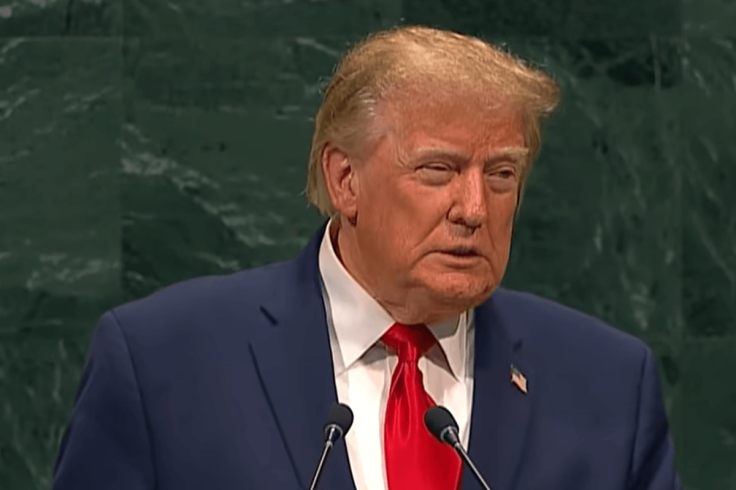
Donald Trump opened his United Nations speech with a sweeping declaration of American strength. Then came an awkward pause.
'America is back, and our country is stronger today than ever before,' Trump told world leaders at the UN General Assembly in New York on 22 September. He appeared to wait for applause, but the opening response was notably muted, with several awkward silences reported from inside the chamber.
The moment set the tone for an address that soon moved from boasts about US power to an extraordinary threat against Iran, followed by an unexpected prediction that a deal could come after the US midterm elections.
Trump keeps pausing for applause at the UN meeting and but it never arrives.
— ThePatrioticBlonde™🇺🇸 (@ImBreckWorsham) September 22, 2026
Every leader from every country around the world knows he's lying and they are refusing to play along.
How embarrassing. pic.twitter.com/0Kc8leZoZl
Trump's Strength Message Meets Silence
Trump used the opening of his speech to portray the United States as an unrivalled global power.
'Our economy is the envy of the world. Our military is the most powerful on earth. Our technology is second to none,' he said, before adding that America was 'rising' and its power was 'expanding'.
But the response to his opening declaration was strikingly subdued.
That does not mean the chamber remained silent throughout. Trump's later pledge that Iran would never obtain a nuclear weapon generated applause throughout the chamber, according to the Los Angeles Times. The contrast made the opening pause stand out even more.
Trump Threatens To 'Annihilate' Iran
The speech took a far darker turn when Trump addressed Iran.
With Iranian representatives in the chamber, he presented what he described as a choice between reaching an agreement and destroying the Islamic Republic.
'Or do I annihilate the Islamic Republic and do it quickly?' Trump asked, before continuing: 'Do I drive them into hell with no chance of survival and no hope of future greatness or generations?'
Trump used the remarks to defend the US campaign against Iran and his insistence that Tehran must never obtain a nuclear weapon.
He also called on other countries to maintain economic pressure on Iran, while claiming that US military action had severely weakened the country's military capabilities. Those claims formed a central part of his defence of the conflict.
From Annihilation to a Deal
Then Trump abruptly shifted from the language of destruction to diplomacy.
'I believe we'll make a deal right after the election,' he said, referring to the US midterm elections on 3 November. Trump claimed Iran was waiting to see how he performed politically.
He then stressed that he was not personally running, saying he had already won 'in a landslide' and would remain president for another two and a half years.
The result was one of the speech's most striking sequences: Trump warned that Iran could face annihilation, then predicted that negotiations could produce a deal shortly after the election.
Iranian Delegates Walk Out
The reaction from Iran's delegation was far more visible than the muted response to Trump's opening boast.
Members of the Iranian delegation walked out as Trump turned to his threats against the Islamic Republic. Iranian President Masoud Pezeshkian and Foreign Minister Abbas Araghchi were in New York for the UN gathering but did not attend Trump's address in the General Assembly chamber.
The Cuban delegation later walked out after Trump described Cuba as an 'absolutely failed state' and said its communist government 'will fall'.
The exits added a striking visual chapter to an address already marked by an uncomfortable opening.
A Speech Built Around American Power
Trump repeatedly presented military strength as the force behind his foreign-policy record.
'While others have talked, I have acted,' he said, claiming that while others had spoken about peace, he had 'made peace'. The White House highlighted the same remarks in its account of the address.
Yet the most revealing sequence came early: a declaration that America was stronger than ever, an apparent wait for applause, a muted response, then an escalation into threats against Iran and a promise that diplomacy could still deliver a deal.
Trump's message to the UN was unmistakable. American power, he argued, could force adversaries towards the negotiating table.
The reaction inside the chamber showed that projecting strength and receiving an enthusiastic response are two very different things.