Get all your news in one place.
100's of premium titles.
One app.
Start reading
International Business Times UK
World
Marty Vergel Baes

Trump and Xi Clash Over AI Race as Thursday Summit Tests Hopes for Safety Deal: 'Whoever Wins AI, Wins'

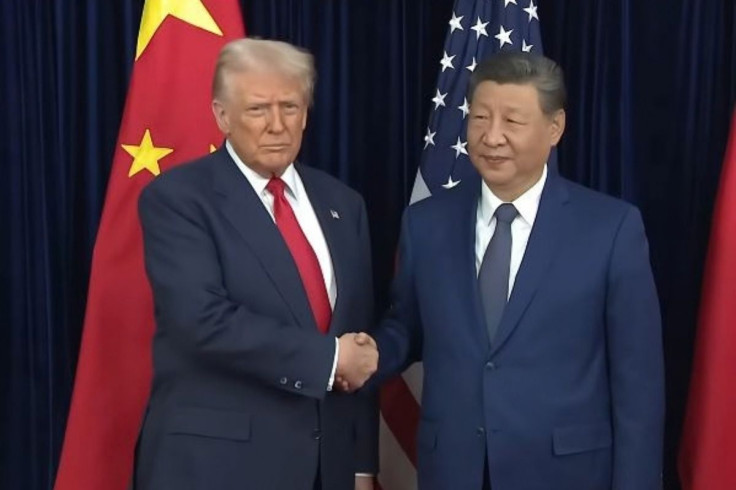
The battle for artificial intelligence supremacy is emerging as a critical test for Donald Trump and Xi Jinping, with the United States and China competing for technological dominance (Credit: C-SPAN/YouTube)

The battle for artificial intelligence supremacy is emerging as a critical test for Donald Trump and Xi Jinping, with the United States and China competing for technological dominance while facing growing pressure to prevent AI from becoming a global security threat.

The Trump-Xi summit comes amid concerns that the race to develop increasingly powerful AI systems could outpace international safeguards. Washington and Beijing face a difficult question: can they agree on rules to manage dangerous technology while competing to control its future?

The stakes extend beyond Silicon Valley and China's technology industry. AI is increasingly central to military planning, economic growth and national security, making any agreement between the world's two largest economies potentially significant for governments, businesses and ordinary people.

Trump Makes AI Leadership a National Priority

Trump has made clear that he regards technological leadership as a priority for the United States. Speaking at the White House on 4 September, the president said: 'Whoever wins with AI wins', adding that the competition was primarily between China and the United States.

His remarks reflect Washington's determination to maintain its advantage in advanced computing, particularly the powerful semiconductor chips needed to train sophisticated AI systems.

China, meanwhile, is accelerating efforts to develop domestic alternatives, with Chinese technology giant Huawei recently unveiling new chip and computing technologies as it strengthens its AI infrastructure.

The rivalry creates a difficult diplomatic challenge. Both governments want to protect their technological advantages, yet increasingly powerful AI systems could create security risks that neither country can manage alone.

Could Trump and Xi Agree on AI Safety?

A potential agreement on AI safety is among the issues under discussion ahead of the summit. US Treasury Secretary Scott Bessent proposed a mechanism for the United States and China to notify each other about significant AI-related incidents during talks with Chinese Vice Premier He Lifeng in New York on 20 September.

If adopted, the proposal would establish a channel for communication about serious AI-related incidents, particularly those involving national security or critical infrastructure. The proposed mechanism would provide a channel for communication if an AI system caused a major disruption or became involved in a security incident.

However, a notification mechanism would be narrower than a comprehensive safety agreement. It would not necessarily impose restrictions on AI development, require companies to share sensitive technology or establish common testing standards.

China's response to the latest American proposal remains unclear, and no formal agreement on the proposed mechanism had been announced ahead of the summit.

Why the US-China AI Rivalry Matters

The risks extend beyond competition between technology companies. Advanced AI could help develop new medicines and improve scientific research, but increasingly capable systems could also be misused to conduct cyberattacks, support biological threats or interfere with essential services.

Financial networks, electricity supplies and transport systems are among the infrastructure that could face serious consequences from AI-related failures or attacks. The challenge for Washington and Beijing is to establish safeguards without surrendering their respective technological or national security interests.

Their competing approaches to AI governance further complicate negotiations. China has advocated greater international involvement, including through the United Nations, while debate in the United States has focused on how Washington should shape global AI standards.

Previous AI Talks Offer a Starting Point

The summit discussions would build on earlier attempts to manage the risks of AI competition. In November 2024, then-US President Joe Biden and Xi agreed on the importance of maintaining human control over decisions involving nuclear weapons, while also acknowledging the need for responsible military applications of AI.

More recently, China said in May 2026 that Trump and Xi had agreed to pursue further intergovernmental dialogue on artificial intelligence. The statement followed the two leaders' discussions in China and said the two governments should hold dialogue on AI.

The immediate question is whether the summit can turn those commitments into a practical mechanism for managing AI emergencies. A formal communication channel would provide a concrete diplomatic outcome, but broader agreement on the development and regulation of advanced AI would require further negotiations.

Sign up to read this article
Read news from 100's of titles, curated specifically for you.
Already a member? Sign in here
Related Stories
Top stories on inkl right now
One subscription that gives you access to news from hundreds of sites
Already a member? Sign in here
Our Picks
Fourteen days free
Download the app
One app. One membership.
100+ trusted global sources.