
Get all your news in one place.
100's of premium titles.
One app.
Start reading
The Conversation
The Conversation
Sophie Blondel, Research Assistant Professor of Nuclear Engineering, University of Tennessee

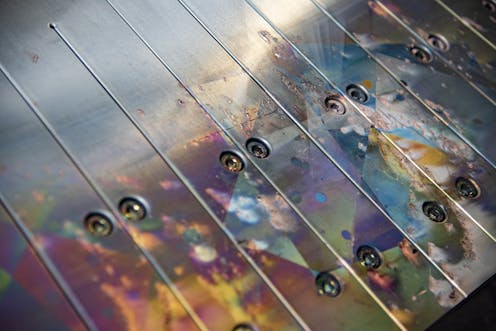
To make nuclear fusion a reliable energy source one day, scientists will first need to design heat- and radiation-resilient materials

A fusion experiment ran so hot that the wall materials facing the plasma retained defects. Christophe Roux/CEA IRFM, CC BY

Fusion energy has the potential to be an effective clean energy source, as its reactions generate incredibly large amounts of energy. Fusion reactors aim to reproduce on Earth what happens in the core of the Sun, where very light elements merge and release energy in the process. Engineers can harness this energy to heat water and generate electricity through a steam turbine, but the path to fusion isn’t completely straightforward.

Controlled nuclear fusion has several advantages over other power sources for generating electricity. For one, the fusion reaction itself doesn’t produce any carbon dioxide. There is no risk of meltdown, and the reaction doesn’t generate any long-lived radioactive waste.

Sign up to read this article
Read news from 100's of titles, curated specifically for you.
Already a member? Sign in here
Related Stories
Top stories on inkl right now
One subscription that gives you access to news from hundreds of sites
Already a member? Sign in here
Our Picks
Fourteen days free
Download the app
One app. One membership.
100+ trusted global sources.







