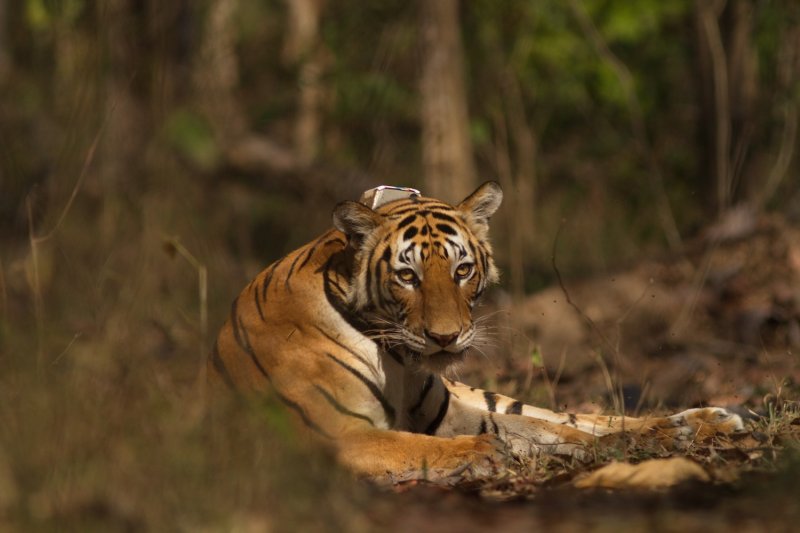
A tiger that killed and dragged away a park ranger in Huai Kha Khaeng Wildlife Sanctuary was behind only the second known attack of its kind in 28 years, and the behaviour was not typical of the species, the Department of National Parks, Wildlife and Plant Conservation (DNP) said on Wednesday.
The comments followed the discovery of the mauled body of ranger Sakarin Wichacharn, 48, near a stream in the sanctuary on Wednesday morning. Officials believe he was attacked while sleeping and dragged about 200 metres from his living quarters. Fresh tiger tracks were found near the body.

Atthapol Charoenchansa, the department’s director-general, told Matichon Online that such incidents were extremely rare, noting that tigers generally avoid humans.
“As far as I can recall, this is only the second time in 28 years that a tiger has attacked a person in this manner,” he said.
Mr Atthapol cited a previous case in Khao Yai National Park on Jan 13, 1998, when a female tiger attacked a park worker in the right arm while they were washing clothes behind staff housing. The worker survived after a colleague fired a warning shot, causing the animal to flee.
Unusual tiger behaviour
Mr Atthapol said the incident did not reflect normal tiger behaviour, noting that tigers are generally wary of people and rarely approach them.
One possibility is that the ranger appeared vulnerable because he was motionless and unable to react.
“It is possible the tiger had been watching for some time before launching the attack,” he said.
Mr Atthapol rejected suggestions that the animal may have been driven by hunger, saying prey remain abundant in the Huai Kha Khaeng forest complex.
Officials are reviewing surveillance footage and images from wildlife camera traps to determine the tiger’s movements before and during the attack. (Story continues below)
Search under way
The DNP has temporarily closed Huai Kha Khaeng Wildlife Sanctuary while authorities search for the tiger responsible.
Mr Atthapol said finding the animal was essential to prevent it from becoming habituated to such behaviour.
“If the animal is not located, there is concern it could repeat the behaviour and pose a danger to officials and the public,” he said.
Sanctuary officials and tiger researchers from the Khao Nang Rum Wildlife Research Station are examining camera-trap footage across the area in an effort to identify the animal.
Mr Atthapol’s assessment was echoed by the Thailand Tiger Project DNP, a Facebook page run by DNP researchers and field staff.
It said the attack was not normal tiger behaviour and there was no indication that the tiger had deliberately targeted a human as prey.
Based on long-term observations, it said tigers typically avoid people and will retreat when a person stands up or moves after being spotted.