
Get all your news in one place.
100's of premium titles.
One app.
Start reading
Digital Camera World
David S Young

This titanium masterpiece was the most advanced film camera of the 1990s – but is now a beautiful ticking time bomb

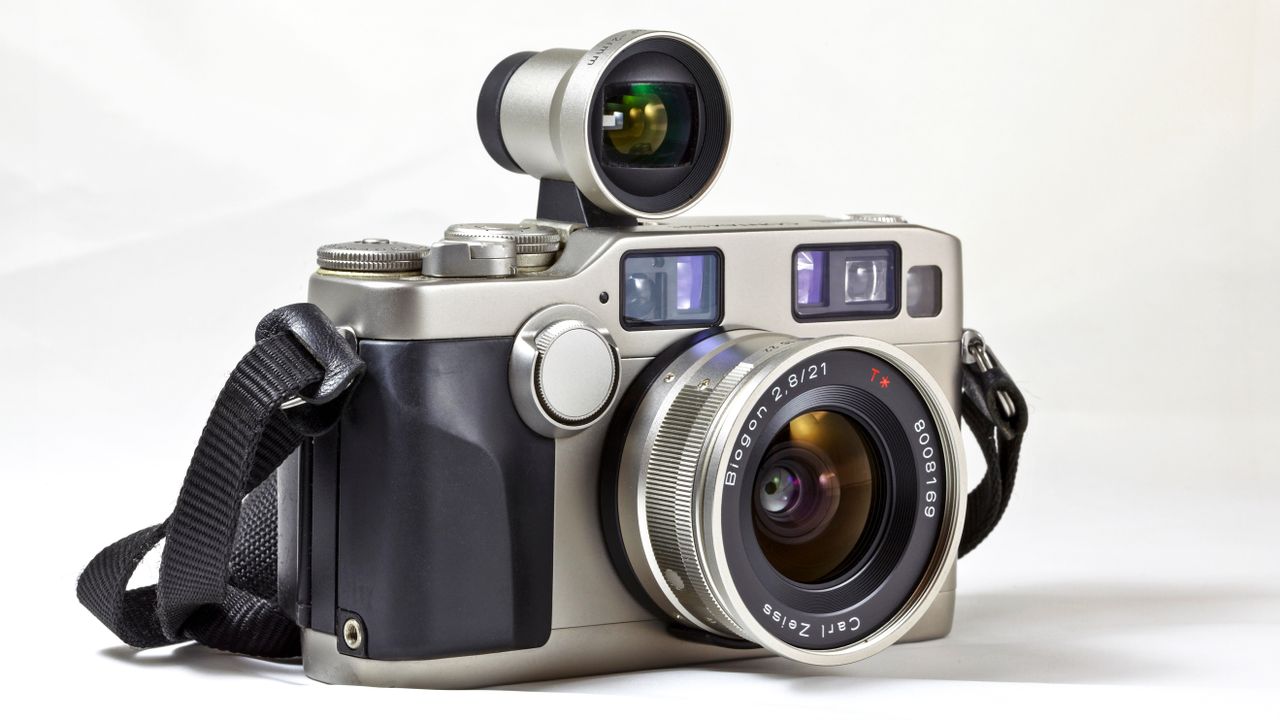
Contax G2.

In 1994, Carl Zeiss unleashed their Contax G1 on the world. While it pioneered the concept of an autofocus rangefinder, its passive-only focusing system struggled in low light.

The solution was the Contax G2, which followed a couple of years later. The G2 resolved the problem by implementing a hybrid autofocus system combining active infrared triangulation with passive contrast detection, making it significantly faster and more reliable.

Both cameras were beautiful and beautifully made. The titanium bodies were entirely designed and built by Kyocera, in Japan, while the body was styled by Germany’s Porsche Design Group.

Each model was offered in black and silver, though the silver (often described as a “champagne color”) with its dark grey accents was by far the more popular of the two. An array of seven lenses was offered, and all were designed and made by Carl Zeiss in Germany.

The Contax G1 (Image credit: Shutterstock)

The G1 came equipped with a Planar 45mm f/2 lens, while the G2 came with a wider 35mm Planar f/2. Also on offer were a 16mm f/8 Hologon, a 21mm f/2.8 Biogon, a 28mm f/2.8 Biogon and a Sonar 90mm f/2.8.

These were followed, in 2000, by the Vario-Sonar 35-70mm f/3.5-5.6 zoom – the first zoom for a rangefinder camera. All were autofocus except the Hologon, which was manual focus with a fixed aperture.

Optically, the Zeiss G-mount (unique to the Contax G1 and G2) lenses were widely considered equal to their Leica counterparts. No third-party lenses were ever made for the G-mount.

Now, I’ve said that the 35-70mm Vario-Sonar was the first zoom lens for a rangefinder camera – but some will point to Leica’s 28-35-50mm Tri-Elmar that came out in 1998, a full 24 months earlier.

While it’s true that the Tri-Elmar is essentially a zoom design under the hood, it has click-stops and is only really usable at the three preset focal lengths – as opposed to the Zeiss Vario-Sonar, which was a true zoom lens and able to be used at any focal length in its range.

The Contax G1 and G2 had unique, highly electronic viewfinder displays that were radically different from traditional rangefinders. Unlike all earlier rangefinder cameras, they had no “focusing patch” as focus was done by an AF system that used rangefinder-esque triangulation, rather than mechanical rangefinding.

Both models featured a sophisticated electronic viewfinder, which automatically adjusted magnification and frame lines based on the attached lens, offering 90% coverage with full parallax correction.

When the Vario-Sonar was mounted, the optics in the viewfinder zoomed to match – showing you the exact framing at every focal length.

Contax G2 (Image credit: Alamy)

The G2’s viewfinder was considered a significant upgrade over the G1, featuring a green readout below the main viewfinder display (which showed the focused distance and AF confirmation) and a manual focus aid (showing small dots on a line scale, to indicate the direction to turn the lens for correct focus when it was in manual mode).

The G2 has often been compared to the Leica M6. In build and optical quality, that’s likely a fair comparison – but they offer fundamentally different experiences.

The G2 had an "electronic rangefinder", featured auto-loading, auto-rewind, aperture priority autoexposure and a motor drive capable of 4fps. So, while the Leica offered a brighter viewfinder and a much wider selection of lenses (including faster apertures like f/1.4 and even f/1), the G2 provided superior convenience.

Unfortunately, all the electronics and motor drive capabilities have become, over time, their Achilles heel. Sadly, in the near 30 years since they came out, the G series has proved a wee bit failure-prone.

Despite its high-quality titanium build, the G2 in particular has been vulnerable due to its complex electronics and a scarcity of replacement parts.

Common failure points include an autofocus mechanism that can fail due to dried lubricants or stripped plastic gears, while the vertical metal focal plane shutter is known to develop issues. And the viewfinder’s electronic overlay can become faint or flicker over time.

Because few technicians are equipped to repair these electronic rangefinders, repairs are expensive and difficult (though not impossible) to find. Thus, examples in good working order now often sell for more than their original new price!

If you’re looking to purchase a used G2, buy only in person or with full return / refund privileges. Check the autofocus at multiple distances (namely infinity and 5m), verify that the frame counter LCD stays lit with the power off, and confirm that the film advances properly through a full roll and rewinds properly.

The number made is not known, but production continued until 2005 when Kyocera abruptly discontinued the entire Yashica / Contax camera division. This left both Zeiss and Leica (for whom Kyocera also made the superb Vario-Elmar-R 80-200mm f/4) in the lurch, while Kyocera concentrated on camera modules for smartphones.

This instantly transformed the G2 from a modern tool into a collector's item. If you have one, you have my envy!

You might also like…

Take a look at the best point-and-shoot cameras you can buy today.

Sign up to read this article
Read news from 100's of titles, curated specifically for you.
Already a member? Sign in here
Related Stories
Top stories on inkl right now
One subscription that gives you access to news from hundreds of sites
Already a member? Sign in here
Our Picks
Fourteen days free
Download the app
One app. One membership.
100+ trusted global sources.