
Get all your news in one place.
100's of premium titles.
One app.
Start reading
Guitar World
Guitar World
Entertainment
Ross Holder

"There’s a clear midrange presence here, but it never tips into that boxy territory that smaller-bodied acoustics can sometimes fall into": Martin LX1E Little Martin review

Martin LX1E review.

What is it?

The Martin LX1E is a compact travel electro-acoustic that has become one of the most recognizable models in Martin’s lineup. Throughout the 2010s, it was a constant presence in guitar stores, as demand grew for smaller, portable guitars that could still deliver a convincing amplified tone. Having spent plenty of time around these in a retail environment, it’s a model that built its reputation on accessibility and practicality as much as sound.

It’s almost impossible to discuss the LX1E and gloss over its association with Ed Sheeran, as he and the LX1E helped bring travel-sized acoustics into the mainstream, particularly for players looking for a reliable option with stage-ready electronics. After all, Sheeran headlined Wembley with one of these things.

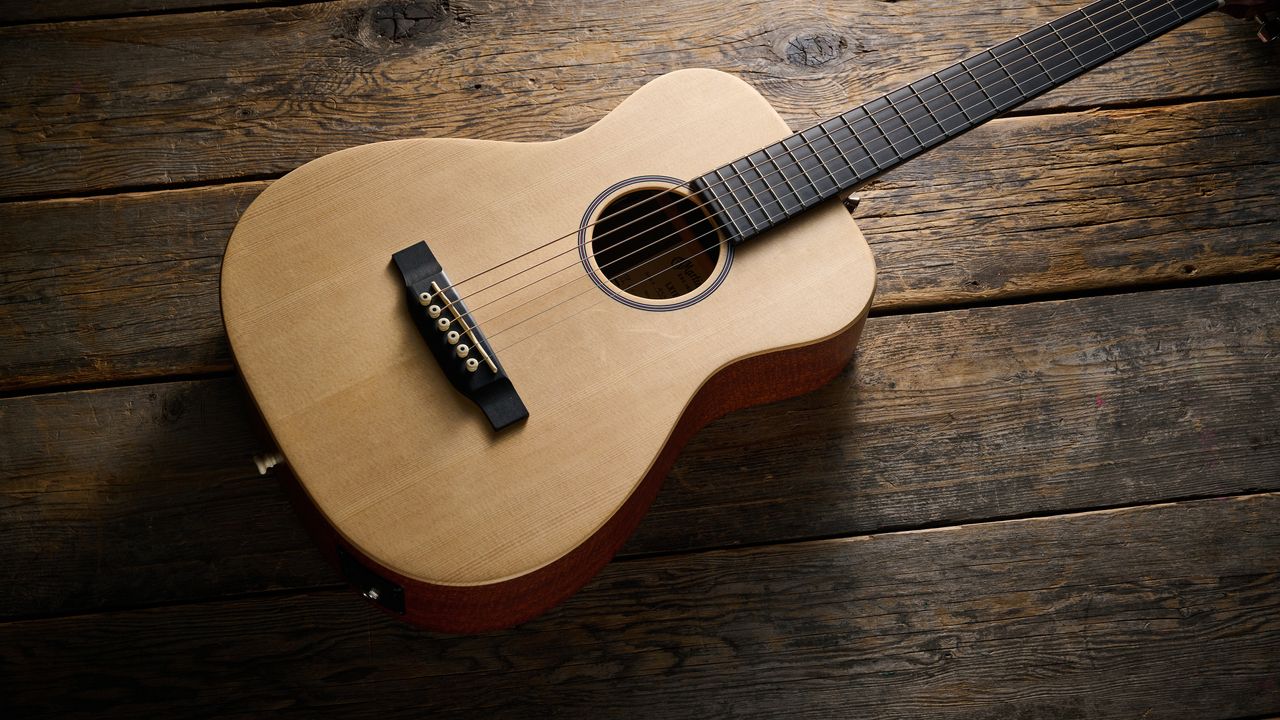
In its current form, it features a Fishman Presys VT pickup system, replacing earlier Sonitone electronics, while the core construction remains largely unchanged. That construction pairs a solid, hand-rubbed spruce top with high-pressure laminate (HPL) back and sides, a choice that keeps the guitar lightweight and resistant to environmental changes, making it particularly well-suited to travel. We also have a Richlite fingerboard, a modified low oval neck profile with a scale length of 23”.

Its closest rival comes in the form of the Taylor GS Mini, another hugely popular option in this category. While the GS Mini is effectively a scaled-down version of Taylor’s Grand Symphony body, the LX1E takes a similar approach, using a heavily modified 0-body as its blueprint.

Of course, it shares some visual cues with a dreadnought, but it features a narrower, more rounded upper bout that contributes to its compact feel and focused projection. Although the scale length is a few inches shorter than a standard acoustic, the nut width at 1 11/16'' is fairly standard, allowing for a less cramped feel at the nut.

While the LX1E’s rise was closely tied to the popularity of Ed Sheeran and the wider boom in travel guitars throughout the 2010s, the question now is whether it still holds up in 2026. As a curly, red-haired guitarist who’s spent years demoing this model in a retail environment, I felt well placed to give it a fair assessment. Let’s find out.

Specifications

(Image credit: Martin)
  • Price: £549/$549/€599
  • Made: Mexico
  • Body shape: Modified 0-14 Fret
  • Body top: Solid, hand-rubbed spruce
  • Top bracing: Non-scalloped
  • Back & sides: High-pressure laminate (HPL)
  • Neck/shape: Modified low oval, Rust birch laminate
  • Scale/length: 23” (584mm)
  • Nut/width: White Corian, 1.6'' (41mm)
  • String spacing at bridge: 53mm
  • Fingerboard wood/Radius: FSC Certified Richlite, 16” radius
  • Body depth: 3.5” (90mm)
  • Finish: Natural, hand-rubbed clear top
  • Bridge/pins: White plastic
  • Tuning Machines: Chrome enclosed gear
  • Electronics: Fishman Presys VT
  • Weight: 3.6lbs/1.6kg
  • Case: Soft shell padded gig bag
  • Left-handed options: Yes
  • Contact: Martin

Build quality

(Image credit: Future)

Build quality rating: ★★★★☆

The multiple seams can be a little jarring for some players who are used to the look of a solid piece of wood

Straight out of the gig bag, the Martin LX1E feels impressively well put together. Despite its compact size and accessible price point, there’s a reassuring solidity to the build, and the included gig bag adds genuine practicality for players planning to travel with it.

One of the standout features is the hand-rubbed solid spruce top. With no body binding, the edge of the top is left exposed, giving a clear view of its thickness where it meets the HPL sides. The edges of the top have been nicely rounded over. So there's no harsh transition from the top to the back and sides. It’s a subtle detail, but one that adds to the sense of quality and craftsmanship. In hand, the smooth finish feels every bit as good as it looks, adding a premium touch to an otherwise modestly priced instrument.

Aesthetically, the LX1E leans into a minimalist design. Aside from the 5-ply black, white, and red rosette, there’s very little in the way of visual flair, but it suits the guitar’s understated, functional character. The HPL back and sides, finished in a mahogany pattern on my review model, may not have the visual depth of solid wood, but they serve a clear purpose.

HPL is widely used for its durability, and here it makes a lot of sense. The layered construction is more resistant to knocks and bumps than traditional tonewoods, making it a great choice for travel and regular gigging. It’s also far less susceptible to temperature and humidity changes. Over a few weeks of testing in shifting spring conditions, I found the LX1E remained impressively stable, with tuning holding firm and no noticeable movement in the action.

That stability is supported by the enclosed chrome tuning machines, which feel solid and reliable in use. They’re not flashy, but in practice, they held tuning consistently throughout longer sessions without needing constant adjustment. Even after leaving the guitar overnight and playing for hours the day before, tuning tweaks were barely necessary.

(Image credit: Future)

Now, one thing worth discussing is the laminate neck construction. At first glance, you’ll notice the neck is made from several pieces of wood, clearly joined and glued together in a way that’s pretty visually apparent. The multiple seams can be a little jarring for some players who are used to the look of a solid piece of wood. However, in terms of feel, the joins are absolutely seamless. When you run your hand along the back of the neck, you can’t detect where the pieces meet. The finish is perfectly smooth, and there’s no interruption at all under your palm. If you didn’t know to look for it, you’d never feel any difference from a traditional, one-piece neck. In practice, it feels just as comfortable and natural as any other acoustic guitar, and any initial visual concerns quickly fade once you start playing.

The fretwork on my review model was particularly impressive, with cleanly finished fret ends and no sharp edges anywhere along the board, a level of consistency that isn’t always guaranteed at this price point.

Internally, there’s a Fishman Presys VT system being utilized, an under-saddle piezo pickup with a simple volume and tone control, powered by a 9V battery. It might sound like a small detail, but having the 9V battery accessible from the outside of the guitar makes swaps much easier. It’s far more convenient than reaching inside the soundhole, especially if you’re changing batteries quickly before or during a set.

Playability

(Image credit: Future)

Playability rating: ★★★★☆

The modified low oval neck profile felt instantly familiar to me, sitting somewhere in that comfortable modern ‘C’ territory

I was genuinely surprised at how playable my review Martin LX1E was straight out of the box. In my experience, travel guitars can be a bit tricky to dial in, especially when it comes to balancing string tension and neck relief. Here, though, Martin has done the hard work for you. With an action height of 2.8mm at the low E and around 1.4mm at the 12th fret, it felt immediately comfortable under the fingers.

There was no fret buzz to speak of, even when I was really digging into open chords. I primarily play in Open G tuning, so after spending some time in standard, I slackened the strings and tuned down. The setup held up well, with the action remaining consistent and no issues when experimenting with alternate tunings.

The modified low oval neck profile felt instantly familiar to me, sitting somewhere in that comfortable modern ‘C’ territory. It’s not overly chunky, but there’s enough there to feel supportive, even when playing with a bit more intensity. As mentioned before, the fretwork is excellent. So, this means that bends and vibrato feel smooth, with no scratchy resistance under the fingers, making for a very nice playing surface.

For me, the string spacing felt fairly comfortable around the nut, but as you climb the fingerboard, it starts to feel slightly on the cramped side. I’ve got fairly large hands, so it took a minute to adjust, particularly when fingerpicking. Once I settled in, though, it became much easier to manage, and I actually found it encouraged some more compact chord voicings that suit the smaller scale length.

(Image credit: Future)

Okay, so moving on to the Richlite fingerboard. Richlite is a composite material made primarily from recycled paper and resin, specially engineered to be dense, durable, and smooth. To both the eye and touch, it’s remarkably similar to ebony, albeit a lot darker and more uniform in color, but it has a very smooth feel under the fingers.

Whenever a brand decides to use a man-made material over traditional wood, many guitarists recoil in horror, but really, Richlite is a smart move here. It’s more durable than ebony, and, like the HPL neck, it isn’t as temperature-sensitive as real wood. More importantly, in use, I find it offers excellent playability, with no sense of it being inferior to traditional timber. If I hadn’t known otherwise, I could easily have mistaken it for ebony, both visually and in terms of feel.

I was also pleased to see the neck join the body at the 14th fret. Combined with the low, comfortable action, it makes the upper register more accessible than you might expect from a guitar of this size. That said, things do feel a little tighter higher up, so if you’re planning on playing further up the neck, a bit more precision is needed.

While playing seated, I did notice a slight neck-heavy balance, which can make it feel a little top-weighted at times. That said, this becomes far less noticeable when standing with a strap. Thankfully, the LX1E comes equipped with two strap buttons, including one at the neck heel, so there’s no need for any aftermarket installation. Given how easy this guitar is to grab and go, I imagine most players will end up using it standing anyway, where it feels much more natural.

Sound

(Image credit: Future)

Sound rating: ★★★★☆

There’s a clear midrange presence here, but it never tips into that boxy territory that smaller-bodied acoustics can sometimes fall into

An acoustic guitar lives and dies by its tone, and with a body this compact, expectations need to be realistic. The Martin LX1E isn’t trying to deliver a huge, booming low end. Instead, what you get is a focused, immediate response that feels very direct and present.

I’m used to playing a Yamaha LS6, a full-size guitar with a larger body, so the LX1E naturally doesn’t have the same depth or low-end response. What it does have, though, is a brightness and clarity that’s genuinely addictive. It has a way of grabbing your attention straight away, particularly when playing with a lighter touch.

There’s a clear midrange presence here, but it never tips into that boxy territory that smaller-bodied acoustics can sometimes fall into. With less emphasis on the low end, it actually lends itself really well to singing. Nothing feels overcrowded, and I found the guitar sat nicely above my voice rather than competing with it, making it a brilliant option for busking or open mic nights.

My review model was particularly sweet sounding, with excellent note separation across the fretboard. For a guitar with only a solid top, the sustain and decay feel surprisingly well developed, which really comes into its own when fingerpicking. It responds well to a lighter touch and does a lot of the work for you, especially when you’re relying on clarity between notes.

(Image credit: Future)

Plugging the Martin LX1E into an AER Compact 60/4 acoustic amp, it’s clear that the Fishman system does a great job of capturing the guitar’s natural articulation and overall character. It’s an active 9V preamp, with simple rotary volume and tone controls mounted just inside the soundhole.

The tone control is straightforward. Rolled back, it shaves off a good amount of top end, while fully open, it allows the bright treble to cut through clearly. It’s a quick, effective tool for immediate tone shaping, particularly useful in a live setting. I did notice that the volume control has quite a steep drop-off from around three-quarters to almost silent, so fine adjustments can be a little tricky.

In a home setting, those controls are easy enough to adjust, but I can see them being a little awkward to tweak mid-performance, especially under stage pressure. There’s no onboard tuner or dedicated feedback control, so players who prefer more hands-on shaping may find it slightly limited in a live context.

That said, there’s no question it’s capable of handling a gig. Running it through an amp and adding a touch of low end helps round out the overall sound, filling in what the smaller body naturally lacks. The more controlled bass response can also help keep feedback in check compared to larger-bodied acoustics like my Yamaha LS6.

Responsiveness when plugged in is another highlight; it’s very sensitive to dynamics, responding just as well to light strumming as it does when you really dig in.

Verdict

(Image credit: Future)

Having spent the best part of 15 years at the top of the 3/4 acoustic guitar tree, it’s easy to see why the LX1E remains a mainstay in Martin’s lineup. It looks the part straight out of the gig bag and, sitting around the $/£600 mark, offers a level of fit and finish that reflects the brand’s long-standing reputation.

If my review model is anything to go by, the factory setup is another major plus. This is a guitar you can tune up and start playing immediately, without feeling the need to make adjustments. That, combined with the included padded gig bag, makes it a genuinely practical option for players who want something they can grab and take on the road without a second thought.

Material-wise, the solid spruce top does most of the tonal heavy lifting. It’s paired with HPL back and sides, which may not have the visual appeal of traditional tonewoods, but make a lot of sense in this context. They’re durable, resistant to environmental changes, and well-suited to the kind of use this guitar is designed for, all while keeping the overall cost within reach.

Most importantly, it sounds the part. For a guitar of this size, the Martin LX1E delivers a sweet, articulate tone, with a bright, immediate character that avoids the boxy response often associated with smaller-bodied acoustics. That said, don’t expect a huge low-end presence, as the compact body naturally limits bass response.

Plugged in, the Fishman Presys VT system does a solid job of translating that core tone, whether through a PA or an acoustic amp. The controls are intentionally simple, with discreet soundhole-mounted wheels for volume and tone, making it easy to quickly dial in a usable sound. You don’t get extensive tone shaping, but for a guitar built around portability and ease of use, it feels like the right trade-off.

Guitar World verdict: Compact, reliable, and consistently great to play, the Martin LX1E proves it still has plenty to offer in 2026. While its smaller body limits low-end depth, its clarity, durability, and ease of use make it a standout choice for travel and everyday playing.

Ratings scorecard

Test

Results

Score

Build quality

An understated, handsome guitar that was spotless straight out of the box. The hand-rubbed spruce top is a particular standout, and although the HPL is an understandable choice, it isn’t quite as attractive as solid tonewood.

★★★★☆

Playability

With an extremely playable action, a smooth, modern neck profile, and well-finished fret ends, the LX1E plays very well. There’s a slight neck-dive when seated, but it feels more balanced with a strap. The slightly cramped spacing toward the 12th fret may take some adjustment for larger hands.

★★★★☆

Sounds

Bright and articulate with impressive sustain, the LX1E sounds as good as most travel guitars on the market. There isn’t a huge amount of low-end depth, but it pairs well with a voice, keeping things clear and uncluttered. Plugged in, the Fishman system delivers an honest representation of the guitar’s character while benefiting from adding bass via an amplifier.

★★★★☆

Overall

The Martin LX1E remains one of the most dependable travel guitars available, combining solid build quality, excellent playability, and a bright, articulate tone. It may lack the depth of a full-size acoustic, but for portability and consistency, it’s hard to fault.

★★★★☆

Also try

Hands-on videos

Gear4Music Guitars

Robert Cassard

Sign up to read this article
Read news from 100's of titles, curated specifically for you.
Already a member? Sign in here
Related Stories
Top stories on inkl right now
One subscription that gives you access to news from hundreds of sites
Already a member? Sign in here
Our Picks
Fourteen days free
Download the app
One app. One membership.
100+ trusted global sources.