Get all your news in one place.
100's of premium titles.
One app.
Start reading
RideApart
RideApart
Enrico Punsalang

The World’s First Gas Motorcycle Was A Wooden Test Mule With Training Wheels

Motorcycles have spent the better part of 140 years becoming increasingly complicated. We now have 200-horsepower superbikes with wings, adventure bikes with radar, cruisers with enormous touchscreens, and electric motorcycles that can download software updates while sitting in your garage.

But rewind the clock all the way to 1885, and the ancestor of the modern gas motorcycle looks less like a technological revolution and more like something somebody built after finding some spare lumber behind the shed.

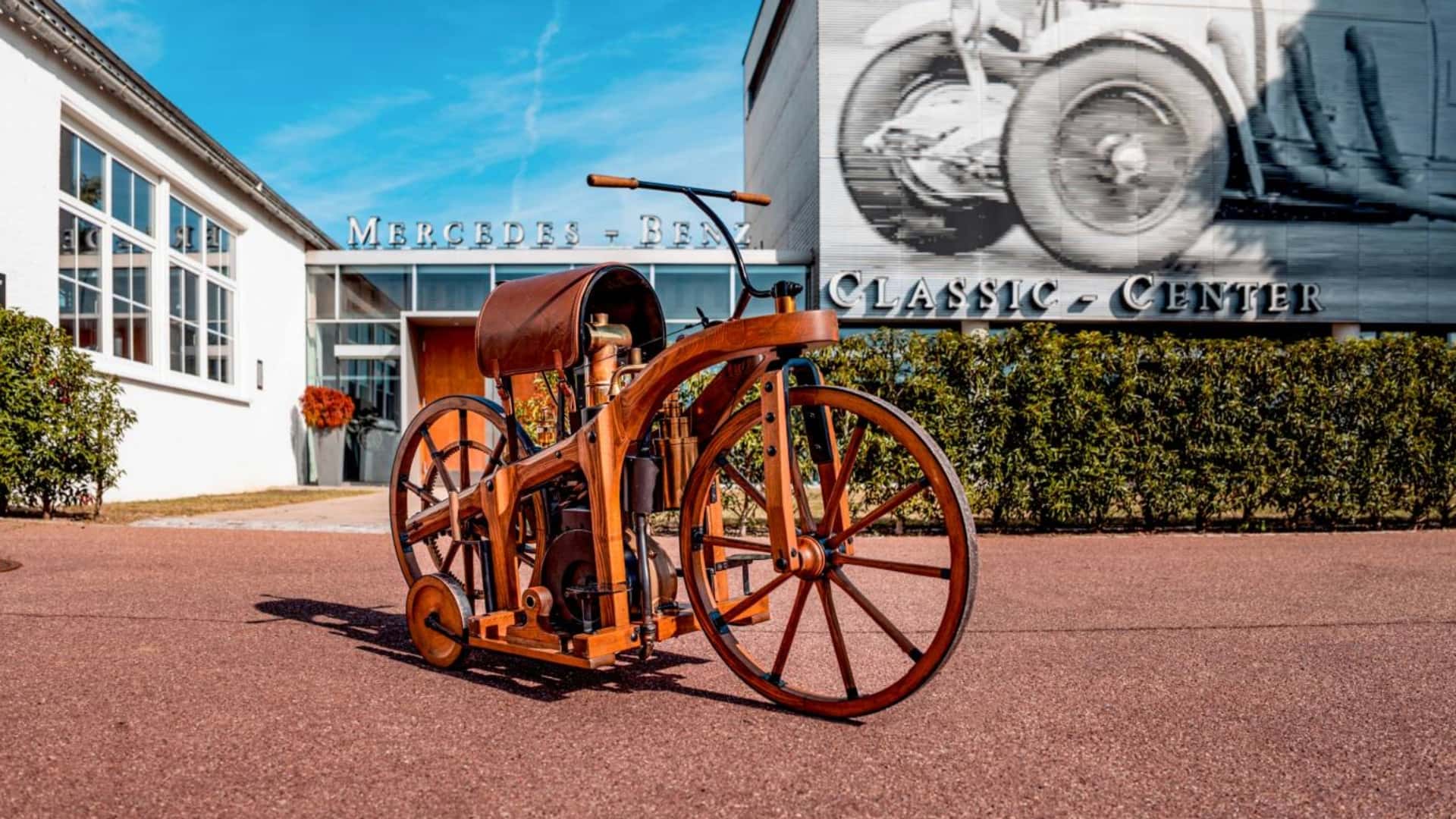
That contraption was the Daimler Reitwagen, created by Gottlieb Daimler and Wilhelm Maybach in Cannstatt, Germany. It’s commonly credited as the world's first gasoline-powered motorcycle, although the definition requires an asterisk since steam-powered two-wheelers had already appeared. Either way, the Reitwagen occupies a hugely important spot in motorcycle history. The funny part is that Daimler and Maybach weren't necessarily trying to reinvent two-wheeled transportation in the first place.

The Motorcycle Was Almost A Side Effect

Daimler and Maybach had been working on something much bigger than a motorcycle. Their goal was to develop a compact, lightweight, high-speed internal-combustion engine that could power vehicles. Daimler envisioned an engine suitable for transportation on land, water, and eventually even in the air. The machine that would become the Reitwagen was essentially a convenient way of proving that their engine could actually move something down the road.

The engine itself was nicknamed the "grandfather clock" because of its tall, narrow shape. In the Reitwagen, the 264cc single-cylinder four-stroke produced a whopping...0.5 horsepower at 600 rpm. Power reached the rear wheel through a leather belt, and Mercedes-Benz says the belt could be moved between two differently sized pulleys while stationary, creating a primitive two-speed arrangement. Suddenly, your motorcycle's clunky quickshifter doesn't seem so bad.

And then there was the chassis.

Calling it a frame in the modern motorcycle sense is being extremely generous. Much of the Reitwagen was constructed from wood, including its large wheels, which used iron tires instead of the luxurious pneumatic rubber we're accustomed to today. There was a saddle on top, a rudimentary handlebar arrangement, an engine hanging underneath, and a pair of small spring-mounted outrigger wheels on either side.

Yes, the ancestor of the modern motorcycle had training wheels.

Half A Horsepower, Four Wheels, And One Very Important Ride

Those outriggers weren't there because Daimler had forgotten how bicycles worked. The Reitwagen was primarily a technology demonstrator, and keeping the thing upright while experimenting with an entirely new propulsion system was understandably useful. Daimler's original patent even describes the small side rollers as a means of keeping the vehicle upright. They made tight turns difficult, but carving corners wasn't exactly the development team's priority.

Performance was similarly modest. The Reitwagen topped out at around 7.5 miles per hour, meaning a reasonably enthusiastic modern cyclist could leave it behind without much effort. But obviously, speed wasn't the point more than a century ago. On November 10, 1885, Daimler's son Adolf rode the machine roughly 1.9 miles from Cannstatt to Untertürkheim and back. The important part wasn't how quickly he got there. It was that the strange wooden contraption actually worked.

Daimler had already filed a patent for the vehicle on August 29, 1885, describing it as a vehicle powered by a gas or petroleum engine. The experiment had demonstrated that a compact internal-combustion engine could propel a road-going vehicle, and Daimler and Maybach quickly moved on to bigger things. In 1886, a developed version of their engine found its way into a four-wheeled motor carriage. Engines would also end up powering boats, with Daimler's broader transportation ambitions beginning to take shape.

Even The First Motorcycle Starts An Argument

There's one catch whenever someone calls the Reitwagen the world's first motorcycle. And that depends on how you define "motorcycle."

Motorized two-wheelers existed before 1885. Steam-powered machines developed by inventors including Sylvester Roper and the team behind the Michaux-Perreaux steam velocipede predated Daimler's creation. The Reitwagen's significance comes from its internal-combustion engine. Calling it the world's first gasoline-powered motorcycle, or the first internal-combustion motorcycle, avoids pretending nobody had previously looked at a bicycle and wondered what would happen if they added an engine.

There's also the fact that the Reitwagen had four points of contact with the ground thanks to those outriggers. Motorcycle classification arguments apparently arrived at roughly the same time motorcycles did. Somewhere, you can imagine an 1885 internet commenter furiously explaining that Daimler's machine isn't a "real bike."

Motorcycling Started With An Experiment

The original Reitwagen didn't survive. What we see today are replicas, including examples displayed and operated by Mercedes-Benz. But what matters isn't really the physical machine. It's what the thing demonstrated.

Daimler and Maybach weren't designing a superbike, a touring machine, or even transportation that ordinary people could realistically buy. They were trying to figure out what their new engine could do. A crude wooden two-wheeler happened to be one of the ways they tested that idea, and its successful run helped prove that small internal-combustion engines could propel vehicles under their own power.

Sign up to read this article
Read news from 100's of titles, curated specifically for you.
Already a member? Sign in here
Related Stories
Top stories on inkl right now
One subscription that gives you access to news from hundreds of sites
Already a member? Sign in here
Our Picks
Fourteen days free
Download the app
One app. One membership.
100+ trusted global sources.