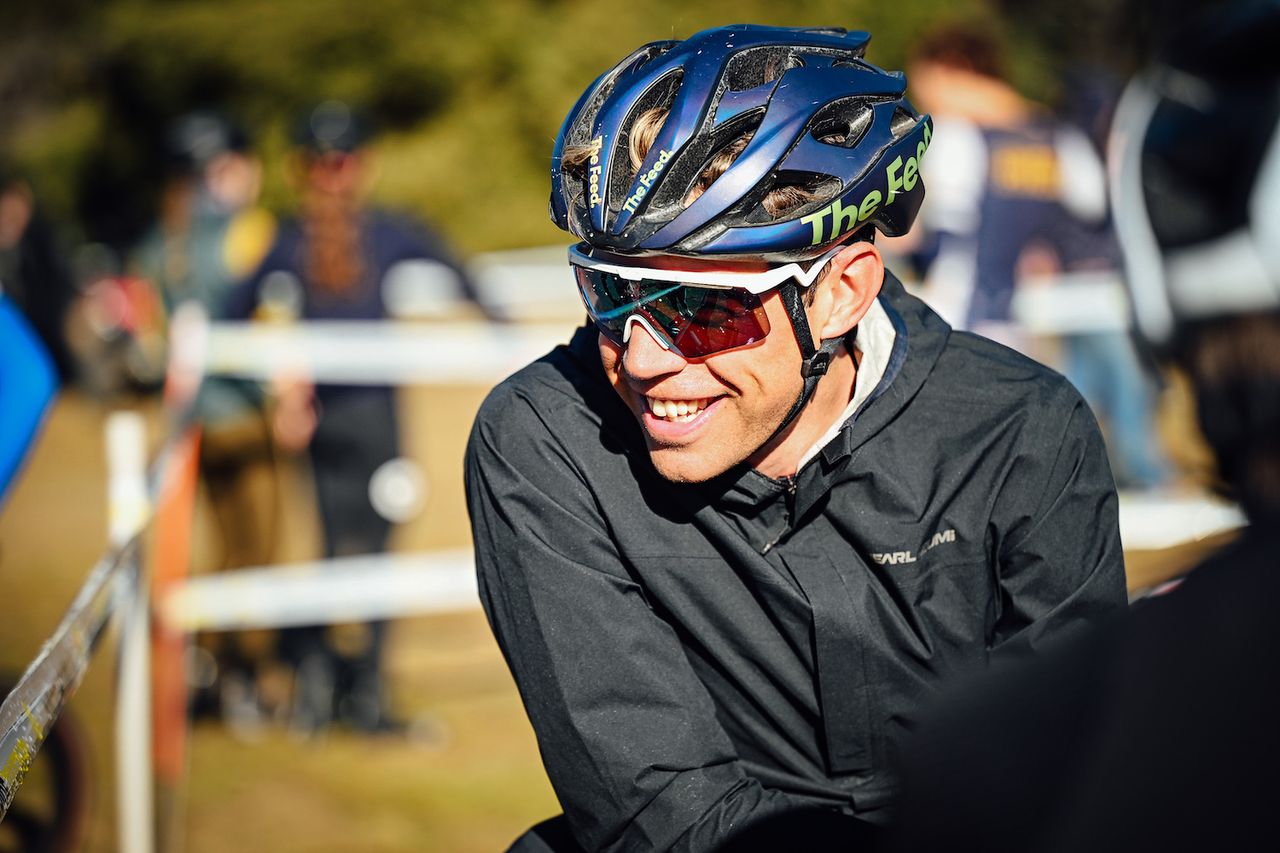
There was a plan, a detailed plan, but then came unrelenting wind. Brendan Johnston (Giant-SRAM) fought through the adversarial weather for the majority of a 3,948.6-kilometre ride and fell short of setting a new fastest known time (FKT) from Perth to Sydney last week.
After 8 days, 9 hours, 5 minutes, Johnston ended the journey in front of the Sydney Opera House with friends and family, and raising $38,961, so far, for Tour De Cure cancer research. The record he sought to break remained safe with Austrian Christoph Strasser, who completed the nearly 4,000km route across southern Australia in 2017 in 6 days, 10 hours, and 58 minutes.

"On the first day, it was pretty telling. We just had that bad wind. Then obviously the next day [January 11] I sort of realised that it was not the cards," Johnston told Cyclingnews Tuesday, two days after he finished the FKT attempt on January 18. His first day on the bike, January 10, was the longest segment, 567.3km with 2,481 metres of elevation gain.
"The wind, it was never not blowing. I had to stop the second-to-last day, the wind was so strong and then it rained. At 1 a.m. on Sunday [final day] the wind was 89 kilometres per hour! In the first hour, I moved about 20 kilometres. I thought, 'at this speed we're never going to make it'."
Johnston had to split the final planned leg into two days, riding 304.4km on January 17 and 302.3km on January 18. It was not until Sunday that the wind was finally not a major adversary, and "it was a nice run to Sydney".
Aside from the highs of finishing the ride and raising money for Tour de Cure, the lows of the endurance feat included facing the wicked wind and dealing with an ankle injury, which caused the 2024 Australian gravel champion to pull out of this Friday's opening race of the season, a defence of his title at RADL GRAVL p/b Quad Lock near Adelaide.
"Pushing into that wind, I just had to push so much harder for a very long period, and I strained my Achilles. It was touch and go for a bit, and then I got going again, just went day by day.
"I felt as long as I wasn't going to do proper damage, that there was enough value personally, and for our team of supporters, that it was enough value in getting it done. And if [the ankle injury] didn't cause too much damage to my body, it was really, really worthwhile. I think that's how it played out. We raised a lot of money, and the satisfaction for myself and from our team was really worthwhile."
Johnston explained that Strasser barely slept on his ride, saying it was "maybe seven hours total" across the six days. Johnston, familiar with endurance events as a six-time Australian Marathon Mountain Bike national champion, had a completely different plan.
"I was planning on stopping, like 40 hours, and obviously riding significantly faster, so that put a lot more focus on the actual speed that I was going to have to ride in order to get the rest that I figured I would need. So when we started to fall behind, like 10 kilometers an hour, on the first day, that was pretty telling that we weren't going to be able to do it unless I went for some kind of epic sleep deprivation. In my mind, [that] did not seem to be safe," he said.
He had a physiotherapist on his support team during the ride who helped him make the decision to continue the FKT attempt. After the ride, Johnston confirmed to Cyclingnews that he "had it scanned" and "it's necessary to take a week off".
"I think it was [due to] a period of time in that time trial position pushing against the wind. Then we had to change the position and stuff out on the road, and that kind of helped for a day or two. But I think each time I had to push harder against the wind, it flared up again. We were onto it pretty early and working to recover as soon as possible," he assessed.
While he earns a living with off-road racing now, he used a Giant Trinity time trial bike fitted with a variety of his Cadex Cycling wheels for the FKT attempt.
He was disappointed not to compete at RADL GRVL Friday for a third time. Instead, he'll serve as part of the support crew for fellow Grand Prix competitor Melisa Rollins, who was second at RADL GRVL last year. Rollins spent last week on the support crew for Johnston.
Next, his focus was on April, when he would begin a fourth season in the Life Time Grand Prix. Since his first outing in the US-based off-road series, Johnston was three-for-three with top 10 finishes, which put him among the riders earning prize money.
"April is the order. The season proper kind of starts then. And obviously we're through to October with [Life Time Grand Prix] in the US. I should be good for Unbound again this year. I don't know, there's much back here that I'll do."
Unbound Gravel 200 remains a major target, a race where he has seen improvements in three outings, from DNF to 15th to fifth last year.
Aside from racing, his other objective was raising awareness and funds for cancer research, himself a survivor of the disease after treatment for testicular cancer when he was a teenager. His Tour de Cure fundraising effort remains open online.
"Sometimes things don’t turn out the way you intended, but then you remember what it was all about in the first place. The challenges of this journey pale in comparison to what people who are living with cancer face every day. It’s always a headlong fight into the wind. Thanks to your generosity with your donations, we’re now all part of that fight."