
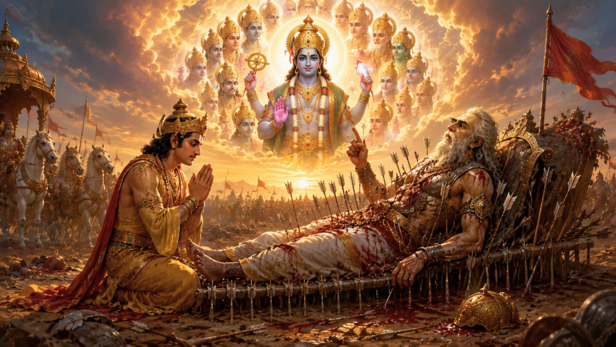
For millions of devotees across India and beyond, the Vishnu Sahasranama is one of the most sacred and powerful prayers dedicated to Vishnu. Many people chant it daily believing it brings peace, protection, clarity, and spiritual strength. Yet what many devotees never fully realize is that this revered hymn did not emerge from a peaceful temple or a quiet forest meditation. It was revealed on the battlefield of Kurukshetra, immediately after one of the most devastating wars described in Hindu tradition. The story begins in the aftermath of the Mahabharata war, when grief, destruction, and emotional exhaustion covered the battlefield. Thousands had died, families were shattered, and even victory felt heavy with sorrow. At this moment, Yudhishthira, the eldest of the Pandavas, was consumed by guilt and confusion despite winning the war. He questioned the meaning of dharma, kingship, suffering, and human life itself.
Seeking answers, Yudhishthira approached Bhishma, the great warrior and elder of the Kuru dynasty, who was lying on a bed of arrows awaiting his final moment. It was here, in one of the most emotionally powerful scenes in the Mahabharata, that Bhishma revealed the Vishnu Sahasranama.










